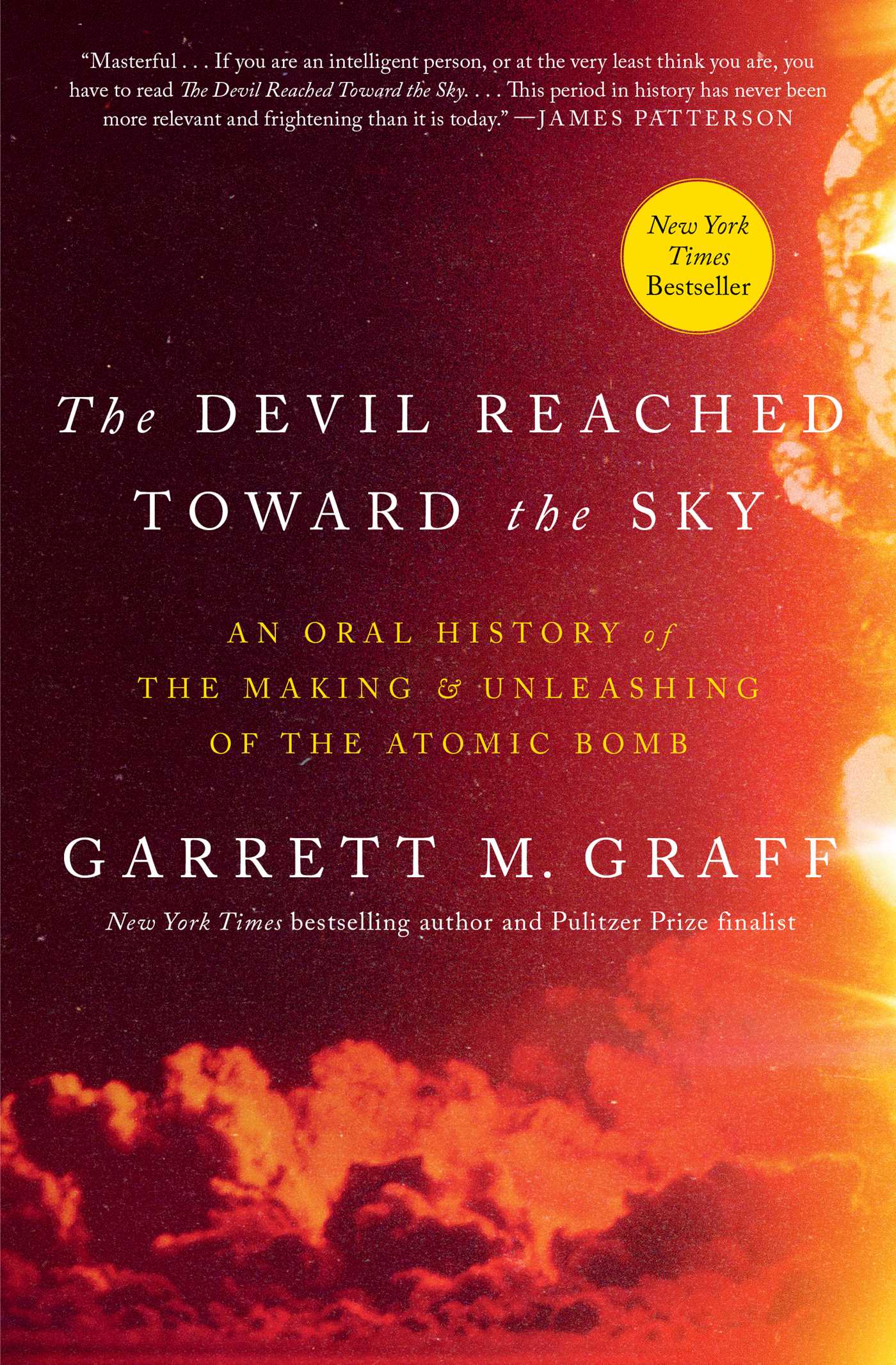
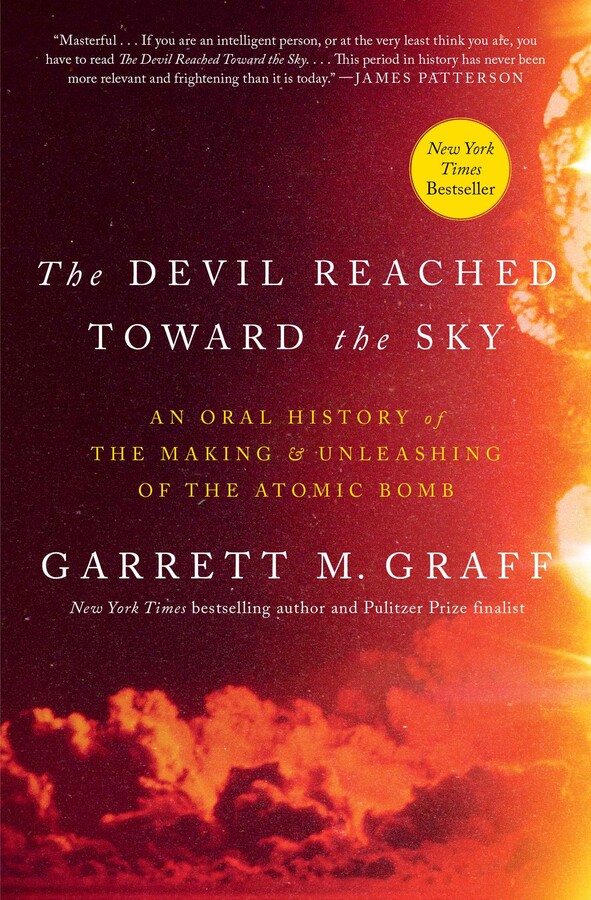
About The Book

NEW YORK TIMES BESTSELLER • “Magisterial…A stunning account that brings to the fore the nuclear saga’s surreal combination of ingenuity, fate, and terror.” —Publishers Weekly (starred review) • “If you are an intelligent person, or at the very least think you are, you have to read The Devil Reached Toward the Sky…This period in history has never been more relevant and frightening than it is today.” —James Patterson • “Comprehensive and engrossing…Excellent oral history.” —Kirkus Reviews

On the 80th anniversary of the Hiroshima and Nagasaki bombings, the Pulitzer Prize finalist whose work is “oral history at its finest” (Pittsburgh Post-Gazette) delivers an epic narrative of the atomic bomb’s creation and deployment, woven from the voices of hundreds of scientists, generals, soldiers, and civilians.


The building of the atomic bomb is the most audacious undertaking in human history: a rush by a small group of scientists and engineers in complete secrecy to unlock the most fundamental power of the universe. Even today, the Manhattan Project evokes boldness, daring, and the grandest of dreams: bringing an end to World War II in the Pacific. As Marines, soldiers, sailors, and airmen fight overseas, men and women strive to discover the atom’s secrets in places like Chicago, Berkeley, Oak Ridge, Hanford, and Los Alamos. On August 6, 1945, the world discovers what the end of the war—and the new global age—will look like.

The road to the first atomic bomb ends in Hiroshima, Japan, but it begins in Hitler’s Europe, where brilliant physicists are forced to flee fascism and antisemitism—bringing to America their determination to harness atomic power before it falls into the Führer’s arsenal. The Devil Reached Toward the Sky traces the breakthroughs and the breakneck pace of atomic development in the years leading up to 1945, then takes us inside the B-29 bombers carrying Little Boy and Fat Man and finally to ground zero at Hiroshima and Nagasaki.

From Pulitzer Prize finalist Garrett M. Graff comes a panoramic narrative of how ordinary people grapple with extraordinary wartime risks, sacrifices, and choices that will transform the course of history. Engineers experiment with forces of terrifying power, knowing each passing day costs soldiers’ lives—but fearing too the consequences of their creation. Hundreds of thousands of workers toil around the clock to produce uranium and plutonium in an endeavor so classified that most people involved learn the reality of their effort only when it is announced on the radio by President Truman. The 509th Composite Group trains for a mission whose details are kept a mystery until shortly before takeoff, when the Enola Gay and Bockscar are loaded with bombs the crew has never seen. And the civilians of two Japanese cities that have been spared American attacks—preserved for the sake of judging the bomb’s power—escape their pulverized homes into a greater hellscape.

Drawing from dozens of oral history archives and hundreds of books, reports, letters, and diaries, Graff masterfully blends the memories and perspectives from the known and unknown—key figures like J. Robert Oppenheimer, General Leslie Groves, and President Truman; the crews of the B-29 bombers; and the haunting stories of the Hibakusha—the “bomb-affected people.” Both a testament to human ingenuity and resilience and a compelling drama told by the participants who lived it, this book is a singular, profound, and searing work about the inception of our most powerful weapon and its haunting legacy.
About The Author

(c) Elman Studio

Garrett M. Graff has spent two decades covering politics, technology, and national security. The former editor of POLITICO and longtime WIRED and CNN contributor, he writes the popular Doomsday Scenario newsletter and hosts the award-winning podcast Long Shadow. He is the author of ten books, including the #1 national bestseller The Only Plane in the Sky, the FBI history The Threat Matrix, Raven Rock, and the New York Times bestsellers The Devil Reached Toward the Sky, When the Sea Came Alive, and Watergate, which was a finalist for the Pulitzer Prize in History.

Product Details

  • Publisher: Avid Reader Press/Simon & Schuster (August 1, 2027)
  • Length: 608 pages
  • ISBN13: 9781668092408

Browse Related Books

Raves and Reviews

“Journalist Graff delivers a magisterial oral history of the atomic bomb. . . . The result is a stunning account that brings to the fore the nuclear saga’s surreal combination of ingenuity, fate, and terror.” Publishers Weekly (starred review)

“The power of Graff’s oral history is the diversity of voices he relies upon . . . He creates a comprehensive account of a what seems like a well-told piece of history by including voices that have been either little-heard or missed altogether in the eight decades since the atomic bombs were dropped. . . . The Devil Reached Toward the Sky focuses not just on the voices of scientists like Robert Oppenheimer and Edward Teller. Graff also explores overlooked pieces of the Manhattan Project’s history, such as how segregation affected life at Oak Ridge. But the most powerful portions come in the final chapters of the book. . . . No writer could describe better the hellscape that the bombs unleashed better than those on the ground who survived it.” Associated Press

“By going deeper into the personal details and reminiscences of a generation that is all but lost to us now, Mr. Graff . . . [has] made the story more human, especially when the weapon’s essential inhumanity threatens to overshadow everything else. . . . Each chapter is a compilation of snippets from interviews, memoirs and the personal testimony of figures from President Truman and Hiroshima’s police chief down to the last survivors of the Hiroshima attack and the man responsible for box lunches at the plant in Hanford, Wash., that made the plutonium for the bomb used at Nagasaki. . . . Mr. Graff gives us fascinating snippets about [J. Robert Oppenheimer] the man who has since become the symbol of the entire bomb project.” Wall Street Journal

“If you are an intelligent person, or at the very least think you are, you have to read Garrett Graff’s The Devil Reached Toward the Sky. Even if you don’t read this lengthy masterpiece, you should keep it in your library to demonstrate that you are curious and literate. If you Zoom frequently, it should be one of the books on the shelves directly behind you so that viewers can register how smart you are.  If you need to know something about the story itself—it’s everything, and more, about the atom, the atom bomb, the Manhattan Project, and the terrifying destruction of Hiroshima and Nagasaki. This period in history has never been more relevant and frightening than it is today.” —James Patterson

“Garrett Graff’s new book about America’s quest for the atomic bomb draws upon hundreds of well-chosen primary sources, and introduces them with some diamond-sharp commentary. The account Graff has assembled is comprehensive and it hits as hard as anything yet written on the topic. . . . By adopting an oral history format and letting the subjects speak for themselves, Graff provides the canon with a valuable human quality without sacrificing the story’s epic sweep.” Quilette

“A comprehensive and engrossing account of the atomic bomb’s creation—and its effects. . . . The 500 voices who make up the oral history include famous and less-known figures, such as members of the crew who created the first controlled nuclear chain reaction; farmers whose land was needed to build massive complexes to produce enriched uranium and plutonium for the bombs; ‘project spouses’ at all three locations raising families under difficult living conditions; politicians and military men involved in planning and executing the bombing of Hiroshima and Nagasaki; and Japanese survivors of the bombings. . . . Excellent oral history.” Kirkus Reviews

Resources and Downloads

High Resolution Images

BACK TO TOP