From the Introduction
The people of Earth have long been fascinated by Mars, and the notion that there might be life on the red planet has absorbed astronomers ever since Giovanni Schiaparelli observed its channels, over 150 years ago.
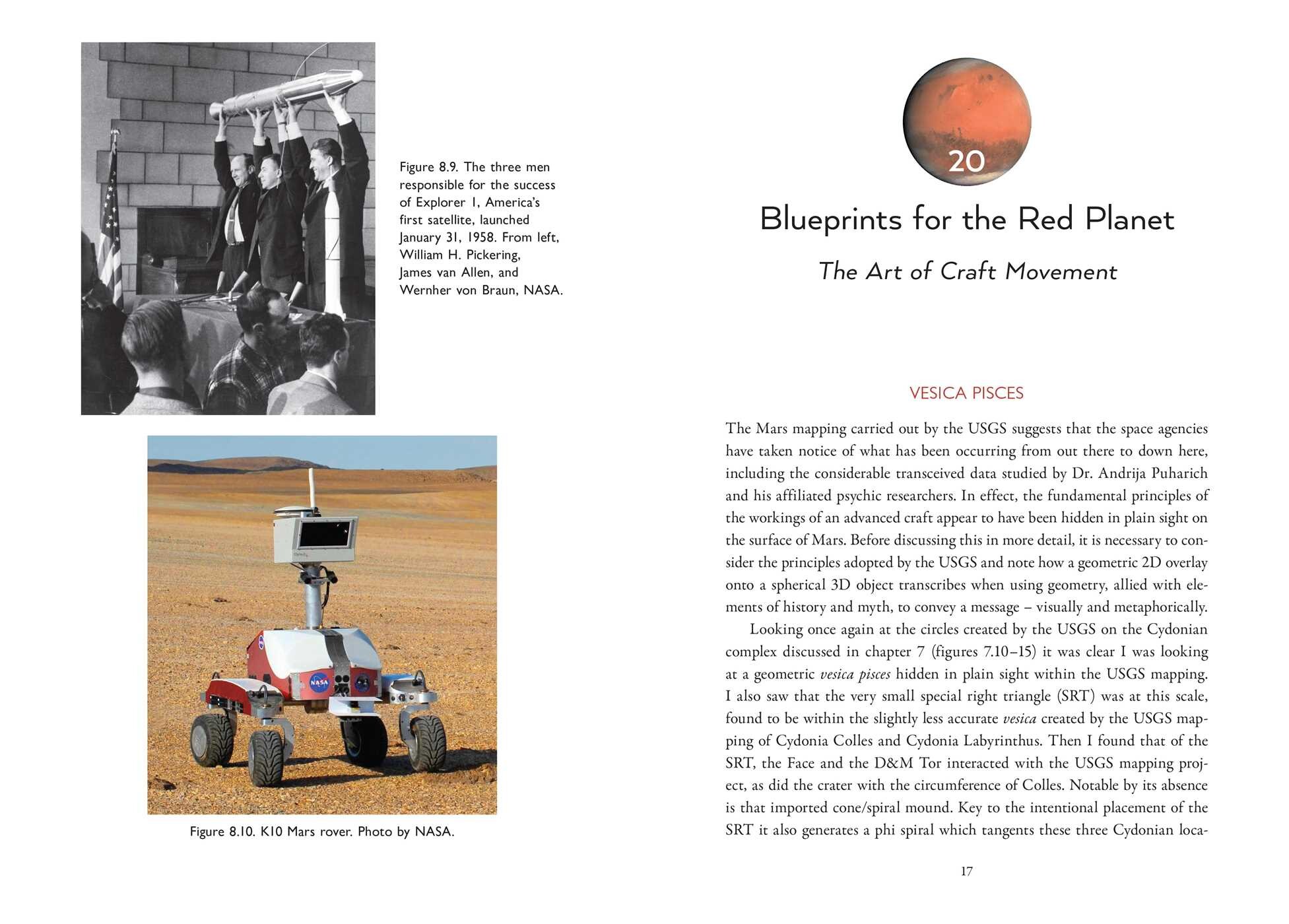
In the 1970s we began physically interacting with Mars, first launching probes to fly past and orbit Mars, then sending small craft to touch down and, in more recent times, sending robots and roving vehicles to explore its surface. As a result of all this activity Mars has been photographed and imaged extensively, but the next step - getting humans all the way there and landing them alive and in a healthy state - is a totally different matter. . . .
It is the premise of this book that the achievement of successfully landing a probe on the surface of Mars demonstrated to extraterrestrial intelligence (ETI) that as a species we are now on the verge of addressing the challenge of sending human astronauts to land on another planet. But in reality, however good automated probes might be, the lack of progress in crewed deep space flight has demonstrated that existing rockets and spacecraft technology are woefully inadequate when it comes to protecting human beings anywhere beyond low-Earth orbit.
During the 1970s the US and the USSR managed to send probes to Mars equipped with cameras to make planetary observations. And as NASA’s Mariner 9 was travelling towards the red planet, space engineers, having decided that mathematics would be understood by any civilisation advanced enough to interface with the probes, were preparing messages for ETI. Greetings plaques were attached to Pioneer craft numbers 10 and 11. Launching in 1972 and 1973 respectively, both of these deep space probes bore an aluminium plaque engraved with the diagrams encoding mathematical, biometric, and locating data.
Simultaneously in June 1972, exactly the same month that Mariner 9, during its extended mission, re-imaged the Cydonia region of Mars for the second time, anomalous events occurred on Earth, indicating interactions from ETI, which, as the following chapters will show, have continued in various forms.
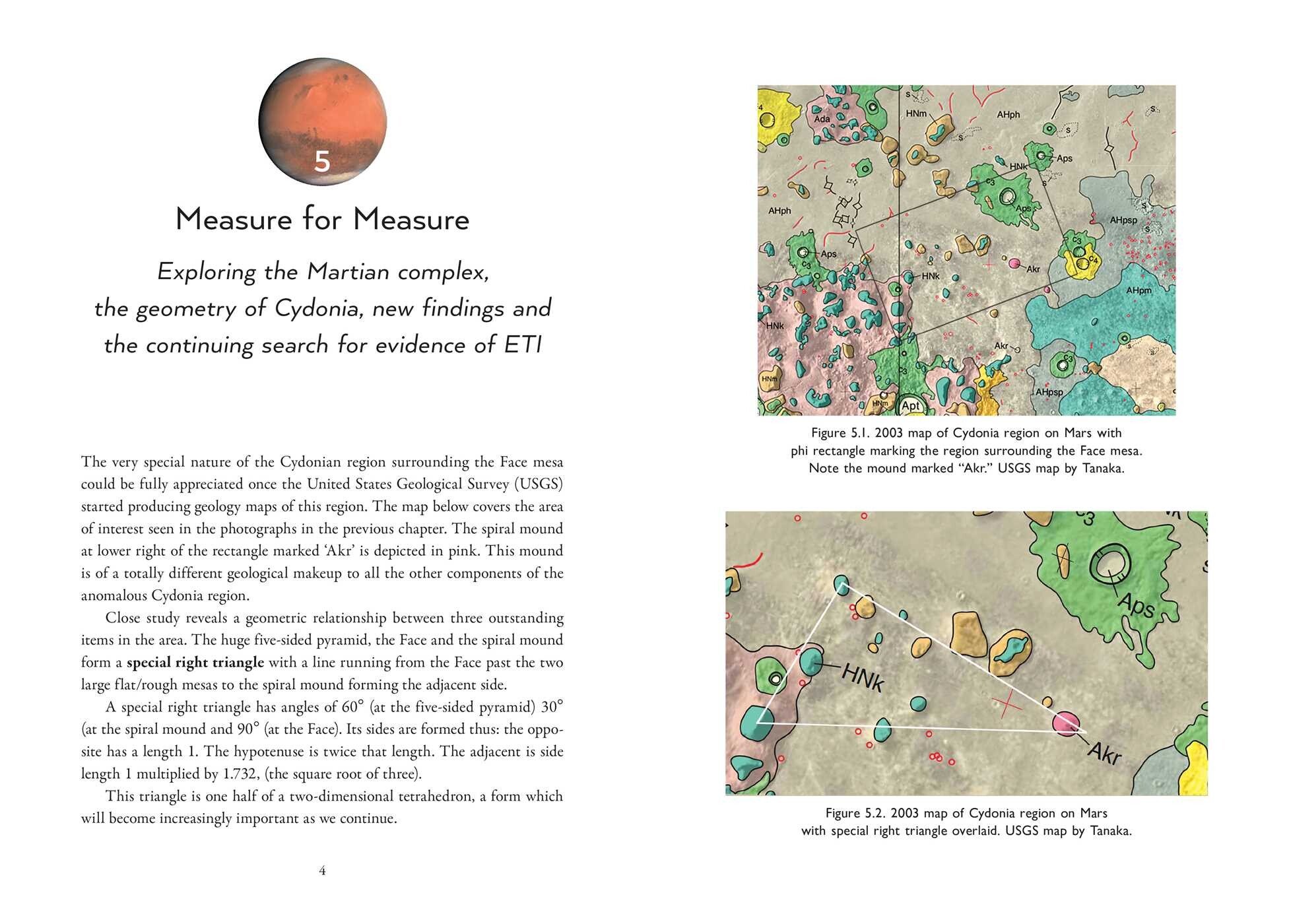
Four years after Mariner 9, the Viking probes were observing Mars once again, and photographing the Cydonian region. In July 1976 an image was returned that looked so much like an upturned sphinx-like face that it was specifically mentioned at a press briefing - despite being dismissed as “a trick of the light.” Coincidentally a committee, led by Carl Sagan, was in the process of selecting elements to be incorporated into a sound recording with the finished product to be attached to the Voyager probes launching in 1977.
After collating the available evidence during research for this book, it has become abundantly clear that communications and messages from Earth have not gone unheeded. Just as humans have sent out encoded and engraved diagrams and disks of recorded sound, messages have been returned to us here on Earth, using the same methods that we adopt to send messages from Earth into space, incising into our material world symbols and shapes containing layers of decipherable meaning.
. . . Today, humans can only travel a fraction of the distance to the Moon--and NASA, the agency that built the rockets and modules of the ’60s, had to retire the Space Shuttle program after it failed to make significant advances and now has to rely on Russian spacecraft to transport astronauts to and from the International Space Station, orbiting a mere 250 miles off the surface of the Earth--just one thousandth of the way to the Moon.
During the 1960s when the term “Rocket Science” became shorthand for doing something really brainy and clever, the public were encouraged to leave the difficult stuff to the scientists. But with the hindsight of 20/20 vision, maybe we should all start asking the awkward questions--since clearly there are profound challenges to be overcome when designing, building, and launching a craft for journeying into deep space with a full crew aboard and a fit-for-purpose lander.
The stagnating technology underscores the necessity for a big rethink. A totally new approach to human space travel is seriously overdue and a paradigm shift is needed to make a genuine breakthrough.
In February 2020, SETI (the Search for Extra-terrestrial Intelligence Institute) announced that the search for ETI had finally “gone mainstream” when it was granted access to real time data coming from the Very Large Array (VLA) Observatory in New Mexico. Should this SETI-VLA collaboration succeed then a change of perspective is on the horizon.
This book suggests that energetic interactions with our world (some via the VLA but mostly by events considered anomalous by scientists) are actually encoded aspects of physics that, to date, mainstream science and the space agencies appear not to have fully grasped.
The messages sent from Earth encode factual information for ETI about the people of Earth, with a sprinkling of culture added to the mix, for example, the first two bars of Beethoven’s String Quartet No.13 in B♭ major. The messages received on Earth contain extra content addressed to creative rather than linear minds, forming neural pathways capable of change and development.
This book contains the story of how we got to where we are today in the matter of ETI and the quest to travel into space and it also suggests how we might proceed in decoding the data and information held within those anomalous events described. It further proposes that the knowledge transmitted can assist us in overcoming present technological difficulties both here on Earth and in space, so that ultimately humans can construct a viable spacecraft sufficiently advanced to take pioneering humans swiftly and safely to somewhere we really want to go--to Mars.