Reading Group Guide
Track, Book 5:
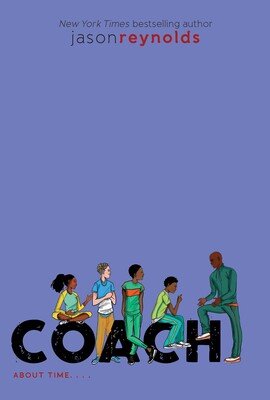
Coach By Jason Reynolds
About the Book The fifth installment of Jason Reynolds’s Track series is
Coach, a story about resilience, friendship, and the choices that shape who we become. Going back to the 1980s, it tells the story of Coach Brody’s experience as a young athlete and reveals what inspired him to coach the Defenders as an adult.
Discussion Questions 1. Explain each of the events that lead up to Otis deciding to shave his head. Have you ever been teased by someone? How did you respond? What do you think Otis should have done when Quentin made fun of him? How does Otis explain why he shaved his head? In what ways are his story believable and unbelievable?
2. Otis’s mother tells him, “You gotta be careful because everything you say is like a seed in the ground . . . It grows and grows even if you don’t see it. It makes roots, and opens up, and after a while it breaks through and starts showing itself.” (Chapter three) What does her advice suggest about the power of words? How can you apply her advice in your own life?
3. Describe Torrie and Otis’s friendship. How do the boys demonstrate that they support each other? What does Otis mean when he says that Torrie is “track cool” and “track tough”? (Chapter four)
4. What details in the book suggest Otis and Torrie’s neighborhood has a problem with gangs and drugs?
5. Why did Coach Marvin and Otis’s father start a track team? What do you think Coach Marvin means when he says, “‘Structure, discipline, and fun will defend against the gun’”? (Chapter four)
6. Who are the Clippers? How does Otis feel about them? How can you tell? How do his parents feel about the presence of the gang? Find quotes from the text to support your answers.
7. Why is Otis excited about Dudley Anderson coming to the Defenders’ practice?
8. Why does Otis push himself to run fast during practice the day after he shaves his head? How does this decision impact his performance the following day? Research the causes of muscle cramping (commonly called a charley horse). What could Otis have done differently to help avoid this happening?
9. How does Otis get a pair of Air Jordan 3s? What do Otis and his friend Goose believe Air Jordans can do for the person who wears them? How does wearing the shoes make Otis feel about himself? Have you ever had an item of clothing or an accessory that made you feel this way?
10. Explain how Otis meets Biscuit. What kind of first impression does Biscuit make on Otis? What can you tell about the way Otis’s mother and father each feel about the man, based on their reactions to him? Later, when Biscuit visits the neighborhood, what details suggest how others feel about him? How does seeing Biscuit hit his father affect Otis?
11. Why does Otis decide he wants to learn how to compete in the long jump? Have you ever wanted to learn to do something to be like someone you admire? Share if you feel comfortable doing so.
12. How good of a runner was Otis’s father when he was younger? What ended his athletic career? How can you tell that he doesn’t feel fully recovered from his injury, even after all this time?
13. Why do Otis’s parents warn him to avoid the barbershop? Why do you think Otis’s father eventually takes him to the barbershop? Does anything happen during the visit to justify the warnings to stay away?
14. How does Otis react upon learning that his friend Torrie made it to the Junior Olympics, but he did not? What does his reaction reveal about their friendship? If you were in a similar situation, how do you think you would react?
15. What does Otis learn about why Mr. Charles keeps a five-dollar bill on the wall in the back of his store? How does this change the way Otis feels about the Clippers? How can you tell that his attitude has changed?
16. When Quentin begins teasing Otis for a second time, how does Otis respond? Why do you think he reacts differently this time than he did at the beginning of the book?
17. Foreshadowing is a literary tool authors use in their writing, dropping hints at actions or revelations that are yet to come. After you learn the truth about Otis’s father, reread chapters 13 to 15, looking for hints that Otis’s father was in trouble. Select one and explain how it foreshadows the revelations about Otis’s father.
18. How does Mr. Crampton help when Otis’s father is missing? How does Otis’s father know Mr. Crampton?
19. In addition to writing novels, Jason Reynolds is also an accomplished poet who uses figurative language (personification, imagery, simile, metaphor, etc.) in his prose. Find an example of figurative language from
Coach, and share your example with the class. For example, “In the morning outside smells like dew. In the evening it smells like done.” (Chapter ten)
20. A book’s setting includes both the place and the time (where and when the story takes place). What details in the text let you know that this story is set in the past? Can you use any of these details to pinpoint the exact year?
21. If you have read the rest of the Track series, you know that Otis makes it to the Olympics and wins a medal there when he grows up. Why do you think Jason Reynolds decided to end Coach’s story before he makes the Junior Olympic (or Olympic) team? How do you think it might change the book’s message if it ended with Otis making it to the Olympics?
Extension Activities 1. Otis’s favorite movie is
Back to the Future. Watch the movie, and then compare the characters of Marty McFly and Otis Brody. Why do you think Otis admires Marty? Why do you think he connects to this story as strongly as he does? Are there any parallels between Marty’s story and Otis’s story? Do they share any themes?
2. During his athletic career, Carl Lewis competed in four Olympic Games. Look up videos of him competing in the 1984 and 1988 Olympics (the same races and events that Otis and his father watch). What qualities set Carl Lewis apart from other track and field athletes? What makes him a good role model for Otis? After researching Carl Lewis, research the 1988 Summer Olympic Games. Choose an event and create a sportscast report about the event as if you were reporting live from 1988. You may choose to either present this in person or to film your report.
3. Otis’s mother tells him to say that he shaved his head to help him run faster using aerodynamics. (Chapter three) Research the role that aerodynamics plays in design by looking at something designed for speed (e.g., a racecar or sports car; brand or style of shoes; jet plane; racing bike or motorcycle; sailboat). Explain how the product was designed using physics to increase its potential for speed. As a further extension for a multidisciplinary project, Cornell University has compiled links to middle school science labs and activities related to aerodynamics:
https://nsdl.library.cornell.edu/websites/wiki/index.php/MSP_MiddleSchoolPortal/Aerodynamic-_Applications_of_Force_and_Flow.html 4. Throughout the novel, Jason Reynolds describes Glass Manor, the neighborhood that is the setting for the Track series. Pay attention to his use of specific details and descriptive language. (See chapters four and eight.) What do these descriptions reveal about the neighborhood? If you have read the other books in the Track series, describe how the neighborhood changed over time. Select a place that you know well, and write an essay describing it. Use Jason Reynolds’s style as a model, and incorporate descriptive and figurative language in your essay.
5. In the
Time magazine article “How the Jordan 1 Became the Sneaker of a Generation,” Emil Wilbekin writes that “its popularity created an intrinsic sense of belonging—a lightning rod of hope.” (
Time, April 2023
) How does owning a pair of Air Jordans create a sense of belonging and hope for Otis? Research the history of Air Jordans. What made Nike’s collaboration with Michael Jordan so culturally important?
6. Otis’s mother has a tradition she calls the Sunday question, which Otis describes here:
The Sunday question was exactly what it sounds like. A question my mother lobbed into the center of Sunday dinner to get everybody talking. It could be anything. Once she asked if I would rather live to be a hundred years old, or start life over at twenty, five times. Another time she asked if I could choose any talent outside of the one I already have, what would I choose? (Chapter eleven)
Working together as a class, brainstorm and create a box full of “Sunday questions.” Use these questions as icebreakers or questions of the day to help you get to know your classmates.
7. Each chapter in
Coach begins with a “Moral of the Story.” Otis explains:
My dad looooves to talk about the moral of the story . . . And by story, I’m not talking about an actual story. Not like a novel, or a fairy tale. The “stories” Dad wanted to talk about were usually moments where I did something stupid that landed me in a stupid situation, which usually had me looking stupid . . . It was his way of telling me what I was supposed to be learning from whatever the experience (or mistake) was. (Chapter eight)
Think about a time when you made a mistake or bad decision or faced a challenge or failure. Tell the story of this experience in a personal essay. What is the moral of your story? In other words, what did you learn from the experience?
8. Look at the descriptive paragraphs that Reynolds writes about Saturdays and Sundays in chapters nine and eleven. Using his descriptions as inspiration, create a weekly calendar that includes a descriptive paragraph about each day of the week.
9. Otis enjoys imagining different designs for time machines, incorporating elements of the design into the way the time machine operates, such as a “fortune-cookie time machine, which is a time machine that works by breaking the fortune cookie in half.” (Chapter nine) Design a time machine using an object of your choice, and create a drawing or model of your creation. How would you operate the machine? If you could travel to a time in the past or future, where would you go and what would you do there?
Extension Activities for Readers of the Other Books in the Track Series 1. The Track series begins with Ghost’s story and ends with Coach’s story. Now that you have read
Coach, read (or reread)
Ghost, keeping in mind how Coach’s experiences in middle school influence the way he responds to Ghost. Pay particular attention to chapter nine; in this section, Coach tells Ghost that he learned “‘you can’t run away from who you are, but what you can do is run toward who you want to be.’” What was Coach running away from? What did he run toward? How does Coach’s life experience prepare him to mentor Ghost?
2. If you have read other books in the Track series, how did learning about Coach’s experience as a young athlete change the way you think about him as a character? If this is your first experience with the series, how do you think knowing Otis’s story will help you understand his character in the other books? As a class, explore history by asking parents, guardians, or other meaningful adults in your lives to visit class for a “living history” day. For their visit, ask them to bring a historical artifact from their teenage years: a yearbook, an item of clothing, an electronic device, a song, or anything else they associate with their generation. After the visit, write a summary of what you learned from the history day. As a further extension, work with your class to create a time capsule for a future generation to open, selecting objects that will help them understand what life was like when you were in middle school.
Guide prepared by Amy Jurskis, English Department Chair at Oxbridge Academy.The websites referenced above are provided for informational purposes only and are not intended as an endorsement or promotion of any website. Simon & Schuster is not responsible for the functionality or content of any external website and expressly disclaims all responsibility and liability in connection therewith. This guide has been provided by Simon & Schuster for classroom, library, and reading group use. It may be reproduced in its entirety or excerpted for these purposes. For more Simon & Schuster guides and classroom materials, please visit https://www.simonandschuster.net/m/prek12-teachers-librarians/teaching-resources