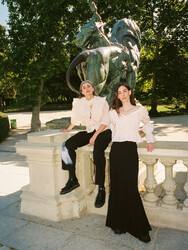
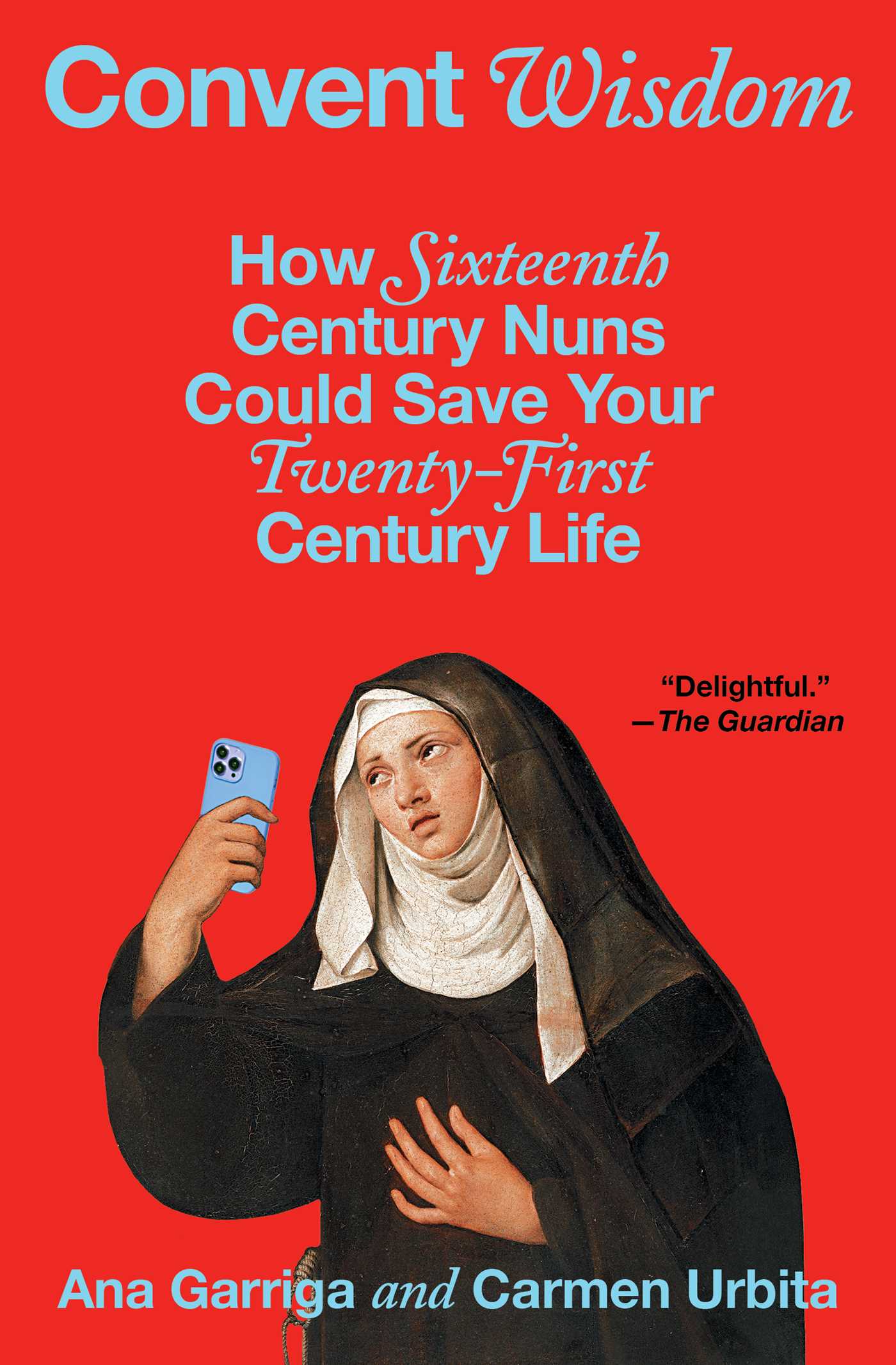
Girlfriends Girlfriends
If only you will love me as much as I love you, I forgive you all you have done and will do. Saint Teresa to María de San José
How a Friend Crush Might Change Your Life Forever
The nun is in her cell. She knows she should be praying for her sisters, considering Christ’s suffering at the cross, or writing a repentance letter for her confessor, but all she can think about is Teresa. No one forgets the sudden onset of a friend crush—not even a sixteenth-century nun dealing with a massive retaliation executed by the ecclesiastical hierarchy. This is not the first Resurrection Sunday that María de San José has spent locked up in the prison of the Portuguese convent she founded herself six years ago. The thought of yet another Holy Week estranged from her sisters and deprived of all exterior communication is a miserable one, but luckily she still has a scrap of paper and some drying ink. She needs a morale boost: “He [God] is overjoyed, / and so I find contentment, / even if I’m cornered / in this sad confinement.” It’s a rather poor sonnet, she knows, but for now, it’s enough to keep her entertained and prevent the bitterness of her unjust imprisonment (imposed by certain friars of her own religious order) from consuming her. On her desk lies the letter she wrote two days ago, filled with rage:
Letter Written by a Poor and Imprisoned Discalced Nun to Console Herself and Her Sisters and Daughters Who Are Afflicted by Seeing Her Thus. She takes pride in the title—dramatic, self-congratulatory, and promising. Though she cannot share it with her companions just yet, she hopes that one day it will be published and serve as a lesson for generations of Carmelite nuns to come.
As she rereads the letter, each word transports her back to the beginning of it all. During her two years of isolation, María has spent many sleepless nights reliving the memory of that first moment when she witnessed Teresa in the midst of a mystical rapture. For a girl born in 1548, the enchanted choreography of an ecstatic body can’t have been any less mesmerizing than the well-rehearsed moves of Dua Lipa today. The languid gesture, the faraway gaze, the parted lips, the hands contracting to the rhythm of the spiritual rapture: a repertoire of masterful expressions that every aspiring mystic knew how to replicate and that María analyzed with the devout attention of a newly converted fan. What she didn’t know was that she would one day become best friends with the great star of mysticism. When they first encountered each other, Saint Teresa had not yet become a saint, and María de San José was going by another name.
In 1562, María was simply María de Salazar, a fourteen-year-old student enjoying a pampered adolescence at the opulent palace of a distant, wealthy relative named Luisa de la Cerda. Vainer than most, María preferred hobbies like maintaining the starched rustle of her dresses and the impeccable whiteness of their lace. That night, however, she didn’t mind putting all that puffed-up pomp aside and dragging her skirt along the ground, hurting her knees just to peer through the keyhole of Teresa’s room. Much like someone elbowing their way to the barricade of a crowded festival, she fought to position herself well among the throng of curious courtiers, all kneeling and struggling to catch a fleeting, sparkling glimpse of the palace’s most popular and intriguing inhabitant: Teresa de Jesús.
Teresa was a forty-seven-year-old Carmelite nun. After two decades of living in anonymity, her mystical charisma, stubbornness, and revolutionary ideas began to set her apart from the countless other religious women scattered around sixteenth-century Castile. Teresa is that friend you look at with bemusement when she decides to leave everything behind and invest all her energy in a self-managed collective housing project—but in the end, against all odds, she succeeds. Teresa had made the decision to found a new religious order, the Discalced Carmelites, enemy to conspicuous religiosity and ostentatious displays of wealth. For forty years, mental prayer, austerity, and intimacy—as opposed to the two hundred nuns who lived in the convent where Teresa had professed when she was twenty, the Discalced Carmelite houses would never have more than thirteen nuns—would be the cornerstones of Teresa’s ambitious dream. Rumors were beginning to circulate that she was more than just a nun—she was a saint in the making.
Many centuries would pass before Teresa became a global icon, with statues of her adorning churches across the world, but her reputation for holiness already preceded her enough for the noblewoman Luisa—hoping to alleviate the sticky tedium of her recent widowhood—to become enamored with the idea of having this spiritual celebrity stay at the palace for a few months. While Teresa shared whispered consolations with the widow, a swarm of dazzled teenagers followed her around every corner. They peered through curtains and tapestries to spy on Teresa’s gripping conversations, her prayer exercises, and the gruesome spectacle of violent self-flagellations performed by someone who was, at her earthly core, a frail lady pushing fifty. It was impossible not to look. The entire palace was in an uproar, but María had a hunch that although these unusual displays were captivating everybody, they were meant more for her benefit than for anyone else’s. María was never Teresa’s least toxic friend, but she would end up being the most loyal.
From the confines of the convent prison where she now found herself, and with that yearning for the carefree and exhilarating days of youth that haunts you as soon as you hit your thirties, María could not stop thinking about those spying escapades of her girlhood that had forever altered the course of her life. Years earlier, in her 1585
Book of Recreations, she had already tried putting the sudden rapture of her friend crush into words: “I was then thirteen or fourteen years old, she was in the house, on that occasion, about six months or so. Now, Sister, I wish another tongue than my own to tell of the transformation wrought in us all by her holy conversation and her practice of prayer and mortification.” Before it was too late, she wanted to leave a testimony of the first time she saw Teresa that would capture the bewitching, relentless character that everyone had recognized in the future saint. Although she feigned humility behind a vague “us all,” what María truly wanted was to feel like an exception by revealing the unique whirlwind of emotion that had, for more than twenty years, formed the backbone of her relationship with the most esteemed woman in sixteenth-century Spain. Had María been able to foresee all the future torments into which her loyalty to Teresa would drag her—including slander, the ordeal of founding new convents, and her current seclusion—she wouldn’t have changed a thing. And neither would we.
Our first meeting also took place among ornate draperies and molded ceilings. Lacking the corridors and chambers of a Renaissance palace, we settled for the lobby of a once grand 1920s hotel, long since fallen into decline. To reach the Biltmore Hotel in Providence, Rhode Island, one must cross a bleak square, cursed by a poor government decision in the 1980s to live out its days as an open-air bus station. Now, the bravest students from Brown and RISD (Rhode Island School of Design), the two wealthiest universities in Rhode Island, wait for their buses, making great effort not to touch anything, all the while thinking about how insightfully they will discuss the opioid crisis once they are safely on the other side of the city. One March night in 2016, overcome by an unnerving sense of newness, we both crossed that square with a light step, determined to impress each other. Every budding friendship is in part a courtship.
In
Instruction of Novices, her manual for novice nuns, María de San José provides very precise guidelines about the protocol two religious women should follow when meeting for the first time: “Between equals, they will make a slight bow to each other, giving way to one another.” Luckily, we had a cocktail menu to help ward off the initial threat of Carmelite stiffness. The chandelier, dusty carpet, and plastic flowers in the Biltmore’s lobby lent a sense of unease that the $16 dry martinis could not quite shake off. Rumor had it that Emma Watson had lived in one of the Biltmore suites during her years as a student at Brown and, for some strange reason, imagining the actor of our childhood riding the elevator that unsuccessfully tried to evoke the city’s bygone splendor gave us a much-needed sense of coziness. Officially, it was our first-time meeting; in reality, without any way to spy on each other through the crack in a door, we had both succumbed weeks earlier to the embarrassing ritual of stalking each other through Instagram. Instead of mystical theatrics or mortifications, we found the illusion of intimacy that kept us equally captivated as we tried to decipher in each other’s gestures the key to our own incomprehensible life decisions. At just twenty-six years old, we had already spent too much time in academic seclusion, dedicated to meticulously dissecting the intricacies of the Catholic Counter-Reformation, the politics of sanctity, and the sensory fervor of Renaissance demonological treatises. This trove of knowledge might eventually help us win some prizes on quiz shows or even score some points on a Tinder date with someone with a fetish for scholarly minds, but it proved largely incompatible with a happy twenties. Without any intention of steering our lives toward more rewarding paths, that night at the Biltmore bar we made a toast to our unusual, shared decision to cloister ourselves for the next five years (eventually seven) in the solitary silence of a doctoral program four thousand miles from home:
- —Carmen, let’s have a toast.
- —To the PhD?
- —To Saint Teresa.
- —You’re right, always to Saint Teresa.
And then we exchanged some religious cards we each kept in our wallets.
The truth is that we had spent more time picturing the aridity of a sixteenth-century nun’s cloistered life than our own desolate journey through academia. The claustrophobia of the narrow cell; the stomach growling in despair after weeks of zealous fasting; the best hours of the day lost to prayers and penance; the bloodshot eyes squinting helplessly at a half-embroidered altar cloth—we thought we knew everything about the rigors of convent life. But we chose to ignore the daily martyrdom that awaited us in the following years: fourteen harrowing hours a day sitting in a chair, our eyes forever locked on a ruthless, uncompromising screen, our gaze getting lost too often on a scratch in the damp wallpaper; the guilt of disobeying the sacrosanct mandate to escort an exquisitely toned body through the marvels of a vitamin-infused prime of life; hearts perpetually torn between the isolation of academia and the tantalizing lure of cultivating a personal brand on social media. On that first night together, we were unaware that within a year we would begin to see our own peculiar paths mirroring the sacrifices of our sixteenth-century idols.
The names of many nuns came up during that first conversation. Once we got past the uncanny feeling that sitting opposite a doppelgänger of convent research induced, all sense of wariness faded and we began sharing names of religious figures with the same irrepressible fervor as stamp collectors in their sixties, and with the same personal and incomprehensible zeal of teenagers swapping Magic: The Gathering cards during recess. In the increasingly deserted lobby, we spoke about Saint Teresa and María de San José. We expressed our joint admiration for the Mexican Sor Juana Inés de la Cruz and reminisced about the juiciest excerpts—her steamy dreams about the town’s confessor, the unruly behavior of her 666 demons—from the autobiography of Jeanne des Anges, the possessed Ursuline nun. We did not, at the time, discuss any of the nuns hailing from the Venetian convents of the late sixteenth century, as figures like the Benedictine Arcangela Tarabotti would become part of the extensive catalog of discoveries we would unearth together in years to come.
Later, we learned that out of the 135,000 people living in Venice, Italy, in 1581, 2,508 were cloistered nuns. At that time, the city was a bustling commercial center, thriving on the textile industry and the production of sought-after luxury goods, including the famous Murano glass. The city was also becoming an elaborate urban recruitment office for convents. With the cost of dowries going through the roof and wealthy families fearing the fragmentation of their dwindling wealth, many found little incentive to continue feeding the city’s marital circuit. As a result, thousands of Venetian teenagers, with or without a calling, ended up behind the walls of convents. Much like how retailers, families, and brides conspire in the TV show
Say Yes to the Dress to turn the quest for the perfect wedding dress into the tearful prelude to the marriage contract, sixteenth-century Venice, with a few shrewd branding decisions, managed to seduce an entire generation of women with a vastly different kind of contractual celebration. To avoid the hassle of domestic disputes and quell adolescent rebelliousness, the city’s upper class devised an enticing package meant to convince their daughters that only by entering the novitiate could they have the wedding of their dreams: an exceedingly lavish ceremony for taking the habit. The sight of each new batch of novices parading in white silk dresses to the convent doors, ready to become brides of Christ, gradually infused the Catholic liturgy with a dramatic allure unrivaled by even the Met Gala. These rituals became known for decadent banquets, exquisite gifts, and trousseaus overflowing with satin undergarments, embroidered veils, and the occasional piece of gold jewelry. Faced with a reality that offered few generous options, many Venetian women learned to eagerly anticipate the day of their entry into the convent. It was a wedding done right, without the added inconvenience of a husband. Had we also waited with anticipation for our own initiation ceremony? We would have never admitted it, but at the very least we were intrigued by Brown’s Opening Convocation and its procession of incoming students through the legendary Van Wickle Gates—only open three times a year with rigorous solemnity. So, casting our graduate students’ insouciance aside, we gave in and passed through those symbolic gates. Though the rite itself certainly felt less glamorous than a Venetian nun’s profession of vows, we were, just like them, unwittingly saying yes to a life of strife only assuaged by the affection and devotion of new friendships.
Not all teenage girls in Venice were persuaded by the promise of a day teeming with feasts and haute couture. Throughout the city the young swapped eloquent verses capturing the disillusionment of a generation in a manner not dissimilar to trap lyrics: “Mother, please, don’t make me take the habit, / I don’t want to talk about it. / Don’t make me a tunic that I don’t want to wear. / All day long at vespers and all day long at mass / With the abbess yelling, it just won’t pass.” It was clear that beneath all the nuptial frenzy, there was an awareness that, as soon as one took the habit, the romantic mirage vanished, replaced by the austere discipline of the novitiate. Perhaps, if we had known that little verse while slowly sipping the most expensive dry martinis of our twenties, we wouldn’t have been so receptive to the snobby charms of a private university. Before that first trip to Providence, we had both devoured
The Marriage Plot, the Jeffrey Eugenides novel in which he imbues Brown University with an aura that made us see the research contract as something akin to a most stimulating marital agreement. Besides—although no one had ever presented us with anything resembling a Venetian trousseau—we soon discovered that we both shared a spirit easily swayed by the offer of indulgences, however insignificant they might be. We confess that on the two university-funded nights we spent at the Biltmore, we were not immune to the pull of a four-poster bed and room service platters of Manchego cheese and quince jelly. If that was Brown’s strategy to seduce prospective grad students into choosing its programs, it certainly did the trick for us. Had we already encountered Arcangela Tarabotti’s
Convent Life as Inferno, the autobiographical manuscript in which the Venetian Benedictine nun condemned the tyrannies of monastic seclusion, we might have more cautiously considered the hell we were committing ourselves to: years of tiny apartments plagued by millennia-old filth, ascetic sleeping habits, cruel crises of intellectual faith, library halogens wrecking our once-smooth skin, a perpetual FOMO we could not shake, and aesthetic ravages (pitiful dark circles around the eyes, a sickly pallor, premature gray hairs) that we now carry around with us with the dignity of survivors. Still, we regret nothing.
María de San José never regretted the path she chose after that first night she caught a glimpse of Teresa. She had plenty of opportunity—a year of isolated confinement in a microscopic cell, without the escapist refuge of scrolling at her fingertips. With her gaze lost in the blue tiles of the Portuguese Convent of São Alberto in Lisbon, María must have mixed up the bells that rang for lauds, the Eucharist, vespers, and for all those services she could no longer attend, while she wondered where she might have been at that moment had she not said yes to the Carmelite habit at the age of twenty-two. After securing a favorable marriage for María, Luisa de la Cerda might have funded her dowry. In this alternate reality, María could be staring down a future of perpetual pregnancy and long, cloying afternoons receiving courtesy visits from distant relatives in the upholstered sitting room of a more or less stately home. But what about her friends now? In that cell, she was isolated, but not alone. She knew she had an entire group of Carmelite nuns outside, encouraging her to write. She was motivated, as she would say, by the duty “that love and tenderness towards them incline me to care for the comfort and well-being of the Sisters, as if they were daughters of my heart.” The path of her cloistered life had dragged her into a hellish captivity, that much was true. But just as Arcangela Tarabotti described her own monastic hell in
Convent Life as Inferno and its luminous opposite in
Convent Life as Paradiso, María never lost sight of the fact that her friendship with Teresa had also given her decades of dizzying thrills. Embedded in the shared biorhythms, collective strategies, and spiritual ambitions of the convent, María found the love and tenderness that we all seek.
Generally, one reaches one’s fourth decade on all fours, bewildered by a tumultuous twenties and relieved to have avoided greater disaster. With varying degrees of self-forgiveness, we all must ultimately accept that, within the absurd and oppressive landscape that we’re forced to negotiate, there is no choice but to reconcile with the arbitrariness of a path that has plopped us in a sufficiently good place in the present. For the nuns of the sixteenth century, options might have been more limited, but that did not lessen the vertiginous bedevilment of decision-making. Some took vows out of obligation, others out of vocation, many to avoid marriage, and more than a few because they fancied the idea of wearing one of those Benedictine habits described by a seventeenth-century traveler touring Venice as “an outfit more suited to nymphs than to nuns dedicated to a life of penance and prayer.” Some sought fame through sainthood, and many, perhaps the majority, simply took vows because their aunts, friends, and cousins had done so before them. All roads through life are capricious, but those who are guided by a desire to be with their girlfriends face uncertainty with a different kind of calm. María de San José could have taken the Dominican or Benedictine path, but from the moment she felt that deep infatuation for Teresa, there was no option but the Carmelite way.
In that spring of 2016, we could have chosen Harvard, Yale, or Columbia, but in the end we decided, almost at the same time, to stay in Rhode Island. Blame it on the Biltmore, Jeffrey Eugenides, and even Emma Watson, but most of all, blame it on that night when we let the intuition of a budding friendship dictate the next years of our lives. No matter what century you’re reading this in, never let the promise of a lucrative salary or the varnish of a prestigious career overshadow the prospect of a life built in community when making important life decisions. The nuns brought us together forever that first night in Providence. They soon ceased to be an object of research and became our most valuable survival tool, imparting a wealth of therapeutic teachings on how to endure isolation by navigating the stormy waters of friendship. As we often say: “Anything you are going through right now has probably already happened to a nun living several hundred years ago.” The euphoria, the sleeplessness, the turbulence, the caring, the rigor, and the devotion of friendship too.
How to Survive Your Friend’s Tantrums Without Banishing Them from Your Life
Every friendship has its triangulation. We all know that moment when the phone trembles in your hand and your lips burn with the need to unload all the gripes of wounded loyalty onto the friendly vertex of a neutral, understanding third party. Because you can only really speak ill of a friend to a mutual friend, just as you can only really speak ill of a mother to a sibling. For Lindsay Lohan and Paris Hilton, Britney Spears was the third vertex that completed their iconic Holy Trinity. Between Teresa and María de San José, the third piece of their triangulation was always Jerónimo Gracián.
Jerónimo was the provincial of the Carmelite order and Teresa’s main ally in all her endeavors. Their mutual devotion was so deep that when the nun’s tomb was opened nine months after her death, revealing her body to be completely incorrupt—who needs Botox when you have sainthood?—the friar, as her closest friend, rolled up his sleeves without the slightest hesitation and cut off the corpse’s left hand so that he could take it to the Carmelites in Lisbon. But the acolytes in Portugal did not receive a full hand: Jerónimo kept the pinkie for himself. Nearly ten years later, still carrying the little finger with him, he embarked on a journey from Naples to Rome that was dramatically intercepted by Barbary pirates. Jerónimo had the sole of his foot branded with a red-hot iron and was held captive for two years under threats of being burned alive, but nothing pained him as much as the moment the pinkie was confiscated. When he was finally released in 1595, the thought of leaving Turkey without Teresa’s digit never even crossed his mind. Later on, he wrote in a marginal note on the first printed biography of Teresa: “I recovered it [the pinkie] for about twenty
reales and some gold rings I had made with some small rubies that adorned the finger.” Jerónimo knew that, regardless of its size or macabre nature, the relic of a close friend, and the memories it contained, was worth the peril of a life-or-death haggle.
The friar had many reasons to cling to Teresa’s anatomical amulet for support. That ill-fated journey was part of a pilgrimage to the Vatican meant to persuade Pope Clement VIII that Jerónimo was being subjected to a ruthless and baseless persecution by his own order. In February 1592, after a humiliating and very public judicial process, Jerónimo had been expelled from the Carmelites. Behind this campaign of harassment was a complex amalgamation of personal grievances and radically opposed views on how external or autonomous the governance of the convents and the spiritual direction of the nuns should be. There was also long-standing concern about the friendship between the friar and María de San José. As early as 1578, when María was the very young prioress of the Seville convent, two of her nuns, Beatriz de la Madre de Dios and Isabel de San Jerónimo, began having visions and prophecies (just another day in sixteenth-century Spain). In the investigations that followed, Jerónimo himself became embroiled in the scandal, accused by his enemies of being a Carmelite Sean “Diddy” Combs, dancing naked in front of the nuns and spending less-than-devout nights with María de San José. Those allegations came to nothing and were dismissed as mere tabloid rumors. In 1585, however, the whispers resurfaced. The leadership of the order grew wary of the time Jerónimo spent with María at her convent in Lisbon. It was rumored that the friar let the nuns there wash his shirts and cook his favorite dishes because—as has always been true—male feminist allies always have a secret self-serving agenda. Shortly before his kidnapping, Jerónimo received a papal brief that officially approved his cancellation. María, who had already made significant enemies by defending Teresa’s legacy, also caused quite an uproar with her letters defending her friend Jerónimo. On September 25, 1587, she wrote a letter—nothing short of sassy by sixteenth-century nuns’ standards—to Provincial Vicar Antonio de Jesús threatening him and all the high-rank friars who were willing to ruin her reputation: “It has come to our attention that they say the whole province is scandalized by the familiarity and conversations that Fray Jerónimo Gracián had with us during the time when he was Vicar General here. For that reason, our conscience compels us, for the sake of the Father’s honor as well as for our own, to seek a means for the truth to be acknowledged and the scandal to disappear.” That’s how she ended up imprisoned and isolated in her Lisbon cell.
Teresa knew that Jerónimo loved María as much as he loved her. That is why, when her closest disciple tests her patience and she finds herself gripping a pen until her knuckles hurt, he is the only person to whom she can imagine venting. On October 4, 1579, Teresa wrote to Jerónimo the kind of message that makes you wish iMessage shall never get hacked and your treasons revealed:
It is with great sorrow that I am troubled by the folly of that prioress [María de San José]. She has lost much credit with me. I fear that the devil has begun to work in that house, which I cannot endure, and this prioress is more cunning than her position demands. Thus, I fear she deceives us, as I once told her, for she never dealt plainly with me. She possesses much of the Andalusian nature. I tell you, I endured much there with her. As she has written to me many times with great repentance, I thought she had reformed, for she seemed aware of her faults. I have written her terrible letters, but it is no more effective than striking steel.
The letter is brimming with ire. Teresa has received news that María, driven by an itch for acquiring real estate, is considering moving the Seville convent to another building. Teresa tries to remain calm, but she is already overwhelmed by too many impertinences from a friend who, she sometimes thinks, no vow of poverty can ever free from the indulgences of a pampered childhood. Only four years have passed since they secured the building where the Carmelite nuns of Seville now live. Under the cover of night, Teresa, María, and two other nuns had squatted in the vacant building that a group of Franciscan friars were reluctant to sell. Teresa believed that none of them would ever forget the “great fear” they endured during those first nights when “all the shadows they saw appeared to them friars,” nor the nightmare of the following month, when they were forced to live together in a cramped basement while workers renovated the building’s main structure. What surprises her most is how quickly María seems to have forgotten their shared enthusiasm for completing the property in Seville, with its orange blossom water fountain and panoramic views that Teresa misses so dearly. Teresa doesn’t know where María is planning to move next, but she knows, and tells Jerónimo, that in any new house, “they will not have the views they enjoy from this one, which is a great delight for the nuns and the best feature of the place. Over here, they are quite envious of it.” Teresa’s anger is like the frustration any of us would feel watching a friend abandon a rent-controlled apartment in the heart of a city ravaged by speculation. Yet her outburst conceals something deeper: the pain of realizing that María is discarding, without any shred of remorse or longing, the emotional territory of a shared project.
Today, Teresa would be the friend insisting that everyone enable location tracking in shared apps for safety reasons, the one who knows everyone’s work schedules, vacations, and the dates of their gynecological appointments by heart. Sometimes, Teresa managed to conceal her need for group surveillance under the guise of affectionate words. At other times, she couldn’t maintain the pretense and ended up unleashing her more controlling nature: “I tell you,” she confessed to Jerónimo, who was already more than accustomed to his friend’s authoritative nature, “that I am terribly upset that I do not have the freedom to do myself what I am telling others to do.” To be fair, María didn’t make it easy for her. Her often sly and secretive ways were a constant burden on the relationship. When Isabel and Beatriz, those nuns who in 1578 had landed with their visionary howls the entire Seville convent in an extremely uncomfortable situation, Teresa had only three pieces of advice for María: Isabel should eat meat for a few days, Beatriz should tone down the intensity of her fasts, and María should do everything she could to smooth things over with the nuns’ confessor to avoid tensions that could further raise the suspicions of the Inquisition. María read Teresa’s letters, responded affectionately and obediently, and then capsized the plan by rudely dismissing the confessor. Teresa never understood why she did this behind her back. Why look for another building in secret and why not tell her about the tumultuous dismissal? Also, why hide the fact that she was negotiating for money with Fray Nicolao de Jesús María? (Perhaps María would have been more cautious had she known that, in a few years, that same scheming and manipulative friar would end up sabotaging the Carmelite reform.) “What has displeased me,” Teresa reproaches her in a letter, is “that you both in the end acted against my wishes.” Deep down, Teresa knows why. Because María is a spoiled and malicious girl, a “cunning fox,” as she tells María herself, almost splintering her quill against the paper with the same rage that must have driven Paris Hilton to maliciously laugh at her friend Brandon Davis’s calling Lindsay Lohan a “firecrotch.” Teresa’s vocal cords contract in a spasm as she holds back the urge to cry. María was a cunning and slippery creature who they should never have trusted.
This sudden estrangement between the two Carmelites was as melodramatic as the fallout between Lindsay and Paris, but unlike the warring nuns, the twists and turns of the celebrities’ friendship strayed far beyond the privacy of letters. Sensationalist magazine coverage no doubt intensified their conflicts, but for generations lacking a collective image of female friendship, two decades of media immortalization publicly demonstrated the subtle complexities that have always been a part of the story of female friends. Reading that the famous pair reconnected after Lindsay’s engagement in 2021—“We’re not in high school anymore,” Paris stated—any twenty-first-century girl can aspire to see her friendship breakups mended. But where was Teresa supposed to look for role models?
Teresa often thought about the final embrace of two particular friends, Saint Felicitas and Saint Perpetua, Carthaginian martyrs who died together in a third-century amphitheater after refusing to worship pagan gods. (If you live in the times of classical antiquity and your best friend refuses to worship pagan gods, then you refuse too.) She also frequently reflected on Saint Justa and Saint Rufina, two sisters from Seville who, also in the third century, chose to endure the torture of the rack and iron hooks rather than renounce Christ by venerating a figurine of a Babylonian goddess. The end of a friendship was supposed to be marked by the defiant and fanatical courage of a Counter-Reformation Thelma and Louise, not marred by murkiness and secrets. Truth be told, Teresa had wished to replicate the guiding relationship that Saint Anne had with her daughter, the Virgin Mary, in her friendship with María. She longed to see in her friend the same dazzled disciple she had first inspired years ago in the palace of Luisa de la Cerda. But María was no longer a child; she was a prioress with her own agenda. The model of Saint Anne no longer applied. In fact, it only served to exacerbate old insecurities.
Teresa never had access to formal education. As a child, she had to learn on the fly from her mother’s readings and prayers. She never mastered the intellectual refinement of Latin and could never quite rid herself of the envy she felt watching María flaunt her education. For her friend, the palace of Luisa de la Cerda had served as an elite boarding school where she learned to conquer Castilian grammar, ace French and Latin, dabble in the metrical forms of the Italian sonnet, and interpret the Bible as she pleased. A bit like us. We’ve often found comfort in imagining how the eccentricity of our academic sacrifice might have served us well in captivating María. But this wasn’t always the case. The ghosts of impostor syndrome hovered over many of our days that first year at Brown; the possibility of blanking during the Q&A session at a conference was enough to give us cold sweats. Faced with such self-doubt, one of us elected to give up a summer of friends, beer, and vitamin D to seek her own palatial erudition at an intensive three-month Latin course hosted by a prestigious New York university that advertised the opportunity to acquire a level of skill that would usually take a decade. We were both equally seduced by the promise of intellectual validation that comes from mastering a dead language. Who knows, together, we might have been able to make it through the language boot camp. But that was not to pass:
- —Carmen, will you still love me when you come back in September a Latin native?
- —Ana, I can’t take it anymore. This tyrannical military discipline required to learn Latin is absurd. A misstep in a declension means unbearable public humiliation. If at 4 a.m. you’re not sweaty on the phone with the professor, discussing various versions of a Catullus translation, it’s like you’re doing something wrong. I don’t want to spend my summer crying because of these Latinists with sociopathic tendencies, but I don’t know how to quit.
Fortunately, friendship can save you from almost anything, including this. Between sobs, we assured each other that no one deserved to risk their sanity for a few crumbs of scholarship. Better not to know Latin at all than to go through such an ordeal. Besides, would our friendship have survived an imbalance in Latin proficiency? Teresa and María’s almost didn’t.
Generally, Teresa viewed María’s intellect with pride and affection, referring to her as “my little scholar” on many occasions. There were, however, times when she wanted to slap her for being a “know-it-all,” such as in 1576, when María wrote a letter to Father Ambrosio Mariano de San Benito, a Discalced Carmelite renowned for his engineering and mathematical knowledge, and tried to flaunt her learning by peppering the lines with Latin quotes. Teresa’s reprimand was swift: “God spare all my daughters from showing off their Latin,” she wrote at once. “I much prefer they take pride in seeming simple, which is very saintly, rather than rhetorical.” This outburst carries a whiff of anti-intellectualism that doesn’t represent the true spirit of Teresa’s foundations (“I prefer having her [a smart nun with no dowry] to taking in foolish nuns,” she had also said.). She also didn’t want them to be conceited or arrogant, nor did she want them to boast about having more education than she did. Above all, she could not stand the idea of the prioress being able to comprehend codes that eluded her. How did the future saint know that her friend had stuffed that letter with Latin phrases? Because María, her intentions known only to herself, had deliberately sent it unsealed.
And then there’s a painful truth: It’s never been possible to keep the thorny issue of money out of friendship. Not even the endless wealth of Beverly Hills prevented Lindsay and Paris from stumbling over the tricky topic of finances in 2006 when a squad of paparazzi captured Paris laughing gleefully, her veneers sparkling, at Lindsay’s alleged financial problems (the “problems” being that the actress’s assets, tragically, did not exceed $7 million). The equalizing, communal setting of the convent should not lead us to believe that the Carmelites could keep their relationships free from financial concerns. With María de San José, as Teresa well knew, it was impossible.
One hot day in 1576, the convent of Malagón, Spain, receives an unexpected package containing half-squashed quince jelly, some tiny fish, and a little tuna from María. Teresa smiles appreciatively at the gesture, but her smile fades as she begins to count the costs of delivering this relatively modest care package—María’s gift doesn’t seem so cute anymore. While the novices buzz around her, tearing into the package and smearing their cheeks with stray jelly in their haste, the founder realizes it would be pointless to reprimand María, just as she didn’t expect much from the letter she had scribbled angrily only two days before. She had reluctantly thanked her for the surprise shipment of orange blossom water for the nuns and the veil for the Carmelite friar Juan de la Cruz. But she could not do the same for the money. Money meant something else entirely. When she opened that package, the sight of coins stung her eyes like an open sore: “How can you presume to send money already! This struck me as funny”—she wrote, disguising her exasperation as sarcasm—“since I am so worried about what you are going to live on.” Remember, the founding of the Seville convent had been a nightmare. The squatting of the property had been a success, but the faith the nuns had placed in the charitable spirit of the city’s wealthy families for their sustenance had proven to be a tremendous miscalculation. No one had offered them financial support. For months, all they had were fragile wicker structures strewn across the floor and a couple of mattresses eaten away by grime and bedbugs. Even now, in Malagón, Teresa spends many early mornings burning the convent’s candles as she scrawls away on crumpled papers, trying to balance the accounts to support her sisters in Seville. It drives her to despair that, during all this, María indulges in the arrogance of exorbitant gift-giving. “You must dream of being some kind of queen,” she will scold María a year later. “Don’t presume to do such things again. When I need something, I’ll let you know.” The unspoken rules of the gift economy have always put friendship at risk. Teresa knew that behind every act of generosity lurks the possibility of incurring an eternal debt, that in any friendship, extravagant gifts are often a red flag or a red herring.
In December 1577, still unsure how to handle María’s impudence, Teresa learns that her friend has been house hunting. She’s managed to quell her anger up to this point, attributing it to María’s openhanded nature. But when she starts tallying up the ducats that the foolish María will have to spend to cover the move, her irritation thickens into a bile reserved only for financial betrayals involving friends and family. “I do not understand,” she writes to María on December 10, 1577, “with what money [you] plan to buy another house.” Finally, abandoning any restraint, Teresa gets petty: “If you have so much money, don’t forget what you owe my brother.” We’d give up the privilege of a lifelong gift card to the home section of our favorite department store (and we are both ardent fans of all things domestic) just to see María’s face when she read that letter. The prioress knew perfectly well that the building in Seville was theirs thanks to the fortuitous investment of Lorenzo de Cepeda, Teresa’s brother. When the convent’s financial situation improved, María continued to procrastinate on repaying the loan. More painful still, in 1579, Teresa asked several times for the funds needed to build a small chapel in memory of her recently deceased brother. María never sent the money.
In the last letter Teresa sends to María, the paragraphs of the saint’s exhausted handwriting, ravaged by the uterine cancer that will take her life a few months later, are interspersed with the light script of a scribe. Despite Teresa’s “tired head” and mounting tensions between them, María’s well-being is top of mind, especially in light of the horrifying news out of Seville: The plague is decimating the city’s population. The thought of María, thirty-three years younger, wasted away from unending headaches and vomiting, her body covered in purulent buboes, plunges Teresa into indescribable anguish. When she finally receives a couple of hopeful letters from María, assuring her that she and all her sisters are safe—enforced seclusion was a very effective way to ward off the plagues—Teresa finds the peace she seeks to surrender to her body’s frailties: “Your letter was a great consolation in that you tell me the nuns are not sick—not even a headache. It doesn’t surprise me that they are well considering the prayers that are offered for them in every house; they even ought to be saints after so many supplications. I at least am ever concerned about all of you and will never forget you.”
Caring for others so that they are never forgotten was always a feature present among the Carmelites, as embodied by Teresa, María, and many others, who fought tirelessly to secure the survival of their little patch of the world. This didn’t mean that betrayals didn’t hurt or that slights were forgotten. The pact of enclosure and the shared devotion to their project created a small, intimate circle of mutual vulnerability and dependence. In this setting, occasional moments of toxicity were not enough for its members to abandon attachments that were meant to last forever. Perhaps that is why, when Teresa received a letter from María in July 1576 saturated in remorse for not having spent more time with her during the months they spent together at the Seville convent, Teresa hastened to reassure her with a love bomb that neither would ever forget:
I assure you that I am touched at the loneliness you say you feel at my absence. The enclosed letter was already written when yours arrived. I was so delighted to get it that I felt softened and ready to grant you pardon.
If only you will love me as much as I love you, I forgive you all you have done and will do, for my chief complaint against you now is that you cared so little to be with me.
Neither of us would have handled the years of our PhD program without the survival manuals of our nuns, nor without the professional help of our therapists (who, incidentally, are also friends with each other). It is precisely because of this that we remain wary of certain therapeutic approaches that encourage severing relationships that we deem too toxic, too unproductive, or unworthy of energy. In a community of thirteen Carmelite women, none could have followed such ideas without turning the convent into an unbearable war zone or fatally disrupting the collective spiritual project. Reclaiming the convent for the twenty-first century might be less about attending choir together or withdrawing from secular life (though that too retains its allure), and more to do with maneuvering the terrain of friendship with the interdependence of the Carmelites: maintaining the bonds of friendship with the care one gives to a delicate miniature, even when the temptation arises to cut someone loose.
How Teresa of Jesus Created the Commune of Female Friends You’ve Been Dreaming Of
Romanticizing independence is difficult in a 269-square-foot apartment where economy is not a choice, but a matter of survival. Nor is it easy to idealize communal living when you share a bathroom with a complete stranger whose shaving habits have become etched in your mind because every third day your sink becomes a graveyard of facial hair. Living under the same roof can be a blessing or the greatest of agonies. We would ban forced cohabitation projects that attempt to cover up the plunder of gentrification, but we celebrate utopian attempts to live with our girlfriends. All of a sudden, returning to the convent doesn’t seem like a bad idea. Remote work has intensified the sense of demoralization and absurdity we feel during our nine-to-fives while increasing the appeal of collaborating with others to achieve something tangible and meaningful. Those mired in the hell of heterosexual dating have always needed a Carrie Bradshaw–like guiding light to navigate its nine fiery circles, but apparently—according to a
Financial Times report on a widening ideological gap within Gen Z that separates the genders—more women have simply given up trying. (Everybody has a friend who unknowingly echoes the complete disinterest in men expressed by a seventeenth-century Mexican nun: “I never kept company with a single male, because I have always felt an unspeakable horror and dread of them, which has always made me flee as soon as I could at times when I had to speak with some man.”) This stubborn pushback against certain societal norms is perhaps, in part, why the nun-core aesthetic seems to have enjoyed such a revival. We see it on the runway at fashion shows for major brands like The Row, the Olsen twins’ company; in the photographs of Rihanna portrayed as a sultry nun shot by Nadia Lee Cohen for
Interview Magazine ; and in the memes that your girlfriends send you, threatening to leave it all behind and relocate the group chat to a convent. As Maria Stanchieri put it in her 2022 article for
NSS Magazine, “We may have officially entered the nun-core season.” The joke is becoming more and more common—and much more serious. We all have reasons, beyond religious vocation or the expense of a dowry, to fantasize about living in a convent. Saint Teresa had them too.
Ten successive pregnancies had driven Beatriz de Ahumada, the mother of Teresa, to her death when Teresa was only twelve years old. Teresa’s thoughts were forever haunted by her mother’s screams during childbirth, and the memory of her frail body suffering alone in a house overflowing with children. If you were a woman, Teresa learned, the exhaustion of managing a household could consume you and take your life before you were even forty. So we can imagine how, years later when Teresa rang the bell to inaugurate her first convent in 1562, it felt like a collective victory: thirteen women living together, free from the tyranny of reproduction. Eight years later, inspired by this communal passion and enchanted by Teresa’s self-aggrandizing performance, María would adopt the Carmelite habit. By then, Teresa was adept at plotting her way through the intricate corridors of palaces and convents, artfully handling disputes with men of the ecclesiastical hierarchy and engaging with the controversies surrounding mental prayer. (It’s true, as Teresa believed, that praying in silence without a repetitive formula might be a more authentic and meditative approach to prayer. However, who could guarantee that the nuns, perpetually silent, were truly engaged in prayer rather than trying to remember how many eggs were left in the convent kitchen or daydreaming about the upcoming Christmas party?) Teresa managed mortgages and loans with the cunning of an experienced moneylender, wrote compulsively, and was resigned to the physical toll that constant travel between the numerous convents she had founded levied on her body. At fifty-five, retirement was far from her mind. Her life before becoming a nun had faded into a jumble of distant memories: the floral scent of cosmetics, reading knights’ tales with her mother, occasional frivolity, debilitating illnesses, and the emotional pain of seeing her brothers flee to the Americas.
At just twenty years old, with the fervor and eagerness only a recent teenager can muster, Teresa committed herself to life in La Encarnación, a monastery crowded with two hundred wealthy girls who never tired of receiving visitors or candies. Why would they? In
The Life Teresa confessed that, in the almost three decades that she spent in that convent, even she could not help but “indulge in one pastime after another, in one vanity after another and in one occasion of sin after another.” Life in La Encarnación was never as sinful as that party where Nicole Richie played Paris Hilton’s sex tape, nor as wild as the Jay-Z listening party where someone bit Beyoncé’s cheek, and it is highly unlikely that, even in their worst and most dissipated days, Teresa and her nuns would have stirred up the convent’s parlor with a challenge even half as bawdy as Katy Perry’s when she offered her guests the chance to pose with a photo of a paparazzied, paddleboarding, naked Orlando Bloom. But still, the discipline in Teresa’s first convent was loose enough to lead its women astray. “Youth, sensuality and the devil,” she reflected, “invite and incline them to do things which are completely worldly; and they see that these things are considered, as one might say, ‘al right.’?” Teresa must have felt like someone who knows she’s chosen the wrong sorority in college. But who could have blamed her? A sixteenth-century religious woman had the same chances as your high-school self of ending up with the mean girls. Young nuns, wrote Teresa, “wish to escape from the world, and, thinking that they are going to serve the Lord and flee from the world and its perils, they find themselves in ten worlds at once, and have no idea where to turn or how to get out of their difficulties.” Internally, Teresa always felt “unliked” in La Encarnación because she was the type of person to prefer a living arrangement with not even a hint of debauchery, no lavishness, and, above all, a much more intimate, less crowded atmosphere where true confidence and affection could blossom. Although she “knew neither how nor when,” she was “very certain” that what she wanted to do was to “found a convent more strictly enclosed.” Founding a religious order based on poverty and contemplation in sixteenth-century Spain as a woman with mystical tendencies and Jewish ancestors was an unsurprisingly difficult undertaking. Teresa nurtured her idea for two decades, knowing that since “I was quite alone [… ] there was so very little that I could do.” So she started talking. She spoke and negotiated tirelessly with bishops, confessors, sisters, friends, and colleagues. During the course of this process, she came to learn, as many do, that you cannot achieve much on your own. Grand plans need great friends. By the time she died in 1582, Teresa had successfully founded seventeen convents. If she’d lived several centuries later, we are certain she could have maintained a lucrative side hustle giving TED talks about her Carmelite achievements.
The itch of coarse fabrics and the chafe of hemp sandals would periodically remind Teresa, María, and countless other sore nuns of the vanities they had left behind. Yet the companionship, comfort, and conversations offered by their sisters more than compensated for the trials of life behind the lattice windows. And there were many trials. The stifled yawns after the early morning call to lauds, the hands chapped from tedious domestic work, and a palate bored with the same food day in and day out—not to mention the condescending attitude of certain confessors, the economic backflips necessary to keep the convents afloat, and the arrogance of the many capricious widows who sought refuge in the calm of a cell but were unwilling to bow to the demands of community life. But bland spoonfuls of lentils in a freezing refectory or harsh scoldings from prelates could never diminish the pleasure that Teresa’s nuns discovered in the convents when they shared moments of fun, cared for one another, read together, or sang the catchy four-line stanza “The founding Mother / comes to recreation. / Let’s dance, let’s sing, / let’s rise our intonation.” These innocent pastimes surely sound less provocative than the mischievousness of La Encarnación’s party girls, and certainly less costly than María’s teenage palace distractions. And yet the writings of both Teresa and María speak of the incomparable joy of connection formed at an intimate sleepover while everyone else is slaying at the club. Their conviction helped us see our joint academic confinement as an unexpected blessing—and it wasn’t easy.
Many months had passed since our first meeting at the Biltmore Hotel. Memories of plush canopy beds and plasma TVs often breached our minds as we struggled to find remotely comfortable positions on our IKEA mattresses from which to squint at blurry photocopies of obscure theological documents. We didn’t have to deal with the itchiness of rough habits or blisters from hemp sandals, but our dreams of grandeur had been largely buried under grueling schedules that would challenge even the most dedicated Carmelite. We were truly miserable. Maintaining the image of an impeccable student meant sleeping five hours a day, analyzing sonnets by Sor Juana Inés de la Cruz over breakfast, losing patience with convoluted poststructuralist texts, and socializing with patronizing professors at events that drained our will to live. Like María de San José, we missed the life we had left behind at the doors of this deceptively idyllic confinement. Yet, just as María had found, no amount of haggard eye bags, unremitting financial insecurity, or tomes of laborious writing could overshadow our elation at having found, amid the groans and yawns, the camaraderie of a true ally. Would we have given up everything, a few Friday nights, just to spend a couple of hours being two Encarnación sort of girls? Probably. But at heart we knew we would always hold dear to this friendship of ours, born and nurtured in the hardest of cloisters, and that we wouldn’t change the way things were for all the decadence in the world.
“For charity’s sake, I beg you to write me through every means you can so that I may always know how you all are.” It is June 15, 1576, and Teresa has found a moment of peace to sit and write these words as she adjusts to life at the convent of Malagón in Toledo. She is over sixty years old, and the aftermath of the arduous 220-mile journey from Seville has kept her from her correspondence for several days. The scene that greeted her on arriving in Malagón is distressing: The convent is so dilapidated that the nuns can barely live within its walls. The prioress, Brianda de San José, is bedridden with a severe and mysterious illness. Meanwhile, Luisa de la Cerda, Teresa’s widowed friend and now sponsor of the convent, is reluctant to fulfill her promise to pay for the necessary repairs. For a few days, all this commotion distracts Teresa from her nostalgia for Seville. After all, she reminds herself, the city was not for her: the “lack of honesty,” “injustices” and “hypocrisy” of its people, and the “abomination of sins you find there” never alleviated her feeling of being a stranger. But now that she knows she will never return, she cannot stop thinking about the Andalusian convent she left behind. She hasn’t had time to shake off the cloying sensation of sweat under her habit, nor the fond memory of the nuns in Seville whispering together as they admired the spectacle of galleys arriving at the Guadalquivir River from across the Atlantic. She tries not to dwell on it too much—she was the first to detest “melancholic” and “gloomy” nuns—but bidding farewell to María de San José, whom she left in charge of the convent in Seville, reverberates relentlessly in her mind. She wants María to write to her constantly,
out of charity, to try to reconstruct the oasis of her friendship.
They will never see each other again.
We have often fantasized about this farewell: Was it controlled and sterile, or emotional and tearful? It’s unlikely to have been a private occasion, because everyone would have wanted to accompany the founding mother to the gate. María, let us not forget, was trained in aristocratic restraint and concealment, and given she needed to project enough authority as prioress that no one would doubt her leadership, she had more reason than ever to hide her emotions behind an inscrutable expression. Sometimes it’s just impossible to serve sensitivity and authority at the same time. Teresa, for her part, was already deeply invested in the persona she had created for herself, bound by a tyranny of well-being that she hoped would inspire the people around her. She likely downplayed the farewell, perhaps even encouraging the nuns to smile or improvising a quick
copla to lighten the mood. Maybe they reminisced about that eventful trip they took to Seville the year before, a journey that had strengthened their friendship as nothing else could have.
Seven nuns, two friars, and a layperson composed the expedition that traveled to Seville in unbearable heat. Teresa’s fevers, which left her “as if delirious,” kept everyone on edge, unable to rest at the intermittent Castilian inns, which were less inviting than even the worst roadside motel. All of them barely made it out alive. While crossing the Guadalquivir River, one of the carriages was swept away by the current, leaving the nuns unable to do anything but scream and pray for a miracle, which duly came: “the boat happened to turn on sandy ground, where was little water, and thus a remedy was provided,” Teresa would recall with relief. What could have been a disaster ended up only a shocking fright. The less traumatic scenes were ones of ordinary warmth: the morning rush to gather firewood, egged on by María’s friend who directed the routine with the agility and contagious zeal of a Pilates instructor; the songs Teresa composed according to each new episode of their adventure—a sort of musical that was part epic, part convent story, and part autobiography that drove away the fear and melancholy of the younger nuns; and then there was the silent but meaningful glance they all exchanged by the Guadalquivir River when Teresa broke the group’s stunned silence with a joke about the accident, instantly raising everyone’s spirits. As we all know, a look exchanged between two friends facing the tragedy of lost luggage, a missed life-or-death connection, a nightmare vacation rental, or a bout of food poisoning miles from reliable plumbing is the blood pact that guarantees a lifelong friendship.
In 2017, a year after we met, we boarded a plane to Puerto Rico, determined to break the monotony of our studies by adding some lush Caribbean landscapes to our lives. The people we traveled with were poorly chosen, we overestimated our tolerance for alcohol after a year of monastic sobriety, and we shared a windowless room that provided not only shelter for us but also for 90 percent of the island’s mosquitoes. To make matters worse, Hurricane María hit. Amid the clatter of trash cans and streetlights snapping, we remembered the journey of Teresa and María de San José. If they had overcome such hardships to reach Seville, and if we knew of nuns who had managed to evade pirates and survive maritime storms to travel from Toledo to Manila, then we could certainly endure the calamities of having planned the worst vacation ever. At least we realized that we were no longer just PhD companions. Like María and Teresa, we were finally true friends.
Since a shared obsession with nuns first brought us together, we have never been apart for more than a couple of months. Our worst nightmare is a separation that cannot be bridged by instant messaging, video calls, and the occasional meme shared during sleepless bouts of procrastination. It was the same for Teresa. From the last of those farewell hugs at the gates of the Seville convent, she spent her days tormented by separation anxiety. Religious life had given her a sense of belonging through the comfort and protection of friendship, but her thirst for spiritual fulfillment brought with it an ache of longing. Desperate after weeks of waiting for mail, she would imagine what her María might be saying in the letters that frequently got lost along the way, or in the ones in which her friend’s poor handwriting made it impossible to decipher a name or adjective. “They [the letters],” writes Teresa in a letter of her own dated July 2, 1576, “arrived in good condition, but whenever you try to improve your handwriting, it gets worse.” She demanded more and more letters all the while painstakingly attempting to commit to paper a scrap, no matter how small, of her yearning for María’s presence. A letter sent by Teresa on January 3, 1577, is both an exquisite display of first-class guilt-tripping manipulation and an alluring lullaby of friendly seduction: “I was very glad to see your letter, but should be far more glad to see you. It would give me special pleasure just now, for I think we should be close friends. There are few with whom I like to talk on many matters as I do with you, for you really suit me exactly, so that it delights me when I realize from your letters that you have realized it too.” It was the letter every girl dreams she’ll get from her friend crush.
It is September 1576, and Teresa and María have suffered a summer full of worries: The Seville convent is overwhelmed by debts, María is suffering from an illness that only Ozempic-like purges can relieve, and the Inquisition is closely watching the Discalced Carmelites of Seville. Upon hearing the mail approaching, Teresa rushes to the turnstile and smiles when she discovers that a package from María has finally arrived. The quince jam, small fish, and tuna that María sends add color to the dismal food landscape in Castile, but as we know, Teresa can’t help but resent her friend’s brazen squandering. However, she almost forgets everything as soon as she finds that María has enclosed two letters folded together for the price of one: “I can truthfully say that your letters are such a consolation. When I read the one and thought there were no more, I myself was surprised by the happiness I felt when I discovered another one; it was as though I hadn’t received the first. You should then realize that your letters are a kind of recreation for me.” She confesses: “You should know that at times I have such a desire to see you that it would seem I have nothing else to think about; this is true.”
In the years that followed our dry martinis in the Biltmore lobby, we devoured Teresa’s letters to María de San José with the same dedication we once possessed as ten-year-olds grappling with the nuances of friendship by watching coming-of-age TV movies. We discovered that piloting the complex desires of friendships in our thirties was made unexpectedly easier by reading how sixteenth-century cloistered nuns expressed their affection in intricate equations of love and how they were always ready to painstakingly build convincing mirages of proximity. Each time she begins a letter to her friend, Teresa is eager to acknowledge the truth that she deeply misses María. She sheds any semblance of moderation, rejecting the pretense of coldness and indulging in confessions of exclusivity that are toxic but unavoidable because, as she will soon admit: “It would be a great consolation for me to see you, for I find few nuns so pleasing to me, and I love you greatly.”
Teresa of Jesús died on October 4, 1582, when María was just thirty-four years old. Her profound grief at the loss of not only a woman she esteemed and enraged in equal measure but also the trove of memories they had shared since she was a fussy twentysomething soon alchemized into a powerful yearning for emulation. Teresa had been her friend, confidante, and teacher. How many others could say the same? It maddened her to think that for decades, Teresa had been the object of a parasocial relationship nurtured by hundreds of nuns who only wanted a bit of her fame to rub off on them. And behind the myth of Teresa lurked a group of recalcitrant theologians and envious friars who had been lying in wait for years. They eagerly anticipated the death of this “restless, wandering, disobedient and obstinate woman” for an opportunity to dismantle her convent.
In October 1582, Teresa’s advice echoed in María’s mind like mantras: “Better to indulge oneself than to be unwell”; “Women understand one another’s language best.” María found solace in knowing she was not alone in her spiritual orphanhood. She sensed that at that very moment, there was a squadron of scattered Carmelites who, while watering their vegetable gardens or scrubbing the tiles of their cells, muttered Teresa’s mandates of joy with pursed lips, hoping to soothe their sadness. She liked feeling accompanied in her mourning—to a certain extent. Just like that friend of yours who “doesn’t get” polyamory, María didn’t believe in hierarchy-free relationships. She took a perverse pleasure in knowing she would never have to blend into the background behind a vast army of anonymous nuns. None of them could claim as many letters from a woman who, everyone agreed, was on the brink of achieving the most exclusive status of the sixteenth century: sainthood. To no one else had Teresa written, with the trembling handwriting of someone nearing death, that “you say everything so well that if my opinion were followed, they would elect you foundress, after my death. And even if I were living, I would be eagerly in favor, for you know much more than I do, and are better; that is the truth.” María valued this letter so much that, in 1588, she called a notary to make an official transcription, the closest thing at that time to a backup copy, in case she lost the original.
Had they been able to leaf through them, Teresa and María would have read with disdain the thousands of lists that flood today’s women’s magazines with advice on how to cultivate friendships in lives overwhelmed by the demands of productivity. They both knew that no tie is more invincible than one born from sharing an ambitious and delirious strategy for geo-religious expansion. Lacking any grief management manuals in 1582, María sensed the sorrow she felt would only be alleviated if she got down to work on some of the many tasks that Teresa had left unfinished. “What joy it would bring me if Portugal were to happen!” Teresa had written to her, almost in a whisper, a couple of years earlier. It was decided: If María devoted herself wholeheartedly to leading a small group of Carmelite nuns to Lisbon, she might feel closer to her friend. Three years later, in January 1585, María de San José inaugurated the convent of São Alberto in Lisbon. Shortly after its founding, the convent received a gift from the provincial of the order—the inauguration present every Carmelite nun dreams of: the incorrupt hand of Teresa, a piece of flesh so worshipped that it would later end up preserved in an ornate shrine (gilded silver, precious stones) strikingly identical to Thanos’s gauntlet. Everything was progressing perfectly, but the happiness would not last long.
Years later, locked away in the cold prison of Lisbon, María would feel fear as a splinter in her throat—and yet, she would convince herself that she was not alone. Setting aside her obsession with an exclusive friendship with Teresa and with the tricky “best friend” narrative that every girl has to face at some point in her life, María found courage through the distant yet impassioned company of all her companions. These lines from her sixteenth-century
Letter Written by a Poor and Imprisoned Discalced Nun should be our collective twenty-first century reminder to always surround ourselves with a squadron of—maybe not so virginal—friends:
I do not know, my dearest sisters and daughters, whether to give in to the passion and tenderness of a woman and join you in your tears, or to follow the light of my heart and lament your sorrow, for it is not fitting, according to the
law of the close friendship we share, that you should cry over what makes me laugh… I will always take pride, if I may, in being
surrounded by a squadron of virgins who, though few, are great in valor. In their strength, I feel the power of your valiant arms against our common enemy, who, seeing my defenders, has not dared to approach the prison door as he would like.
In her
Spiritual Conferences, many years after Teresa’s death, Ana de San Bartolomé, another of the saint’s dearest disciples and friends, faced the challenging task of instructing the novices at a newly founded convent in Antwerp. Although Teresa had already been canonized and was widely praised for her mystical prowess, Ana chose to teach her novices the lesson she thought would help them the most when they encountered spells of sorrow and needed to ease their estrangement: “And you will see for yourselves that sometimes you will go reluctantly to recreation feeling sad and melancholic, but you will find that the joy and good spirit of the sisters will distract you from your sorrow and turn it into happiness.” No matter what century you’re reading this in: The most reliable cure for ailments of the spirit is always a good time with your girlfriends.