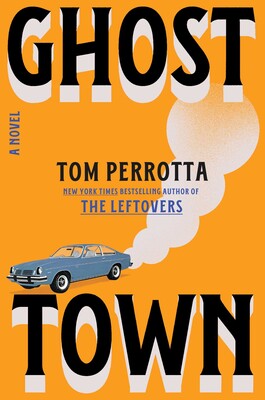
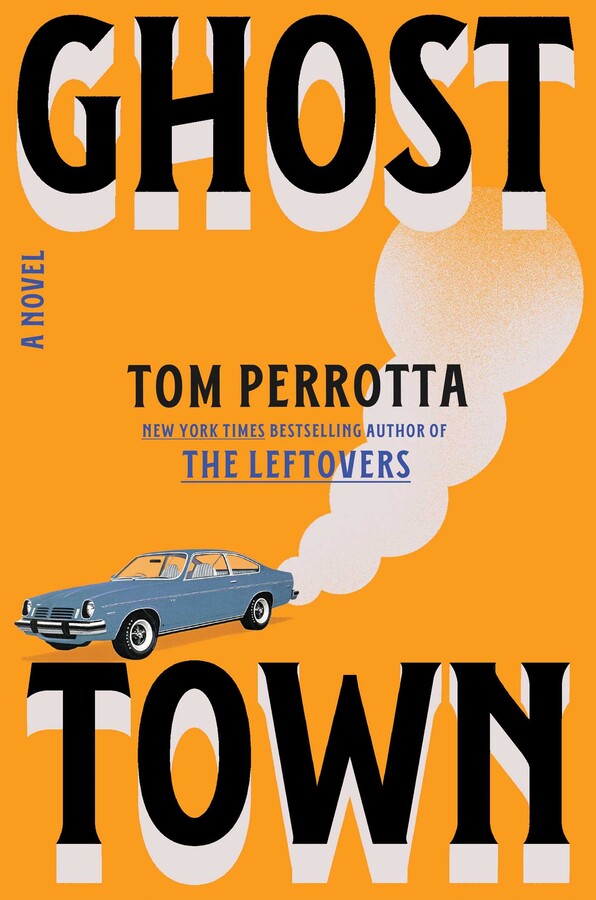
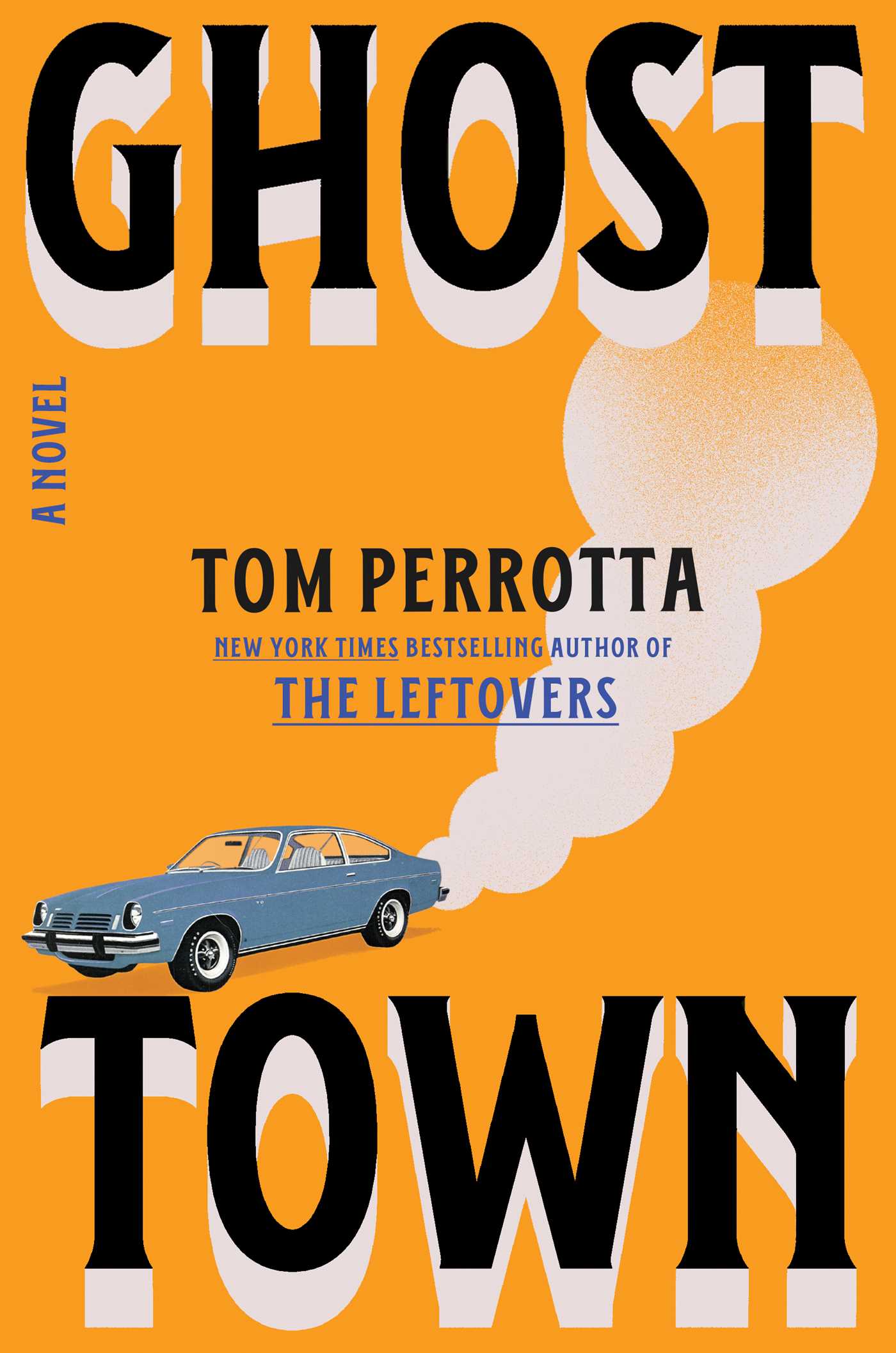
A gripping and darkly nostalgic tale, “Perrotta at his finest” (Ron Charles), about a tumultuous summer in 1970s suburban New Jersey, from the perspective of a middle-aged writer looking back on a series of events that changed his life—and the story he finally has the courage to tell.
Jimmy Perrini lives in 1970s suburban New Jersey, a few miles from Manhattan, but a world apart. At the end of eighth grade, after tragedy strikes, Jimmy finds himself lost in a fog of grief that alienates him from friends and family, drifting instead into troubling friendships with two older teenagers: one a notorious local burnout with a fast car, an endless supply of weed, and a shaky grasp of reality; the other a smart, eccentric girl, whom Jimmy finds himself drawn to as they become entranced by her Ouija board, which may just offer the only salve to their grief.
As a fateful public drama unfolds, Jimmy is torn between the occult beyond and the cold realities of the place he has called home. Narrated by a much older Jimmy, a literary-turned-commercial novelist, Ghost Town is an “emotional wallop [that] nails the restless ennui of adolescence” (People), revealing how the past haunts the present and the way our ghosts are always with us, even when we think we’ve left them behind.
Appearances
AUG 22
6:00PM
In Person
National Book Festival
Washington Convention Center
Washington, DC 20001
Reading Group Guide
Join our mailing list!
Simon ❤ Indies is full of valuable information for indie booksellers and buyers (both Children's and Adult), including:
The story begins with Jimmy Perrini receiving an email invitation to return to his childhood home of Creamwood, New Jersey, to honor his late father’s memory with the naming of a new municipal building for him. While the message disturbs Jimmy, it causes him to reflect on that fateful summer of 1974 and the “bad memories” of his hometown that he had locked away. How does Jimmy’s attitude about his hometown, and his hesitation to return, set up the novel for what took place for him that summer?
The community considers the Perrini family to be a respectable, “normal” one, and “Normal families were the glue that held the world together.” And yet, the narrator questions his family’s personal dynamic, his unreliable memory, and the town’s morals. How does the novel challenge the ideas of what’s normal and play with memory throughout the story? How does Jimmy’s unreliable childhood memory establish the tone of uncertainty and foreshadow something menacing beneath the surface? What moments reflect this in the story?
Discuss Creamwood’s history and what the town was like in 1974. Who were some of its prominent residents and what was the town’s culture? How has the town changed when Jimmy visits as an adult?
At Jimmy’s mother’s funeral, the first of many “ghosts” in the story are revealed, several of whom play a key part in reflecting Jimmy’s feelings at the time. How do spirits and ghosts operate in this novel? Do you think they’re real or fictional to the characters?
Who is Eddie Fitzpatrick? What is Eddie’s reputation in town and why does Jimmy wonder if the summer of ’74 would have been different if he hadn’t gotten into Eddie’s Chevy Vega?
Mr. Kazmierski, or Kaz, is described as an easygoing and fun teacher whose only quirk is being a stickler for the Pledge of Allegiance and his vocal patriotism. But how does this description of him differ from the man we see later in the novel, his actions, and his beliefs? What hints are there in the story that signify his darker side? Name some of the other characters who are described one way, then show contradictory behavior when their belief systems are challenged.
How does each Perrini family member manage grief? How do their individual actions widen their interpersonal relationships in 1974 and later when Jimmy is an adult?
Think about Jimmy and Olivia. How does Jimmy’s connection with the Ouija board and his relationship with Olivia reflect his inner state? What does Jimmy hope to gain from trying to communicate with the dead—and does he succeed? And how does Olivia’s interest in the supernatural reflect her own stress?
How do the older teenagers, such as the camp counselors Eddie and Leonard, function in Jimmy’s life as mentors, enablers, dangers, stand-ins for adults, or distractions from his reality?
Reflect on the moments in the novel where we jump forward in time to Jimmy’s adulthood. How does Jimmy view his writing career? How does his rewrite of his “commercial” novel for monetary gain speak to the themes of this story and Jimmy’s childhood summer of 1974?
What is Shirley, the manager of a McDonald’s, relationship to Leonard and how does Jimmy’s interaction with them both test his relationship with Eddie, and what does it say about his character?
What happens when Jimmy spends an evening with Olivia for the first time? What about the last time? What do we learn about Jimmy and Olivia from these events and how do they both grow and process their individual childhood grief over the course of their relationship?
Who are Wayne, Nilda, Hector, and Yvette? Discuss the scene at the Jade Palace and what takes place there with Kaz. How does this scene tie into the fire at Wayne and Nilda’s house, with the town gathered around “like a block party.” Who and what do you think started the fire?
Adult Jimmy states that he went back to Creamwood for himself. That’s the dream, right? To look at yourself and be at peace with the person you were and the person you’ve become. The things you were stuck with and the things you got to choose. You can’t just erase the parts you don’t like or hide from the ones that scare you or make you feel ashamed. I wanted to be whole again. Does Jimmy’s visit to his hometown make him whole by the end of the novel? Why or why not?
How does Tom Perrotta comment on the legacy of whitewashing in communities across America during the 1970s? How does that combine with the idea that the ghosts of our past are always with us, even when we think we’ve left them behind? How do these themes reflect the American political climate of today’s times?
Enhance your book club
As a group, read Tom Perrotta’s past works such as Election, Tracy Flick Can’t Win, Mrs. Fletcher, and others. How does Ghost Town compare to other Perrotta novels in its treatment of adolescence, memory, and longing?
As a book club, discuss each member’s childhood hometown. What did the town believe in and what were some of its biggest rumors or darkest secrets? Then, discuss with each member if their perception of their hometown has changed (or not) from their adult perspective.
Pick up a Ouija board with your group or a friend and try to communicate with the afterlife.*
*Scribner Books is not responsible for any spirits, ghosts, or otherworldly visions that may occur during your session. Your mileage may vary.
Tom Perrotta is the author of eleven works of fiction, including Election and Little Children, both of which were made into Oscar-nominated films, and The Leftovers and Mrs. Fletcher, which were adapted into acclaimed HBO series. His new novel is Ghost Town.
"This is Perrotta at his finest, working in that cramped space between crying and laughing. ...The ending is an absolute wallop, a tragedy hidden in the grass so subtly that no adolescent could have seen it coming, and no adult could ever survive it intact." —Ron Charles
"A writer returns to his hometown for an awards ceremony and revisits the year his mother died and the tragedies that followed. Perrotta packs an emotional wallop and nails the restless ennui of adolescence during a suburban summer ca. 1973, while evoking the scent of Coppertone and cigarette smoke." —People Magazine
"The brisk, resonant Ghost Town might be Perrotta’s best book. I’ve enjoyed all of his novels, but it feels like he has pared this one down to its essence, which is beautiful and true: how we stay connected to the people we’ve lost and how we learn to move on." —Chris Hewitt, Minnesota Star-Tribune
"Stellar…Perrotta is a confident storyteller, and he packs a great deal of heart into this tale of moving forward amid crushing grief, in which a writer finally gets a chance to exorcise 'the demons you think you’ve outrun.' This is sure to resonate with Perrotta’s longtime fans and win him new ones." —Publishers Weekly, STARRED Review
"An atmospheric elegy to innocence lost… melancholy, moving, dark, redolent with regret and loss. His sharp characterizations and social observations serve to bemuse rather than amuse this time, but as he builds to a shocking climax, it turns out he’s just as good at that." —Kirkus Reviews
One of LitHub's Most Anticipated Books of 2026
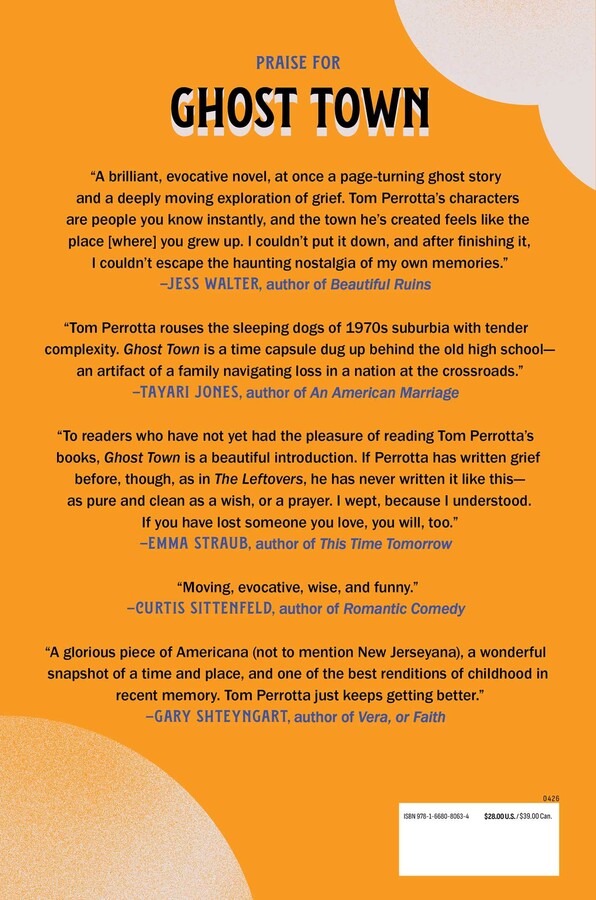
"Tom Perrotta rouses the sleeping dogs of 1970s suburbia with tender complexity. Ghost Town is a time capsule dug up behind the old high school—an artifact of a family navigating loss in a nation at the crossroads.” —Tayari Jones, author of AnAmerican Marriage
"To readers who have not yet had the pleasure of reading Tom Perrotta's books, Ghost Town is a beautiful introduction. If Perrotta has written grief before, though, as in The Leftovers, he has never written it like this—as pure and clean as a wish, or a prayer. I wept, because I understood. If you have lost someone you love, you will, too." —Emma Straub, author of This Time Tomorrow
"Ghost Town is a brilliant, evocative novel, at once a page-turning ghost story, and a deeply moving exploration of grief. Tom Perrotta's characters are people you know instantly, and the town he’s created feels like the place you grew up. I couldn’t put it down and after finishing it, I couldn’t escape the haunting nostalgia of my own memories." —Jess Walter, author of Beautiful Ruins
"Ghost Town is a glorious piece of Americana (not to mention New Jerseyana), a wonderful snapshot of a time and place and one of the best renditions of childhood in recent memory. Tom Perrotta just keeps getting better." —Gary Shteyngart, author of Vera, or Faith
"I love the sense of constant presence and interplay of time/timelessness in Tom Perrotta’s gorgeous new novel. Ghost Town is a wise, funny, bittersweet testament to the fact that ghosts live in us and with us, always." —Jayne Anne Phillips, Pulitzer Prize-winning author of Night Watch
"Ghost Town [is] moving, evocative, wise and funny." —Curtis Sittenfeld, author of Romantic Comedy