Named One of TheNew York Times Book Review’s Top Ten Books of the Year Winner of the National Book Critics Circle Award for Autobiography | Finalist for the Kirkus Prize | Nominated for the Women's Prize for Nonfiction
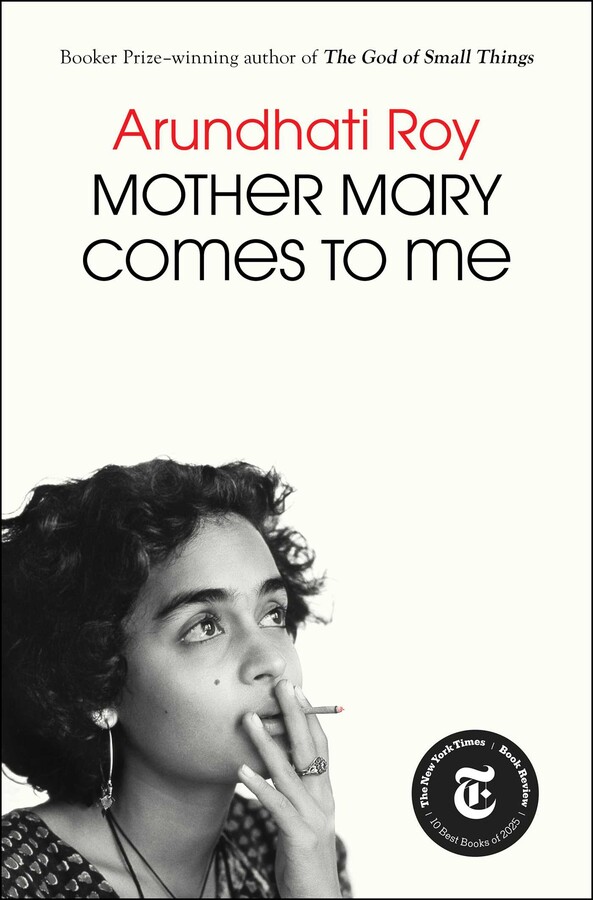
One of the best-reviewed books of the year, a raw and deeply moving memoir that “pulses with compassion and moral outrage” (The Wall Street Journal) from the legendary author of The God of Small Things and The Ministry of Utmost Happiness that traces her complex relationship with her mother, Mary Roy, a fierce and formidable force who shaped Arundhati’s life both as a woman and a writer.
“Heart-smashed” by the death of the mother she ran from at age eighteen and shaken by the intensity of her response, Arundhati Roy began this remarkable memoir—a soaring account, both intimate and inspiring, of how the author became the person and the writer she is: shaped by circumstance but above all by her relationship to her extraordinary, singular mother Mary, who she describes as “my shelter and my storm.”
With the scale, sweep, and depth of her novels, and the passion, political clarity, and warmth of her essays, Mother Mary Comes to Me is an ode to freedom, a tribute to thorny love and savage grace—a memoir like no other.
Reading Group Guide
Join our mailing list! Simon ❤ Indies is full of valuable information for indie booksellers and buyers (both Children's and Adult), including:
This reading group guide for Mother Mary Comes to Me includes an introduction, discussion questions, and ideas for enhancing your book club. The suggested questions are intended to help your reading group find new and interesting angles and topics for your discussion. We hope that these ideas will enrich your conversation and increase your enjoyment of the book.
Introduction
A heart-wrenching, beautiful memoir, Mother Mary Comes to Me follows the contours of Arundhati Roy’s life, mapping her extraordinary experiences with humor, gravity, and grace. From her upbringing in Kerala to her young adulthood in Delhi in the seventies to her meteoric rise on the global stage and her searing political writing, Roy details her unlikely path through tumultuous decades of Indian politics, her own creative pursuits in a variety of mediums, but, most of all, her fraught, impossibly intricate relationship with her mother, an icon in her own right, Mary Roy.
Written in the wake of Mary’s death in September 2022, this account helped Roy process the complexity of her feelings toward her mother, whom she describes as “my shelter and my storm.” As vivid and breathtaking as her novels, and with the acuity and conviction of her essays, Mother Mary Comes to Me is a stunning chronicle and testament to the power of memoir.
Topics & Questions for Discussion
In the opening pages, Roy writes: “I have thought of my own life as a footnote to the things that really matter . . . Maybe I pitched my tent where the wind blows strongest hoping it would blow my heart clean out of my body. Perhaps what I am about to write is a betrayal of my younger self by the person I have become” (3). In these lines, Roy names some of the ways she’s tried to understand herself: as a footnote; as the unwitting owner of a heart; as a betrayer of a younger version of herself that she was forced to leave behind in order to live. What is the tone of these descriptions of herself? What effect did they have on you?
The God of Small Things, Roy’s debut novel and a critical and bestselling phenomenon, is referenced often in the first few chapters, as the novel hews closely to Roy’s own life. She notes that the dedication page she wrote for the novel contains “a lie. A good one. I crafted it—‘she loved me enough to let me go’ . . . [Mrs. Roy] quoted it often, as though it were God’s truth” (4). But, Roy admits, the actual truth is that “I left my mother . . . to be able to continue to love her. Staying would have made that impossible.” Consider these two statements—what is the difference between them?
At the end of the first chapter, Roy credits her lifelong pursuit of understanding her mother as the thing that made her a writer—and notes that “perhaps even more than a daughter mourning the passing of her mother, I mourn her as a writer who has lost her most enthralling subject” (7). What is the difference between mourning someone as a daughter and as a writer? What is the difference between mourning a mother and a subject?
The symbol of “a cold, furry moth on a frightened heart . . . my constant companion” (22) recurs throughout the book. What does this moth symbolize? What effect does it have on Roy throughout her life? Can you point to some examples in the text?
Discuss how the dynamics of the family shifted after Mary founded her school. What existing dynamics did the school exacerbate, and to what extent did it usher in new ones?
As much as this memoir is about how Arundhati Roy became who she is today, it’s also about how Mary Roy became a legendary figure in her own right—from a struggling single mother to a trailblazing figure known throughout the country. What was her impact? Why does Roy describe it as “revolutionary” (34)? And at what cost did all these achievements come?
Revisit pages 38–39. Discuss Mrs. Roy’s treatment of LKC and how it impacted Arundhati’s ideas of feminism from an early age, “fill[ing] it with caveats” (38). Roy writes, “My brother and I grew up in the cleft between that syrupy dream and our capricious nightmare, not always knowing which was worse. On balance, if we had to choose between the two, I think I’d choose our nightmare, and he, the dream” (39). What is the dream here, and what is the nightmare?
Choose a few moments from the text in which you can see Roy’s political consciousness and identity forming. What was she exposed to, or not exposed to, in her youth? How did this change through all her phases of adulthood, and what brought about these changes? How do you see this all bearing out in her later work?
Once in Goa, Roy arrives at yet another turning point in her life, and she describes her behavior as “inexplicable” (98). What is she running away from and why? What does she mean when she reflects on the fact that, throughout her life, “the safest place would become the most dangerous” (109)? When else does this happen in the memoir?
Periodically, Roy interrupts the flow of a paragraph with one interjection: Lucky. What does this repetition mean to you, and what larger themes does it resonate with? Were there times when you were surprised to find that she considered herself lucky? Do you agree that she has been lucky in her life?
Regarding her aspirations of being a writer, Roy remarks, “As a child, it’s all I ever thought I’d be . . . [but] even then I knew that the language I wrote in was not mine . . . I don’t mean English, Hindi or Malayalam, I mean a writer’s language. Language that I used, not language that used me . . . I knew even then that that language was outside me, not inside me. I knew it would not come to me on its own. I needed to hunt it down like prey.” (125–27). Discuss this passage with the group. What difficulties of language is Roy expressing here? Why did writing fall by the wayside for her—and what conditions allowed her to resume writing?
Before she introduces the reader to her father, Roy notes, “It’s easier for me to write about politics, or to write fiction, than to write what I am about to write. There’s no glory in this. Nor—relatively speaking—any great tragedy. I wonder why I need to make this very private moment public” (142). What does this mean in the context of this scene in particular? How does this notion, the idea of making difficult private moments public, speak to the rest of the memoir?
What led Roy to feel “principled and hypocritical all at once” (220) in the years after she and Pradip inherited the property? She describes two “traps” in the chapter “Things Fall Apart.” What are they, and why do they feel like traps to her?
What distinction does Roy make between writers and activists, and why does she find the term “writer-activist” absurd? How does she define what a writer’s role is in society?
Roy describes the rise of Hindu nationalism and the BJP in India in tandem with the events of her own life. What effect did this have on you as a reader? Why was it important to Roy to give a strong sense of her political-social environment in the memoir?
Roy worked on The Ministry of Utmost Happiness for a decade, and in that time also wrote some of her most potent and contentious nonfiction, and as a result was hounded by threats of imprisonment, which have followed her throughout her life. At what points did her fiction writing and her nonfiction writing interrupt each other and why?
Reflect on the final chapter of the book. How has Roy’s relationship with her mother changed? How has it stayed the same? What is Mary Roy’s legacy?
Enhance Your Book Club
On page 66, Arundhati gets her first sense of how a stranger, someone outside of Mary Roy’s “cult,” sees her, offering her a way of seeing her mother outside of her cult of personality. This both affirms her worldview and turns it upside down. Think about a time when your own sense of your world and how you grew up was shaken like this, and discuss.
Referring to The God of Small Things, Roy writes, “My cold moth asked if she could be in the book. I told her she most certainly could” (187). Name a few moments where you see echoes of Mother Mary Comes to Me in The God of Small Things. Where does the moth appear? Where and how does the author’s family appear? Do certain lines or scenes resonate or even repeat between the two texts?
Watch In Which Annie Gives It Those Ones. How does the School of Planning and Architecture and the student culture that Roy describes during her years there match up with the film? What do you observe atmospherically about the Delhi of the 1970s? Does anything surprise you?
Arundhati Roy is the author of The God of Small Things, which won the Booker Prize in 1997, and The Ministry of Utmost Happiness, which has been translated into more than forty languages and was longlisted for the Booker Prize. Roy has also published several works of nonfiction, including Azadi, The Algebra of Infinite Justice, Field Notes on Democracy: Listening to Grasshoppers, and Broken Republic. In 2023, she was awarded the prestigious European Essay Prize for lifetime achievement, and in 2024, the PEN Pinter Prize for telling “urgent stories of injustice with wit and beauty.” She lives in Delhi.
Winner of the National Book Critics Circle Award in Autobiography Shortlisted for the Women's Prize in Non-Fiction A New York Times Notable Book of 2025 Finalist for the Barnes & Noble Book of the Year
Named a Best Book of the Year by the New York Times, the New Yorker, Time Magazine, The Guardian, NPR, TIME Magazine, LitHub, The Economist, Elle Magazine, BookRiot, Mother Jones, BookPage, Booklist, Minnesota Star Tribune, Apple Books, Amazon, The Times (UK) and the Independent (UK)
"[Roy] channels warmth, moral clarity and a sweeping bird’s-eye view of modern India to tell her life story, which was shaped by poverty, violence, political upheaval and—most of all—the volatile single mother who raised her." —The New York Times
"Tender...full of precise imagery and blistering emotional intelligence." —The Washington Post
"An electrifying look at the author’s career and activism." —People Magazine
"This book pulses with compassion and moral outrage…Ms. Roy acknowledges that her difficult mother shaped the free-spirited, headstrong, risk-taking writer she became…It’s clear from this memoir that while Ms. Roy has lost her chief adversary, she hasn’t lost her fire." —The Wall Street Journal
"Writers have the ability to tell stories that create the world we want to live in...With every book, every essay, every speech, Roy builds worlds that are revolutionary, made from the darkness that she spins into purpose." —The New Republic
"The first memoir from Roy details her come-up as a writer, but it’s as much a biography of her complicated, compelling single mother, Mary…fascinating." —New York Magazine
"The book has the lyricism of Gabriel García Márquez, the political sweep of Barbara Kingsolver, and the antic family humor of David Sedaris." —Financial Times
"The prizewinning novelist’s unsparing memoir, Mother Mary Comes to Me, captures the eventful life and times of her mother, a driven educator and imperfect inspiration." —The New York Times Book Review
"Cinematic…dense with the lyrical language, deep empathy and fierce social critique that have made Roy’s novels international bestsellers…a masterpiece of memoir writing, a rich tapestry of memory, reckoning and longing." —Minneapolis Star Tribune
"In electrifying, intimate prose, Roy’s first memoir traces her complex relationship with her mother, Mary and how it shaped the person—and writer—she ultimately became." —The Millions
"Roy turns inward to reflect on a complicated relationship with her late mother, herself an activist, whose barbed love of Roy and her brother could by turns sustain and devastate." —NPR.org
"The first memoir from legendary novelist Arundhati Roy tackles her complicated, fascinating relationship with her mother and how it shaped almost every part of her life." —Town & Country
"Booker Prize–winning Indian novelist Arundhati Roy recounts a life of poverty and upheaval, defiance and triumph in an emotionally raw memoir, centered on her complicated relationship with her mother...Her candid memoir revives both an extraordinary woman and the tangled complexities of filial love. An intimate, stirring chronicle." —Kirkus Reviews (starred review)
Praise for Arundhati Roy
"The world has never had to face such global confusion. Only in facing it can we make sense of what we have to do. And this is precisely what Arundhati Roy does. She makes sense of what we have to do. Thereby offering an example. An example of what? Of being fully alive in our world, such as it is, and of getting close to and listening to those for whom this world has become intolerable." —John Berger
"Arundhati Roy is one of the most confident and original thinkers of our time." —Naomi Klein
"Arundhati Roy calls for ‘factual precision’ alongside of the ‘real precision of poetry.’ Remarkably, she combines those achievements to a degree that few can hope to approach." —Noam Chomsky
"Arundhati Roy combines her brilliant style as a novelist with her powerful commitment to social justice in producing these eloquent, penetrating essays." —Howard Zinn
"Arundhati Roy is one of the few great revolutionary intellectuals in our time … courageous, visionary, and erudite." —Cornel West
"Her incomparable divining rod picks up the cries of the despised and the oppressed in the most remote corners of the globe; it even picks up the cries of rivers and fish. With an unfailing charm and wit that makes her writing constantly enlivening to read, her analysis of our grotesque world is savagely clear, and yet her anger never obscures her awareness that beauty, joy, and pleasure can potentially be part of the life of human beings." —Wallace Shawn
"[Roy is] an electrifying political essayist. . . . So fluent is her prose, so keen her understanding of global politics, and so resonant her objections to nuclear weapons … that her essays are as uplifting as they are galvanizing." —Booklist
"The scale of what Roy surveys is staggering. Her pointed indictment is devastating." —New York Times Book Review