Chapter One
Sak Yant
The Spiritual Hallmark of Sacred Mastery
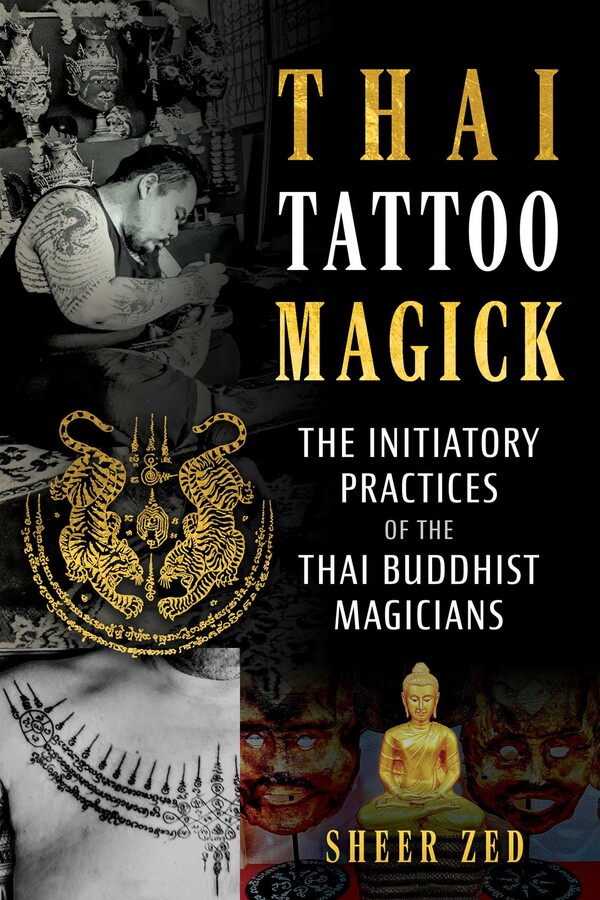
Spirituality founded on materialism is ultimately devoid of meaning. Likewise, there is a huge difference between “spiritual tourism” and meaningful pilgrimage. Preparation, contemplation, and meditation are essential prerequisites for any successful pilgrimage abroad. When entering a new, alien, and unknown environment, one must do their best to be sincere, flexible, and undemanding rather than stubborn. For me, Sak Yant is not just a “spiritual tattoo” and—despite the undeniable esoteric charm, gravity and magnetism they exude—is not just a “souvenir” or ordinary road-side tattoo. The sublime living spirits inherent to Buddhist magick actively inhabit the countless myriad forms of Sak Yant. My encounter, engagement, and full immersion into Thai Theravāda Buddhism is characterized by what can only be described as a predestined affinity, a journey over a long and serpentine pathway in which I explored many other variants of this profound philosophy.
To place undue limitations and definitions upon the forms that are known as Sak Yant would be of course to reduce its exquisite and pristine essence. Sak Yant is definitely a commitment to living in a very specific manner. The fine print requires one to uphold certain values that reflect the magickal components of this deliberately constructed tattooed spell. Irrespective of whether the monk or Ajarn is more than happy to accommodate Westerners in its application, it is extremely important to understand that Sak Yant is an ancient animist, faith-based, shamanic, cosmic, and ultimately Buddhist magickal spell that will profoundly alter one’s mind and psyche. Equipping oneself with a basic working understanding and knowledge of Thai Buddhism and animism (which have evolved alongside each other and in tandem with many other esoteric practices) before plowing headlong into acquiring a Sak Yant tattoo, is to demonstrate the basic respect required in order to properly receive such a powerful form of magick. Unthinkingly scouring the internet or books for designs to match one’s personal, ego-driven urges, much in the way one might shop for new clothes, is not a good idea. However, meditating upon messages and signs that arise while in meditative absorption or contemplation is heartily encouraged. If your own deep intuitive impulses lead you to a very specific design this means that this particular design is calling you. I encourage seekers to find an Ajarn to assist them.
An Ajarn is a Thai language term, which translates as “professor” or “teacher.” It is derived from the Pali word acariya, and is a term of respect, similar in meaning to the Japanese sensei. Personally, I liken the term Ajarn to “magician.” This is because Ajarns can perform Sak Yant rituals, magickal rituals, blocking spells; create amulets and Pha Yants (magickal hanging cloth); and bless all manner of situations and occasions. The experienced Sak Yant practitioner has absorbed and memorized whole sets of scripts and yantra in ancient languages such as Khom, Pali, Lanna, Tai Yai, Old Mon, and Burmese.
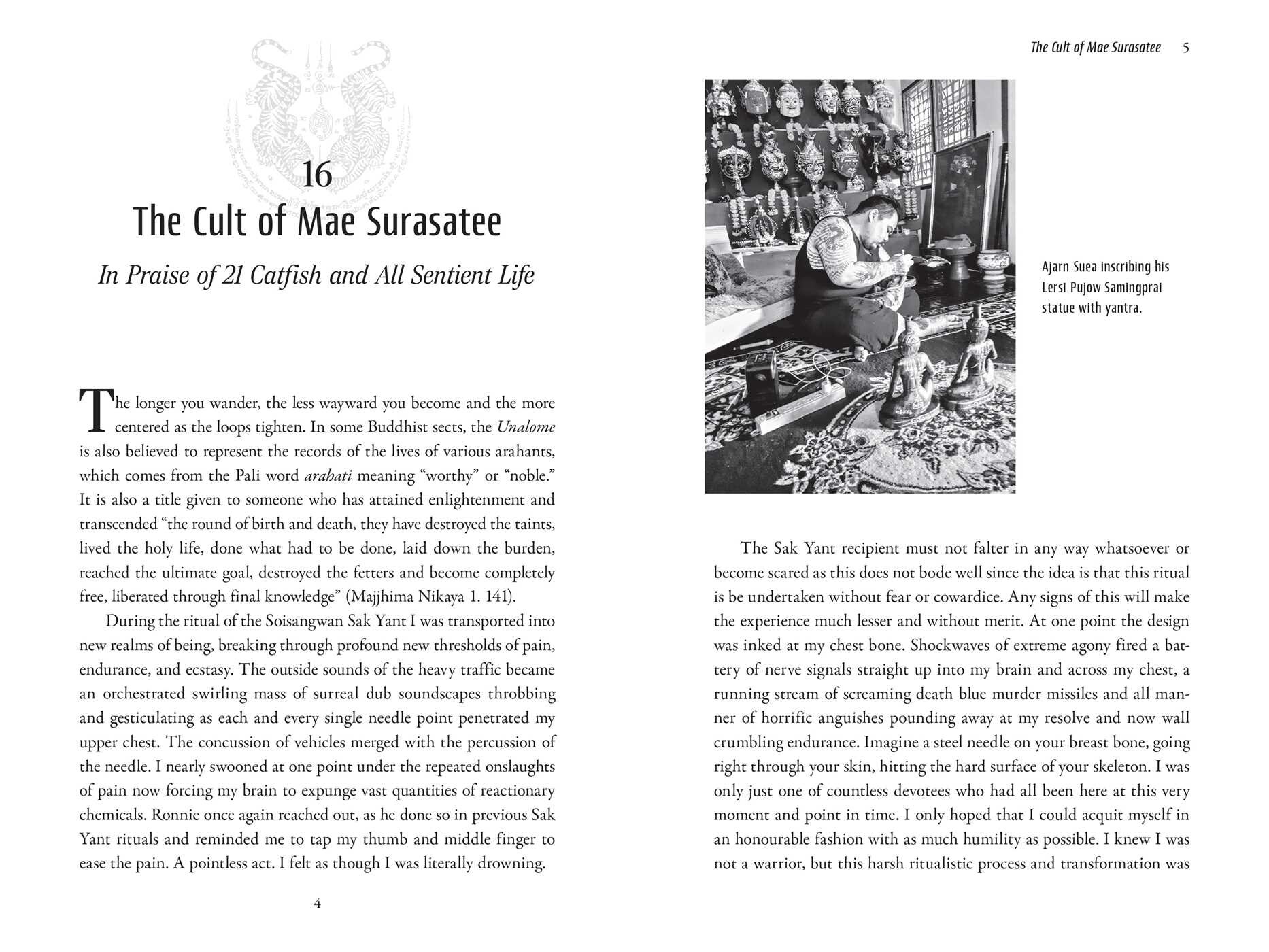
Abstract, mystical designs resembling yantra initially birthed themselves during early Indian history in the Harappan Culture Civilization, an Indus Valley Bronze Age civilization in the northwestern regions of South Asia (3300 BCE to 1300 BCE). Then, through subsequent cosmic symbolistic evolutions in Vedic (c. 2000 BCE) and later tantric renaissance (700 CE to 1200 CE), they eventually migrated from India into Southeast Asia. The yantra of the ancient sacred geometry of the Vedic Brahman tradition, considerably older than Thai Buddhist yantra, encountered numerous influences, and, while still being an integral and essential part of the spiritual landscape for centuries, yantra underwent its own very unique evolutionary reinterpretation in Southeast Asia. References to sacred tattoos date back to second-century Chinese records of the Cambodian Funan Kingdom located around the Mekong Delta from the first to seventh centuries. It is widely accepted however that the Cambodian tattoo tradition can be traced back to northern Thailand. In the fourth century CE, Chinese records refer to the tattooed P’u people on their southern borders as wearing “skin garments.” I was blessed to have spiritual guidance via the visions of Ajarn Suea, who, on two occasions—and much like a doctor prescribing medicine to a patient—saw (or “diagnosed”) specific Sak Yant designs for my body.
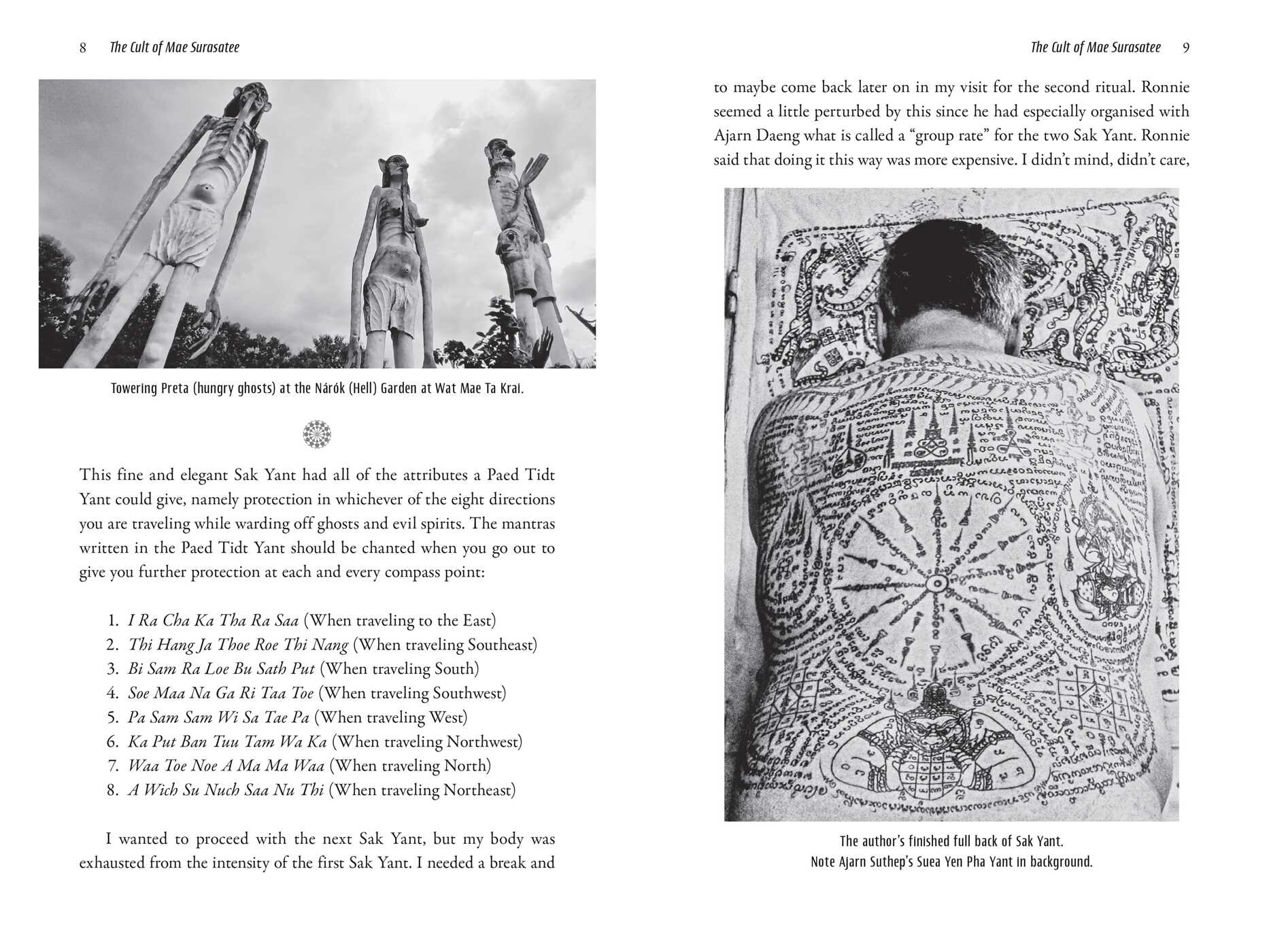
One would not be remiss to view Sak Yant design as a piece of magickal software written onto the hardware of the human body. After all, they rewrite the mind, body, and spirit of the person that wears them. Sak Yant should not however be viewed as a security patch. These are extremely potent, active talismans, each one a rock-solid and powerful piece of yantra firmware that fundamentally changes those that have it implemented onto their body. Certain Sak Yant designs such as tiger (Suea Yen) and Hanuman cannot be worn by just anyone. The devotee must be able to control these Sak Yant. Much like driving a fast, high-powered vehicle that one does not know how to properly control, Sak Yants can prove fatal if not managed and handled correctly by those that hold them upon their body. Yes, it is possible for anyone to get a Sak Yant; as of the writing of this book, there is no bar whatsoever as to who can obtain one. And yet, the consequences of allowing these designed yantra spells to take residence upon your body without proper understanding or knowledge range far and wide. Being unaware of the religious and cultural sensitivities of the unknown places you visit for the first time is not advisable and can even ultimately end in your arrest and deportation. For example, activating the Sak Yant in the proper manner, requires one to understand and adhere to the basic Buddhist precepts* that surround Sak Yant, which—while I will go into these in more depth later—I will lay them out here as follows:
1. Do not kill
2. Do not steal
3. Do not indulge in sexual misconduct
4. Do not make false speech
5. Do not take intoxicants
The Eight Precepts—of which I hold the eighth—are the first Five Precepts plus three more, which are listed below. The Eight Precepts are observed by nuns, lay Buddhists, and are observed on special days of observance as forms of purification, cleansing, and aiding meditation. In Thailand, if one of the eight is broken, they are all broken.
6. Abstaining from taking food at the wrong time (before noon only)
7. Abstaining from dancing, music, visiting shows, flowers, make-up, the wearing of ornaments and decorations (extremely difficult for me being an amulet-and flower-loving musician!)
8. Abstaining from sleeping in a tall, high sleeping place (I sleep on a ground level futon)
It is important to note that there are invisible karmic wires attached to receiving Sak Yant. Blessings chanted by an Ajarn or monk can incorporate taking refuge in the three jewels of Buddhism namely the Buddha (Siddhartha Gautama, most commonly referred to as the Buddha), the Dharma (The Buddhist path to liberation, referred to as awakening), and the Sangha (a Sanskrit word used in Indian languages, including Pali, meaning “association,” “assembly,” ”company,” or “community”). The initiatory chanting of the three jewels of Buddhism is viewed by some as a ritual facilitating one’s formal conversion to Buddhism. Do the countless waves of tattoo-hungry Westerners flooding into Thailand to acquire Sak Yant understand that they are converting to Buddhism when they receive a Sak Yant? Maybe. Maybe not. Either way, don’t assume that leading the life of a dissolute Westerner (of which I counted myself as one before encountering the Ajarns of northern Thailand in 2017) in any way excuses you from a duty to uphold the Five basic Precepts necessary to maintain the efficacy of your Sak Yant.
If you do not uphold the precepts, your Sak Yant will fail to work as it should. However, on the other hand—in my personal experience—upholding the precepts guarantees results that are nothing less than magick. Some say that upholding the Buddhist precepts makes Sak Yant “superstitiously effective.” I find use of the word superstitious here to be dismissive and therefore urge caution in its use. In Thailand, what many Westerners would label “superstition” is in fact a deeply embedded part of Thai tradition, heritage, and cultural landscape. The earliest known use of the word superstition in the West as a noun can be found in the work of early Romans such as playwright Plautus, poet and writer Ennius, and lastly, the author Pliny, who refers to it as the art of divination, namely “divinatory practice.” From the first century CE we are given another meaning, which is to “practice outside official religion.”