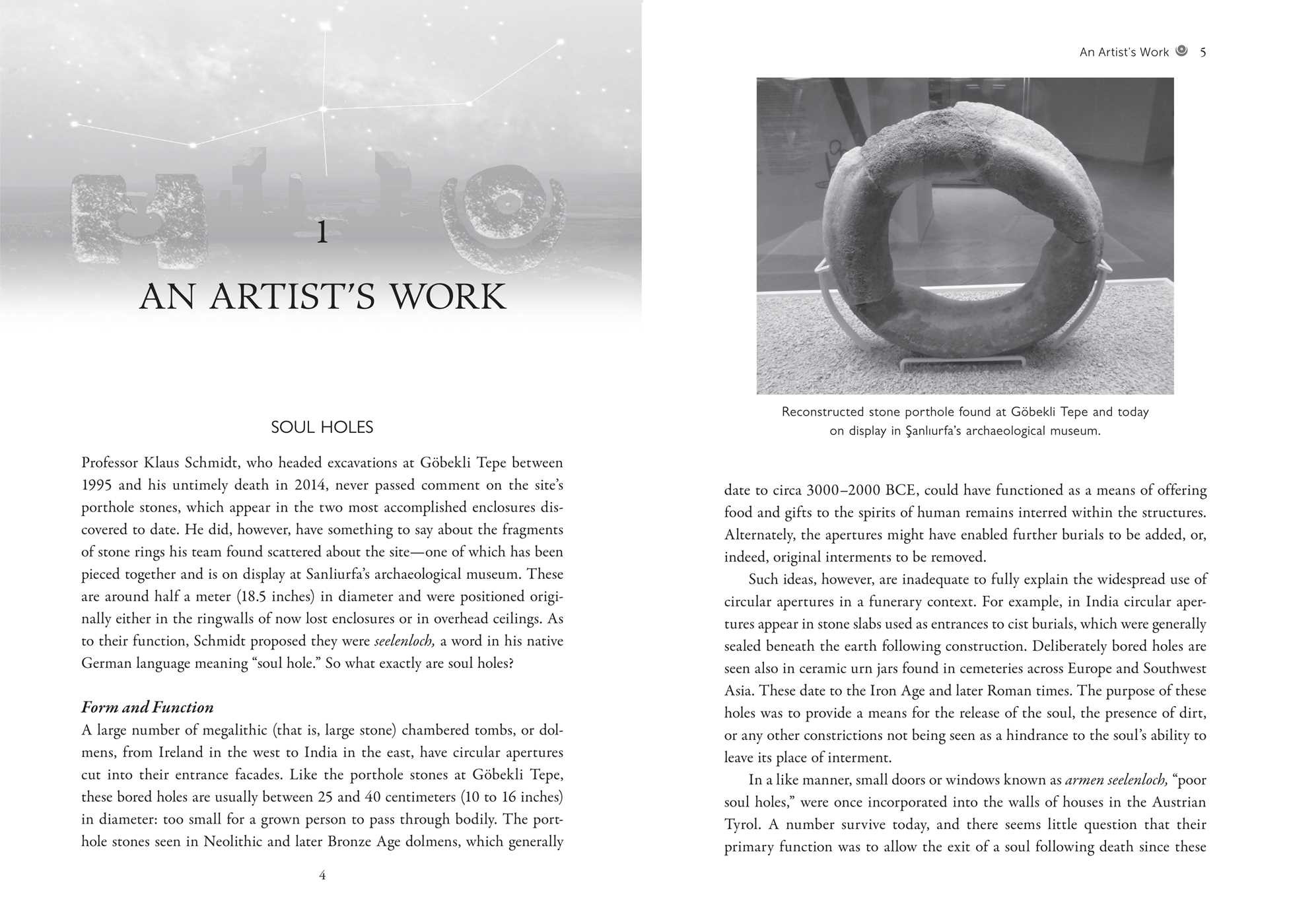
Chapter 1
An Artist’s Work
Soul Holes
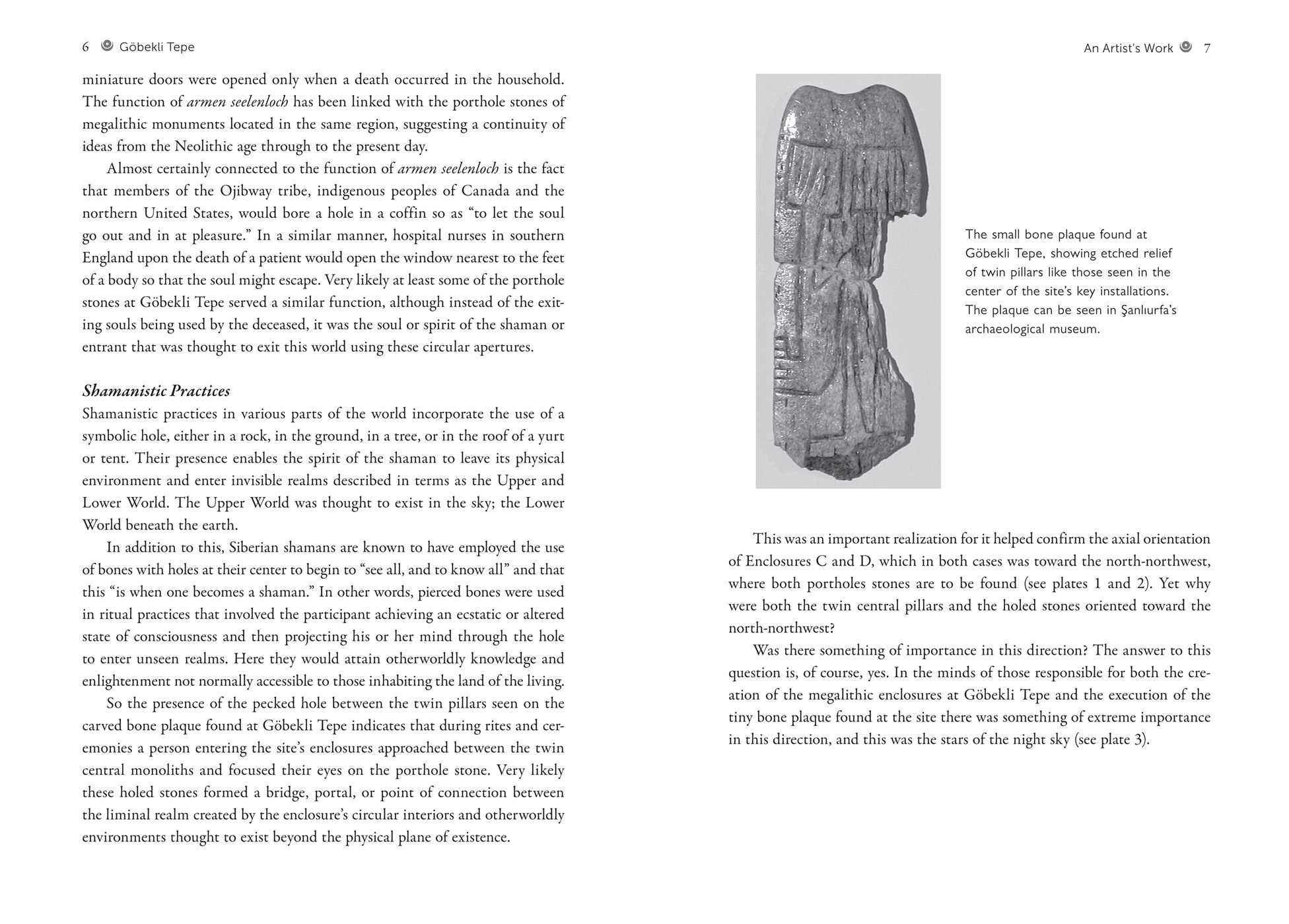
Professor Klaus Schmidt, who headed excavations at Göbekli Tepe between 1995 and his untimely death in 2014, never passed comment on the site’s porthole stones, which appear in the two most accomplished enclosures discovered to date. He did, however, have something to say about the fragments of stone rings his team found scattered about the site--one of which has been pieced together and is on display at Sanliurfa’s archaeological museum. These are around half a meter (18.5 inches) in diameter and were positioned originally either in the ringwalls of now lost enclosures or in overhead ceilings. As to their function, Schmidt proposed they were seelenloch, a word in his native German language meaning “soul hole.” So what exactly are soul holes?
Form and Function
A large number of megalithic (that is, large stone) chambered tombs, or dolmens, from Ireland in the west to India in the east, have circular apertures cut into their entrance facades. Like the porthole stones at Göbekli Tepe, these bored holes are usually between 25 and 40 centimeters (10 to 16 inches) in diameter: too small for a grown person to pass through bodily. The porthole stones seen in Neolithic and later Bronze Age dolmens, which generally date to circa 3000–2000 BCE, could have functioned as a means of offering food and gifts to the spirits of human remains interred within the structures. Alternately, the apertures might have enabled further burials to be added, or, indeed, original interments to be removed.
Such ideas, however, are inadequate to fully explain the widespread use of circular apertures in a funerary context. For example, in India circular apertures appear in stone slabs used as entrances to cist burials, which were generally sealed beneath the earth following construction. Deliberately bored holes are seen also in ceramic urn jars found in cemeteries across Europe and Southwest Asia. These date to the Iron Age and later Roman times. The purpose of these holes was to provide a means for the release of the soul, the presence of dirt, or any other constrictions not being seen as a hindrance to the soul’s ability to leave its place of interment.
In a like manner, small doors or windows known as armen seelenloch, “poor soul holes,” were once incorporated into the walls of houses in the Austrian Tyrol. A number survive today, and there seems little question that their primary function was to allow the exit of a soul following death since these miniature doors were opened only when a death occurred in the household. The function of armen seelenloch has been linked with the porthole stones of megalithic monuments located in the same region, suggesting a continuity of ideas from the Neolithic age through to the present day.
Almost certainly connected to the function of armen seelenloch is the fact that members of the Ojibway tribe, indigenous peoples of Canada and the northern United States, would bore a hole in a coffin so as “to let the soul go out and in at pleasure.” In a similar manner, hospital nurses in southern England upon the death of a patient would open the window nearest to the feet of a body so that the soul might escape. Very likely at least some of the porthole stones at Göbekli Tepe served a similar function, although instead of the exiting souls being used by the deceased, it was the soul or spirit of the shaman or entrant that was thought to exit this world using these circular apertures.
Shamanistic Practices
Shamanistic practices in various parts of the world incorporate the use of a symbolic hole, either in a rock, in the ground, in a tree, or in the roof of a yurt or tent. Their presence enables the spirit of the shaman to leave its physical environment and enter invisible realms described in terms as the Upper and Lower World. The Upper World was thought to exist in the sky; the Lower World beneath the earth.
In addition to this, Siberian shamans are known to have employed the use of bones with holes at their center to begin to “see all, and to know all” and that this “is when one becomes a shaman.” In other words, pierced bones were used in ritual practices that involved the participant achieving an ecstatic or altered state of consciousness and then projecting his or her mind through the hole to enter unseen realms. Here they would attain otherworldly knowledge and enlightenment not normally accessible to those inhabiting the land of the living.
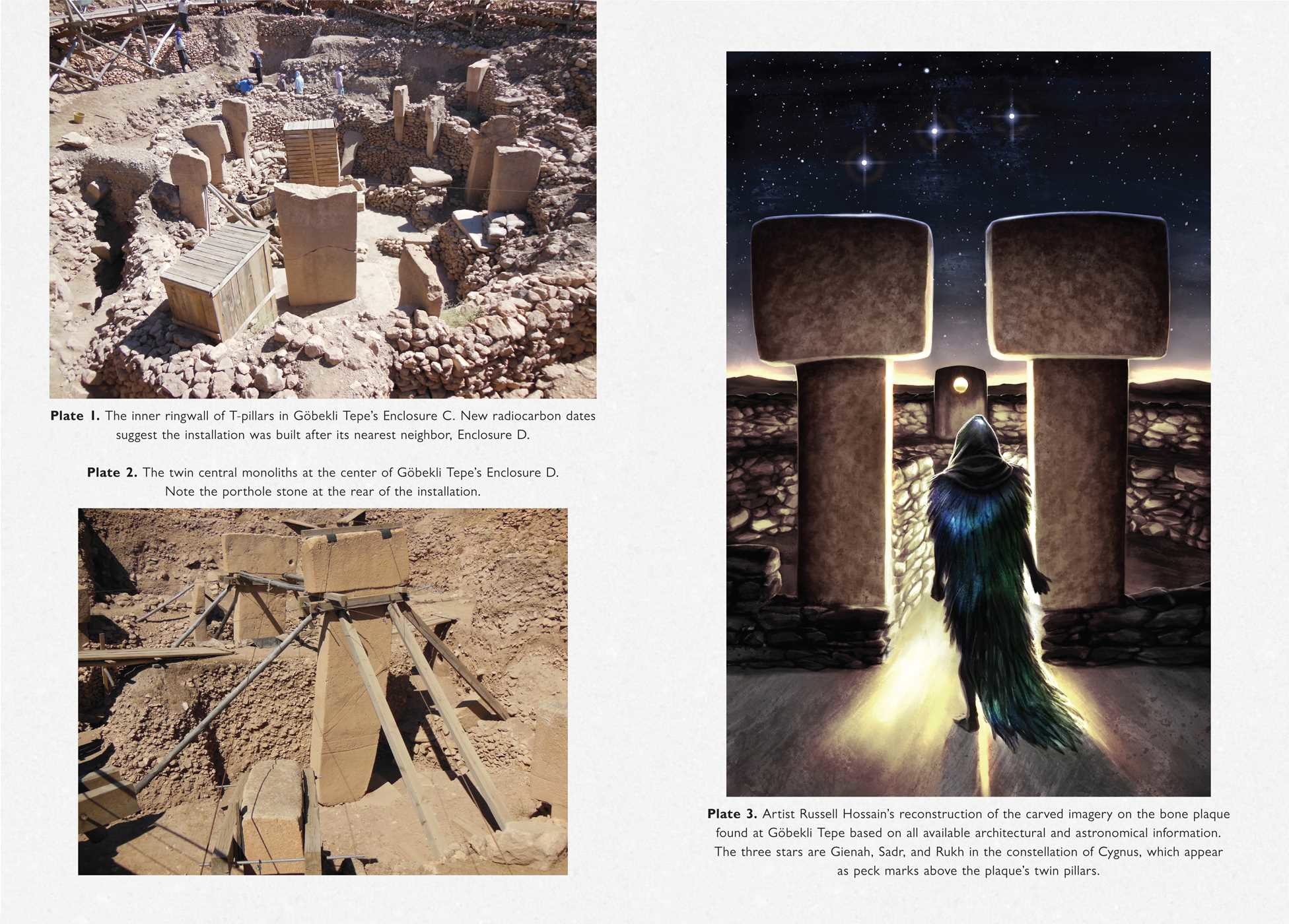
So the presence of the pecked hole between the twin pillars seen on the carved bone plaque found at Göbekli Tepe indicates that during rites and ceremonies a person entering the site’s enclosures approached between the twin central monoliths and focused their eyes on the porthole stone. Very likely these holed stones formed a bridge, portal, or point of connection between the liminal realm created by the enclosure’s circular interiors and otherworldly environments thought to exist beyond the physical plane of existence.
This was an important realization for it helped confirm the axial orientation of Enclosures C and D, which in both cases was toward the north-northwest, where both portholes stones are to be found. Yet why were both the twin central pillars and the holed stones oriented toward the north-northwest?
Was there something of importance in this direction? The answer to this question is, of course, yes. In the minds of those responsible for both the creation of the megalithic enclosures at Göbekli Tepe and the execution of the tiny bone plaque found at the site there was something of extreme importance in this direction, and this was the stars of the night sky.