1. The Stable Boy THE STABLE BOY
I was the first to see them—perhaps the very first in this country. Marinesha would have been first, but she ran off into the woods while I was still trying to apologize. I never knew the right way to be with Marinesha. Perhaps there was none. I wonder if I would ever have learned.
Of course, I had no business on the road at that hour. It was late, past sunset, and time to bed down the horses. In justice to old Karsh, no one will ever be able to say that he treated an animal unkindly. I would leave the finest, most high-strung horse with him at any time, or a blind, useless, beloved dog, but not a child. My name, as far as I know, is Rosseth, which in our tongue means something not quite worthless, something thrown in to sweeten a bad bargain. Karsh named me.
Marinesha, now. Marinesha means scent of the morning, and I had followed that scent through both our chores all day, teasing and plaguing her—I admit it—until somehow she had half-agreed to meet me after milking by the bee tree. There are no bees there now—they all swarmed long ago—but Marinesha still calls it that. I found this as maddeningly touching as the way her hair goes back from her forehead.
Well, then. I swear I had no more than stroked that hair, not even uttered my first fumbling lie (in honesty, I had never expected her to come—she had never kept her word before) when she was gone again, skittering away through the trees like a moth, leaving nothing but her tears in my hands. I was angry at first, and then alarmed: there would be no way of slipping back to the inn before Karsh had noticed my absence, and while that fat man misses with most of his blows, the few that land land hard. So it was that I was still standing in the middle of the road, trying with all my weary wits to think of a story that, in the right mood, Karsh just might choose to believe, when I heard the three horses.
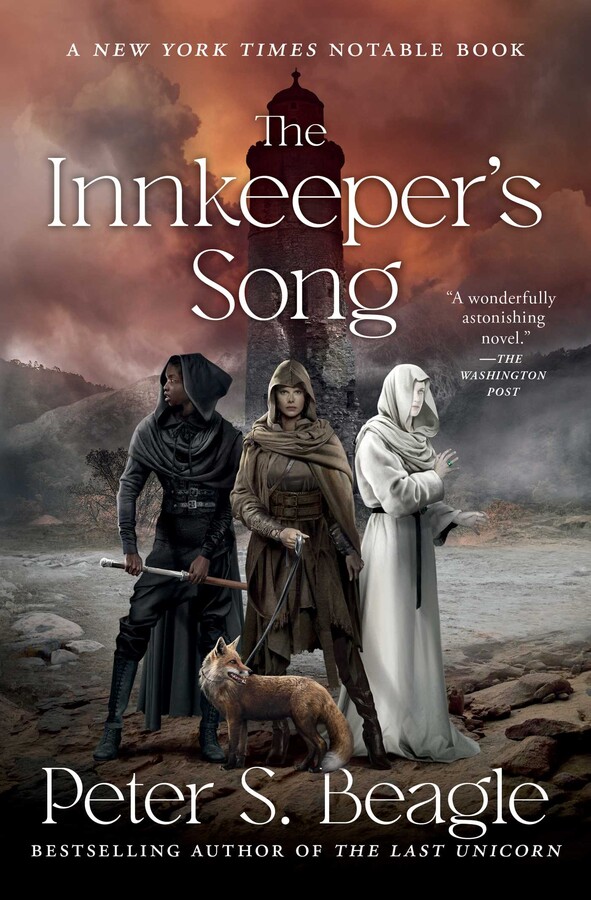
They came around the bend beyond the little spring where no one drinks, three women riding close together. One black, one brown like Marinesha (though not nearly as pretty) and one so pale that to call her “white” has no meaning. Lilies, corpses, ghosts—if these are white, then there must be another word for that woman’s skin. It seemed to me, gaping in the road, that her color was the color of something inside her, some bright, fierce life thumping and burning away with no thought at all for her body, no care or pity for it at all. Her horse was afraid of her.
The black one was a little way in the lead. She drew rein in front of me and sat silent for a moment, considering me out of long, wide eyes. If you could make gold out of smoke, you would have something like the color of those eyes. For my part, I stood like a fool, unable even to close my slack jaws. I know now how different it is elsewhere, but in the country of my birth women do not ride out unescorted, however many they be. And Lal—I learned her full name later, though never how to say it properly—Lal was the first black woman I had ever seen. Black men, yes, often, as traveling merchants and now and than a poet, rhyming for bread in the marketplace, but never a woman. I believed, with most, that there were none.
“Sunlight on your road,” I managed to greet her at last. My voice had changed some years before, but you could never have told it then.
“And on yours,” the black woman answered. I say it in shame and honesty that my mouth fell open again to hear her speak my language. I would have been less astonished if she had barked or flapped her arms and screamed like a hawk. She said, “Boy, is there such a thing as an inn or a tavern in these parts?” Her own voice was low and rough, but even so the words rose and fell with the sound of small waves breaking.
“An inn,” I mumbled, “oh, aye, you mean an inn.” Lal said later that she was certain their prankish luck had brought them upon a natural, a wandering carrot. I said, “Aye, there’s a such—I mean, there’s an inn. I mean, I work there. Stable hand, Rosseth. My name.” My tongue felt like a horse-blanket in my mouth, and I bit it twice getting all those words out.
“There would be a place? For us?” She pointed at her companions and then herself, still talking carefully to an idiot.
“Yes,” I said, “oh, yes, certainly. Plenty of rooms, business is a little slow just now”—Karsh would have killed me—“plenty of empty stalls, hot mash.” Then I saw the brown woman’s saddlebag ripple and lurch and twitch open at one corner, exactly like my poor idiot mouth, and I said hot mash again, several times.
The sharp, grinning muzzle first, black nose reading the wind; then the red-brown mask and the crisp arrowhead ears. Throat and chest white gold, shoulders—for he came out of the bag no further just then—darker than the mask, the play of muscles casting small shadows all through his fur. I have seen many foxes, most of them dead in snares, or about to be, but never a fox that rode in a saddlebag like a gamecock or a hunting shukri; and certainly never a fox that looked back at me as though it knew my name, my real name, the one I don’t know. I said, “Karsh. The patron. My master. Karsh won’t.”
“We will see how slow business is,” the black woman said. She gestured for me to mount behind one or the other of her companions, then smiled to see me stand flat-footed, frightened now for the first time and hot with shame to be so. But I was not sharing any saddle with any fox, and it was beyond me to take the least step toward that white, burning woman. Lal’s smile widened, making the corners of her eyes tilt up. “With me, then,” she said, and I scrambled to join her, clinging as though I had never been on a horse before. Her leather garments smelled of weariness and the sea, but under that smell was Lal’s own. I said, “Three miles to the crossroad and a mile west,” and I forgot Marinesha for the rest of that day.