Introduction to the New Edition
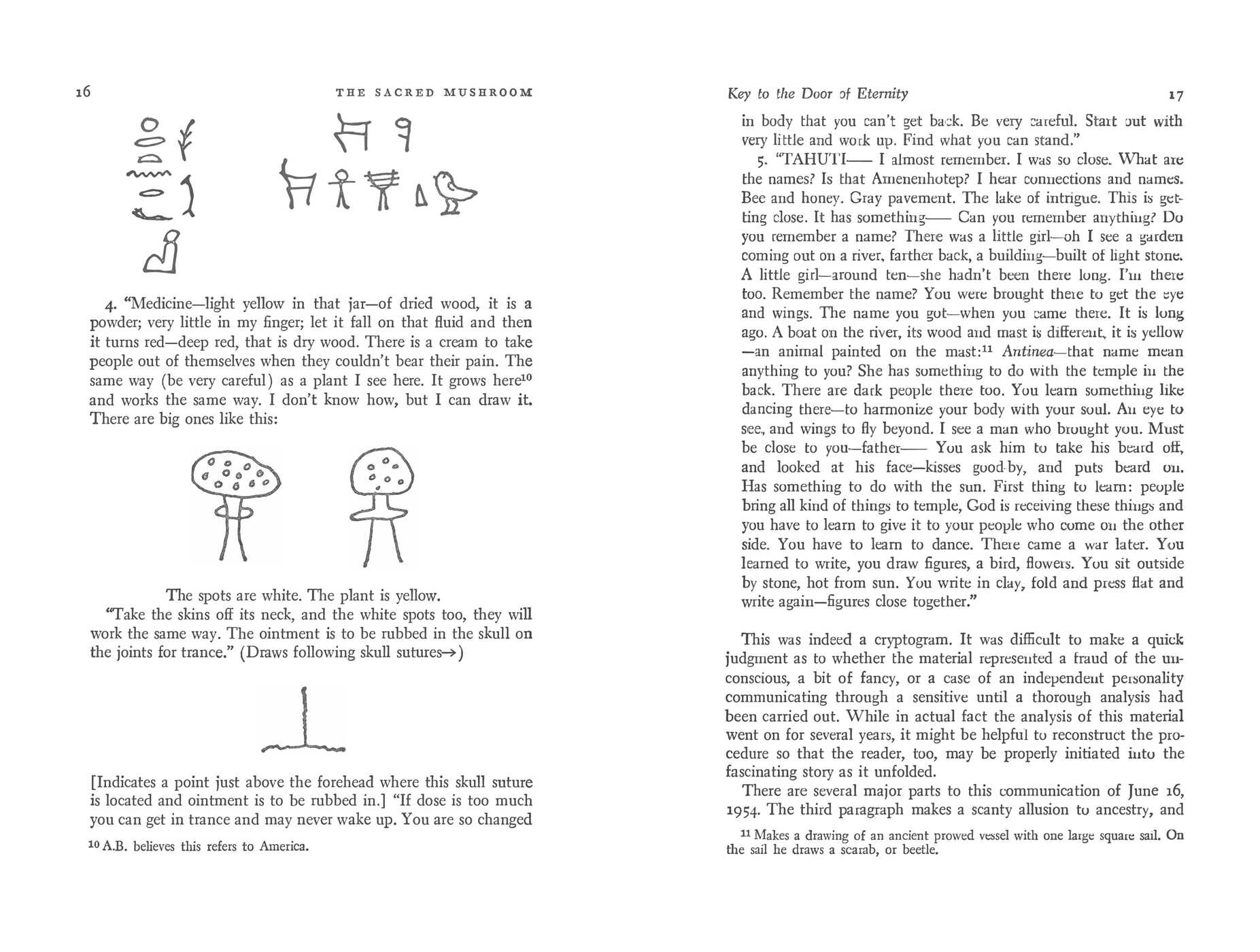
Henry Karel Puharić, better known as Andrija (Croatian for "Andrew") Puharich, is perhaps best remembered as the man who introduced Israeli psychic Uri Geller to the world. But long before Puharich was documenting Geller’s knack for E.T. contact, mind reading, and spoon bending, Puharich was working as a medical officer for the United States government. It was in 1954, while stationed at the Army Chemical Center in Edgewood, Maryland, when an ancient, visionary substance presaging future things to come landed luckily and unexpectedly in his lap. On June 17, a strange event involving a Dutch sculptor and telepath named Harry Stone was casually brought to Puharich’s attention. The previous night (June 16), American heiress and member of the Astor family Ava Alice Pleydell-Bouverie was hosting a dinner party at her home on East 61st Street in New York City, at which Harry Stone was present. Thinking that as an artist, Stone would be interested in the piece, the quinquagenarian socialite handed the young sculptor a gold pendant—jewelry that had allegedly belonged to Tiye, the Great Royal Wife of Amenhotep III, mother of Akhenaten, and grandmother of Tutankhamun. However, rather than offering a comment on the artifact, as soon as Bouverie had handed him the piece, Stone immediately "trembled all over, got a crazy staring look in his eye, staggered around the room a bit, and fell into a chair," apparently in a state of somnambulistic trance—at which point he requested a pencil and some paper. In addition to a number of what appeared to be ancient Egyptian hieroglyphs, Stone proceeded to draw what can only be described as an anatomically correct fruiting body of the infamous, intoxicating mycorrhizal mushroom Amanita muscaria, aka fly agaric. As he sketched, he spoke:
TEHUTI AKH. NESI NESU KHUTA NEFERT KUFA
ANKH KHUT. PTAH KHUFU. PTAH KATU. EN KATU.
[ . . . ] There is a cream to take people out of themselves when
they couldn’t bear their pain. The same way (be very careful) as
a plant I see here. It grows here and works the same way. [ . . . ]
The spots are white. The plant is yellow. Take the skins off its
neck, and the white spots too, they will work the same way. The
ointment is to be rubbed in the skull on the joints for trance.
If dose is too much you can get in trance and may never wake
up. You are so changed in body that you can’t get back. Be very
careful. Start out with very little and work up. Find what you
can stand.
While the intoxicating properties of A. muscaria have been known since at least 1730 with the initial publication of Johan von Strahlenberg’s book An Historical and Geographical Description of the North and Eastern Parts of Europe and Asia, Particularly of Russia, Siberia, and Tartary—a text concerning a region where the concept of shamanic flight is commonplace— Stone’s communication marks the first time that the motif of soul flight was ever directly associated with the fly agaric (or any other) mushroom. Moreover, the connection signals the beginnings of a long trend in historical, anthropological, mycological, and botanical research that seeks to explain magical and mystical tropes in terms of the use of psychedelic drugs. Perhaps more significantly, unlike later arguments for the use of such substances in magico-religious settings that relied heavily upon solid evidence, sound deduction, and logical reasoning, Stone’s transmission instead depended solely upon an apparent act of entranced channeling—and that from an alleged four-thousandsix- hundred-year-old high-born Egyptian. To say that Puharich had stumbled upon an interesting area of research would be putting it lightly. His interest was piqued.
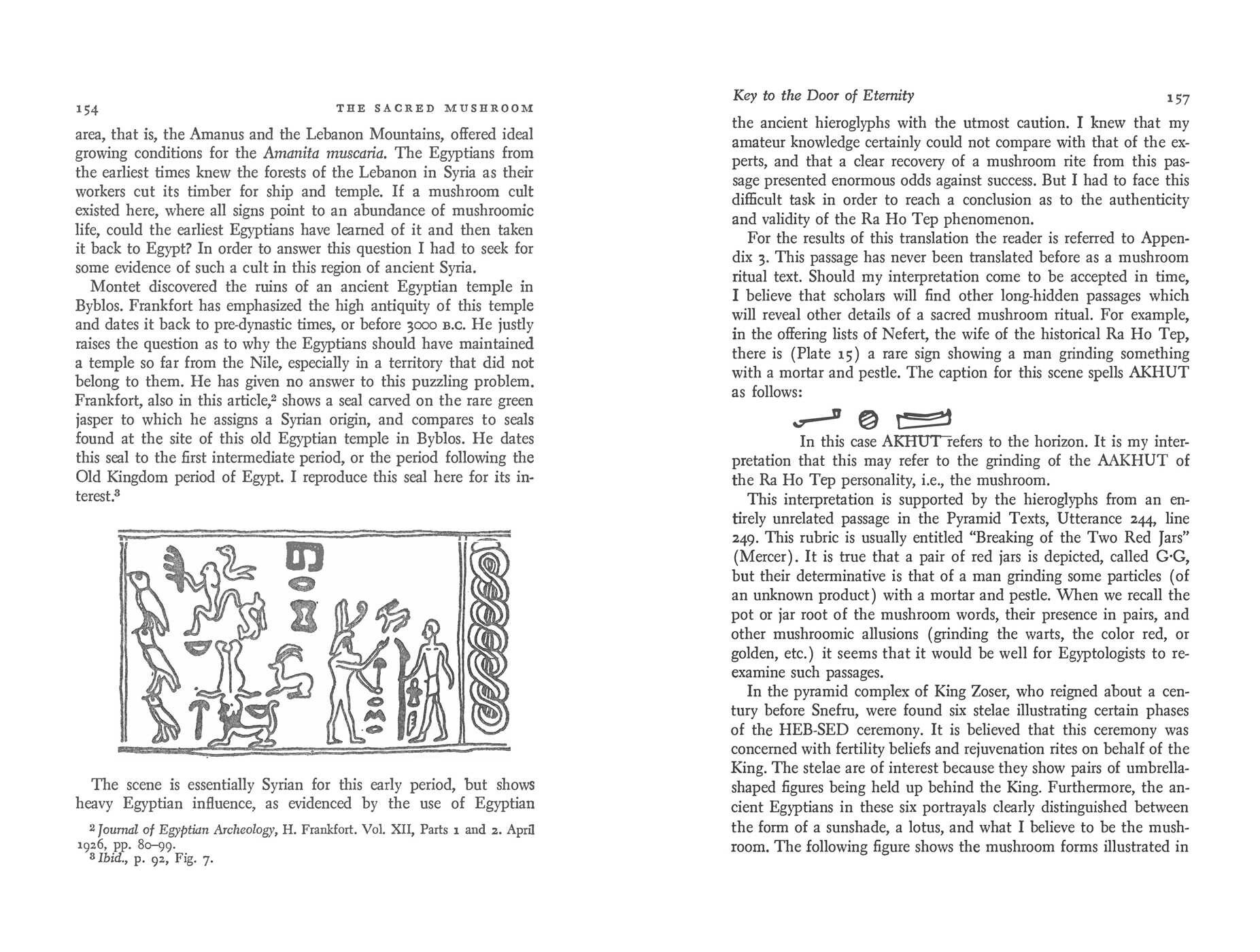
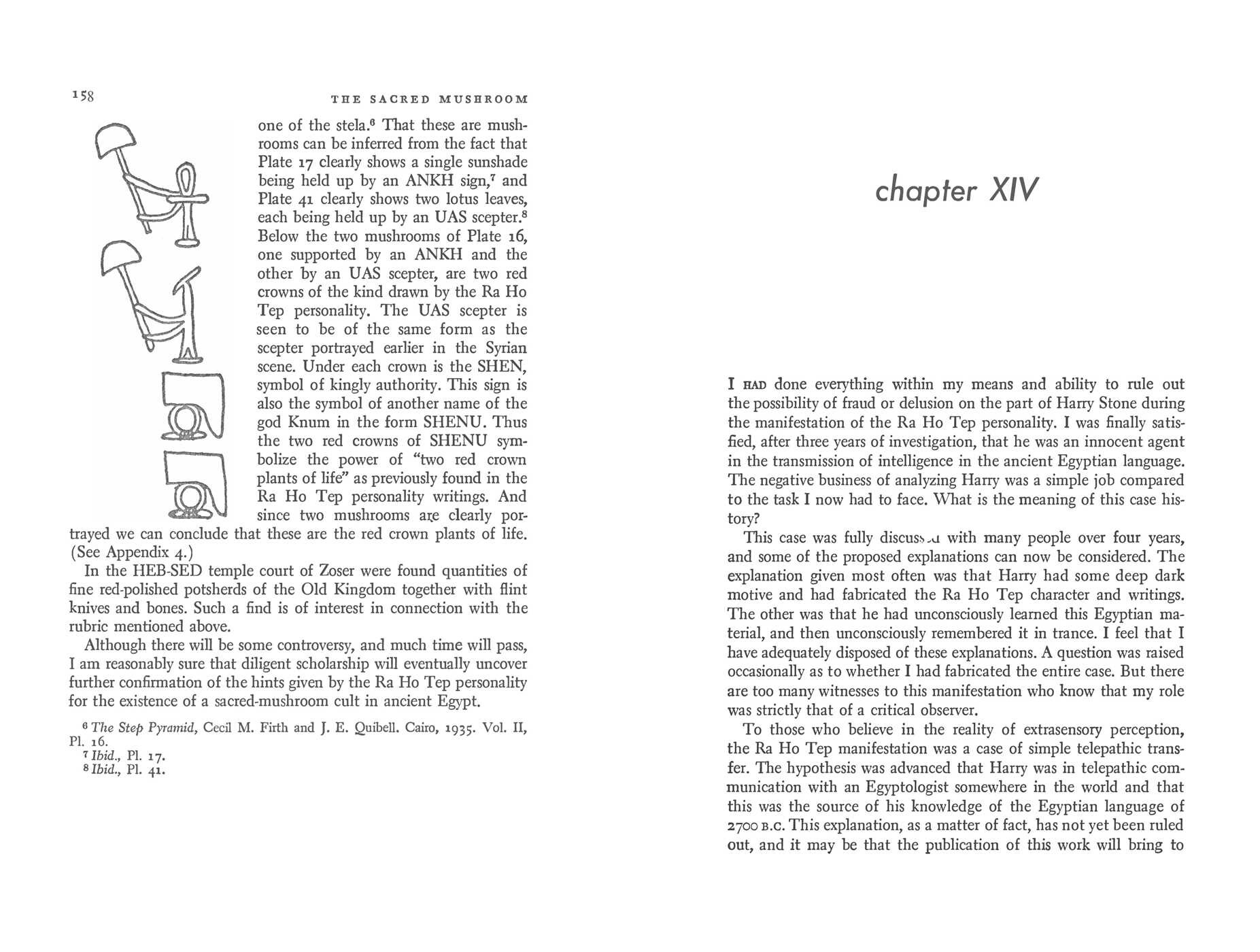
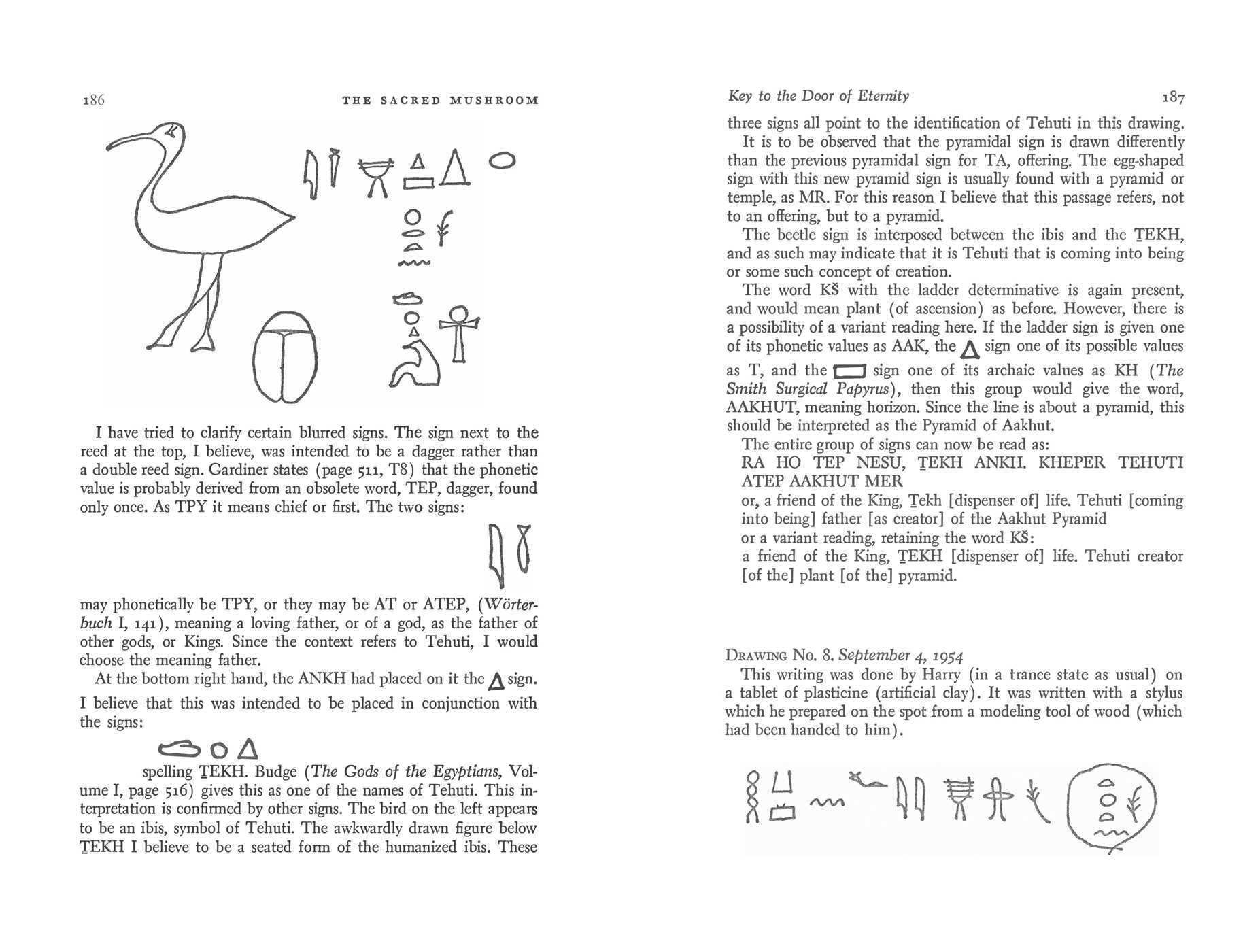
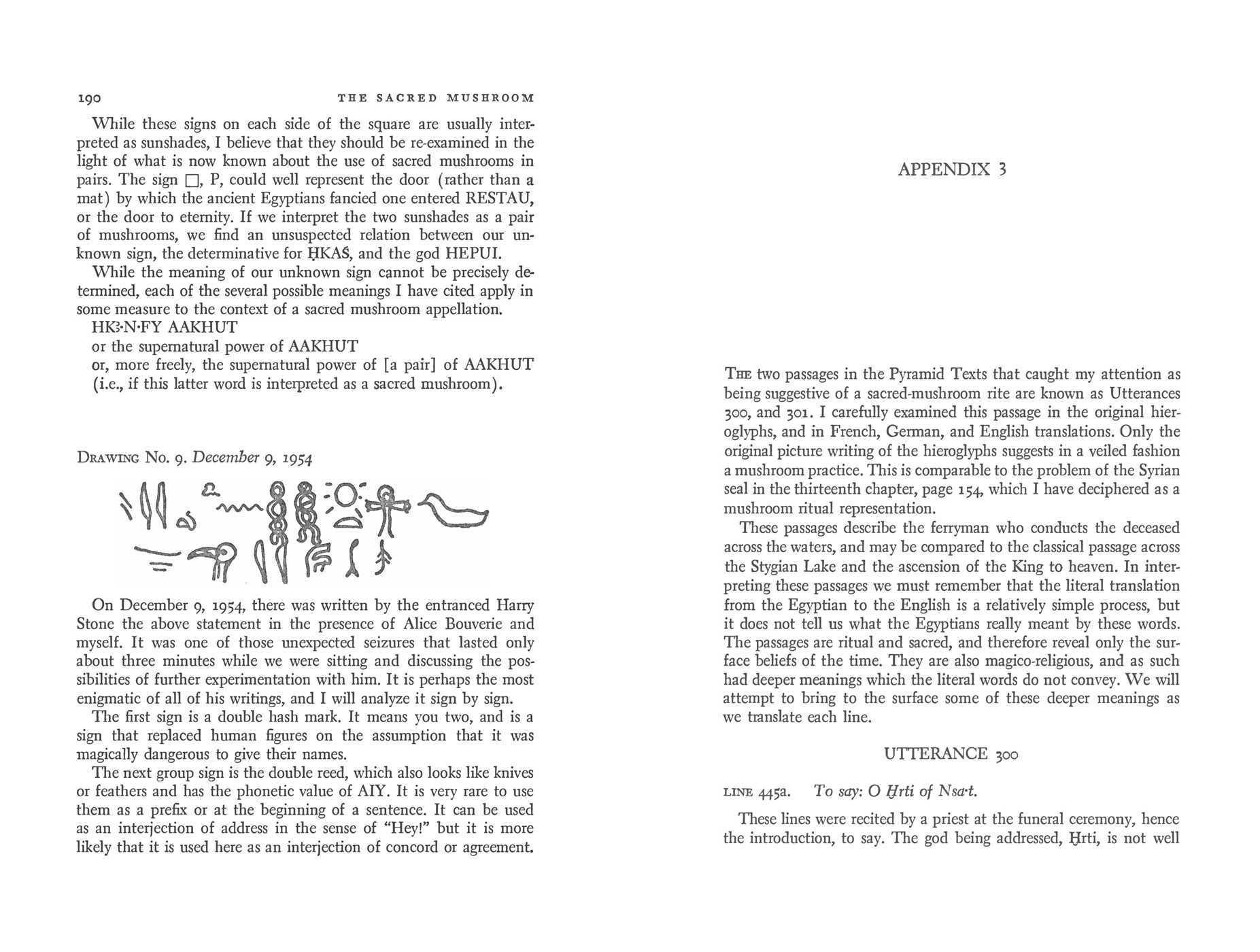
Turning his attention to the hieroglyphic symbols, Puharich enlisted a medical associate with a degree in Egyptology in an attempt to determine whether or not Stone’s speech and sketches were legitimate. Not only was his colleague able to successfully translate the message, but he noted that many of the symbols employed represented rather archaic glyphs that, having been dropped shortly after the time of the early dynasties, were rarely used in Egyptian writing. "As far as I know," the translator remarked, "there are only a few scholars in the United States who are expert in this particular period of Egyptian history, so-called ‘Old Kingdom.’" Among the symbols present were the untranslated phrases "EN KATU" and "ANKH"—words that had appeared in the seemingly nonsensical speech at the very beginning of Stone’s trance episode. Furthermore, among the translated hieroglyphs and utterances were what appeared to be references to the mushroom itself: "The King [or sovereign] speaks of the beautiful sacred plant," "a plant with a red crown."
For all of its consistency, one aspect of Stone’s message warrants at least some comment—namely, the discrepancy between the two colors cited in connection with the mushroom: yellow and red. "In Europe and the Far East the Amanita muscaria was red with white spots," Puharich observes later in the text, "and in the eastern part of North America it was yellow to golden with whitish spots." Notably, the yellow Amanitas are specifically cited by the source of the communication in reference to the one that "grows here," that is, in the northeastern United States. Later in Puharich’s escapade, a transmission is received that instructs the team not only on when the fungus grows in their region ("July") but they’re actually told where it can be found ("right here in Glen Cove . . . in the woods . . . under oaks . . . on the coast . . . on the Penobscot Bay side [of the peninsula] . . . near the . . . south end of the road"). And, when they did successfully locate a specimen, that’s precisely when and where it was found. I don’t want to spoil all the developments in Puharich’s plot, however. So, I’ll leave the remainder of these terrific twists for readers to discover in their own time.
Puharich’s landmark study would go on to influence a number of significant publications concerning the possible role of A. muscaria in the various mystery traditions of the ancient world, from ancient Egypt to archaic Greece to Rome in Late Antiquity to Vedic India—all the way up to western Europe in the Middle Ages and Renaissance and even to the pre-Colonial Americas. Indeed, few and far between are the locations where one researcher or another has failed to find at least some evidence for what is interpreted to be A. muscaria use within magico-religious contexts. The most notable of these subsequent studies include: Soma: Divine Mushroom of Immortality (1968) by R. Gordon Wasson; The Sacred Mushroom and the Cross (1970) by John M. Allegro; Persephone’s Quest: Entheogens and the Origins of Religion (1986) by R. Gordon Wasson, Stella Kramrisch, Jonathan Ott, and Carl A. P. Ruck; Strange Fruit: Alchemy and Religion: The Hidden Truth (1995) by Clark Heinrich; The Apples of Apollo: Pagan and Christian Mysteries of the Eucharist (2000) by Carl A. P. Ruck, Blaise Daniel Staples, and Clark Heinrich; and Sacred Mushrooms of the Goddess: Secrets of Eleusis (2006) by Carl A. P. Ruck. To the present day, similar studies continue to emerge that pick up on the toadstool trail originally blazed by Andrija Puharich. And, if the scope of the available literature on the subject is any indication, we can expect future studies to chronically spring up . . . like mushrooms.
P. D. Newman
Tupelo, Mississippi
P. D. Newman has been immersed in the study and practice of alchemy, hermetism, and theurgy for more than two decades. A member of both the Masonic Fraternity and the Society of Rosicrucians, he lectures internationally and has published articles in many esoteric journals, including The Scottish Rite Journal, Knights Templar Magazine, and Ad Lucem. He is the author of Angels in Vermilion: The Philosophers’ Stone from Dee to DMT, Alchemically Stoned: The Psychedelic Secret of Freemasonry, Tripping the Trail of Ghosts: Psychedelics and the Afterlife Journey in Native American Mound Cultures, and Theurgy: Theory and Practice—The Mysteries of the Ascent to the Divine.