About The Book

National Bestseller
Named a Best Book of the Year by The Washington Post and The Minnesota Star Tribune
Named a Best Book of the Summer by People, Oprah Daily, and Today
A LibraryReads Top 10 Pick

How do we live so that we are satisfied? How can people connect during moments of loneliness? This is the story of Joan Liang, a woman who moves across the world to America, and in trying to answer these questions builds a wildly original life.

Joan’s life is a series of unexpected events: she never thought she would live in California, nor did she expect her first marriage to implode—especially as quickly and spectacularly as it did. She definitely did not expect to fall in love with an older, wealthy American man and become his fourth wife and mother to his youngest children.

Joan and her children grow older, and one day she makes a drastic change: she opens the Satisfaction Café, a place where customers can find connection through conversation. With humor and grace, Joan creates a space for meaningful relationships and constructs a lasting legacy.

Vivid, comic, and profoundly moving, The Satisfaction Café is a novel about found family, the joy and loneliness that come with age, and how we can seek satisfaction at any stage of life. This is a novel of tremendous pleasures: sentences that teem with rich observations, wonderful plotting, and, in Joan, a protagonist for the ages.

Excerpt

Chapter One

CHAPTER ONE


Joan Liang’s life in America began in Palo Alto, where she lived in the attic of a two-story home on Azalea Street. Joan did chores for the widow who owned the house in exchange for reduced rent; she never could have afforded such a nice neighborhood otherwise. She lived in that attic until she was married, and she was married for only six weeks before she stabbed her husband. Joan was twenty-five and had lived in the United States for two years. The year was 1977.

Joan had not thought she would stab her husband. It had been an accident (sort of). Afterward she was disappointed that marriage had not turned out as she’d imagined. She had thought it would be wonderful. It had been, actually. Until it wasn’t.

Though later, Joan would wonder why she’d ever thought marriage would be so special. As a child in Taiwan, most of the married women Joan encountered were melancholy, if not outright miserable; throughout her childhood, Joan’s own mother had on occasion risen from the kitchen table without warning to cry with showy force into her hands.

“You’ve ruined everything!” Mei would shriek if any of the children came near, and so they soon learned to keep away, which only worsened Mei’s despondency. At least every other Saturday, Joan’s father, Wen-Bao, spent the night across town in Shilin, where he kept a two-bedroom apartment for his mistress. Joan’s mother was haunted by the two bedrooms; it drove her nuts, Mei said, to think of so much empty space.

“Can you imagine,” Mei would remark, legs crossed as she sat before her vanity, “how much lust a man must carry inside, to furnish such a large place for one woman? When all six of us are crowded in the same square footage? Do you understand the scope of his betrayal?” At this point Joan’s brothers usually wandered off; they were bored by this conversation, which repeated itself every few months. Only Joan would remain at her mother’s feet, where she watched Mei sit with perfect posture before her mirror and pluck white strands from her hairline.

After moving to California, Joan established the routine of calling her parents every Sunday evening Taipei time, during which Wen-Bao, if he’d visited his mistress that weekend, would have already returned home. On these calls, Joan’s parents performed the same interrogation: how her studies at Stanford were proceeding, if there was any chance to graduate early from her master’s program so that she might begin to earn money. Money was key. Joan had three brothers, each of whom by various rights (older, male) should have been sent abroad before her. Two had been disqualified by their academics, whereas the top candidate, Alfred, had been surprised by “issues” (his girlfriend was pregnant), and so at the last minute Joan was sent instead.

Through her father’s job at the electric utility, Joan’s parents had saved three thousand dollars for Alfred to begin his life in America. Out of this three thousand they spent five hundred on a plane ticket for Joan and repocketed the remainder. For this Joan was grateful, as she was a girl and thus not entitled to anything. At dinner her father took the first cut of meat; he also ate all the yellows from eggs. After her father, the meat went to Joan’s brothers, and then to her mother, and then to Joan, by which time there was usually nothing. So just because Alfred was supposed to have gone to America didn’t mean Joan would. Mei and Wen-Bao, however, had been nervous—having already fled the Communists once, they preferred to settle a child abroad, an international insurance policy drawing Western wages.

On their calls, Joan’s parents never inquired about her romantic life. If she were to, say, divulge that she’d kissed a man, or even dined alone with one, such news would have been met with recriminations followed by punishing silence. A husband, naturally, must be found at a certain point. A husband was part of the scaffolding upon which all the family’s dreams—money, safety, education—would be constructed. But Joan’s parents did not want to know anything of the process; the eventual union with the man you slept with each night should be accomplished without sex or romance, at least if you were a good, responsible girl. And for her entire life thus far, Joan had been a very good girl.

The man Joan married was named Milton Liu. He was, of course, Chinese—aside from her landlord, Joan socialized only with Chinese people. Milton, who was studying architecture, was tall and well built, with elegant long fingers. He played piano, which Joan liked; she possessed no musical ability, but one of her first splurges in America had been a record player and a few LPs of Bach and Chopin. Milton had an easy way of speaking and excellent cheekbones and a gentle, sleepy expression, which was what had attracted Joan in the first place: besides being handsome, he also looked nice. Because her parents were mean, Joan was drawn to this sort of appearance.

When she had an open afternoon between classes and her job as a hostess at Lotus Garden, Joan liked to sit and daydream on one of the benches within Stanford’s campus. That such splendor was free for the general public to enjoy seemed to her a uniquely American miracle. After she met Milton, she asked him about the school’s architecture. He told her the style was Mission Revival.

“It’s incredible that one man could create such a majestic place, all in the name of learning,” Joan had remarked. It was their first real date. Their previous encounters had all been group outings: weekend hikes or evening potlucks, since no one had enough money to host a real dinner party.

Milton informed Joan that Leland Stanford had used Chinese labor to build his railroad fortune, millions of which he spent constructing the school. “Many Chinese died,” he added. “The men were blown up tunneling through caves.” They were at Harbor Place in Chinatown, where the specialty was shrimp noodle soup. Around them sat slouched men wearing padded jackets, sipping tea, and slurping broth; outside, knots of similarly attired men were huddled on the sidewalk, smoking and arguing in Cantonese.

“Did he go to jail?” Joan asked.

“What? Of course not.”

Joan ate some more noodles as she considered this. She usually vowed not to drink the soup due to its sodium but couldn’t help it—and Harbor Place had such good soup, the bits of roasted duck and chopped scallion and fried onion all melding into a layered broth. It was always served near scalding; on the off chance that a white person came upon the restaurant, the waiters would shout, “Careful! Very hot!” as they set down the bowls. She swirled the noodles into an oval on her spoon. In the middle of the spoon, she placed a shrimp dumpling, soggy enough now that its skin was beginning to disintegrate.

Joan tipped the spoon into her mouth and closed her eyes. The bite went down smoothly, the heat and texture and salt playing together in pleasant symphony. Due to the expense, she didn’t often eat at restaurants. Joan liked to believe she could make the same food at home for less money, but the reality was the meals she made herself, well—for some reason there wasn’t any soul. She assembled another spoonful, and by the time the bowl was empty, she’d decided she wouldn’t think of Leland Stanford any longer. Weren’t vicious men a given in this world? Ultimately it was pointless to try to keep track of them all. Stanford may not have built his splendid university with its towering eucalyptus groves for people like Joan, but the fact was that she was indeed here, and he was long dead, and thus she needn’t think of him any longer.

Reading Group Guide

THE SATISFACTION CAFÉ Reading Group Guide

This reading group guide for The Satisfaction Café includes an introduction, discussion questions, and ideas for enhancing your book club. The suggested questions are intended to help your reading group find new and interesting angles and topics for your discussion. We hope that these ideas will enrich your conversation and increase your enjoyment of the book.

Introduction

Like many people, Joan Liang could never have predicted the way her life would turn out. As her circumstances change in surprising ways, Joan revisits her childhood dream of a Satisfaction Café—a destination where people can feel, at least temporarily, a little less lonely. She eventually makes her dream a reality and creates a place of human connection, not only for herself, but for her community.

Topics and Questions for Discussion

1. In the opening paragraph, the reader is told that Joan “was married for only six weeks before she stabbed her husband” (page 3). How does this line set up your expectations for the novel? What does it do for the tone of the book?

2. The novel is divided into four parts: “The Trick to a Good Marriage,” “The House Was Promised,” “The Demon Rock,” and “How to Start a Conversation.” How do the events in each section relate to their respective titles?

3. Joan fears the judgment of her family and friends when she gets divorced, yet ends up marrying Bill, a thrice-divorced American man. What role does divorce play in the novel? Discuss how the novel portrays divorce from various perspectives involved (spouses, children, friends).

4. Compare Joan’s marriage to Milton with her marriage to Bill. How are they different? Are there any ways in which they are similar? How does Joan’s relationship with Bill transform across their life together?

5. Joan doesn’t “believe in telling people they would never die,” even when it comes to her children (page 88), but other characters (Misty, Bill, and Lee) all fret about dying. How does the novel explore the end of life and its psychological effect on the characters?

6. When discussing Theo’s career wishes with Bill, Joan withholds her opinion, noting that “it was just one of those unfortunate circumstances of marrying a man who’s already lived a

whole other life before meeting you” (page 108). Discuss the age and experience gap between Joan and Bill and how that affects their marriage. What are the expectations on each side?

7. Jamie quickly accepted Lee as his sister when Joan adopted her, and “Lee generally worshipped Jamie, in the manner that older siblings are worshipped ” (page 109). Talk about Jamie and Lee’s relationship. How does their relationship differ from the relationships between the other siblings in the novel?

8. Joan faces microaggressions throughout her life, such as being mistaken for her children’s nanny instead of their mother. How do these instances affect Joan? Her children? Would Joan’s reaction be different had she been born in a different era?

9. Bill is surprised to hear that Joan says she loves their children more than she loves him. According to Joan, “in Taiwan, you were always supposed to love the next generation more, or at least say you did” (page 125). Why do you think this is? How do you feel about this sentiment, and is it different from your own cultural norms?

10. Joan and Misty’s respective pregnancies and experiences of motherhood couldn’t be more different. Talk about motherhood and parenting in the novel. Does either woman have a balanced view of motherhood versus maintaining their own identity?

11. When discussing Japan’s host/hostess clubs, Joan thinks: “Young people like Lee and Marc imagined loneliness as a consequence—something you did or didn’t do to end up on your own. . . . Youth didn’t understand, however, how much luck played into it, that loneliness wasn’t always a choice. Whereas at Joan’s age, you knew it was always somewhere ahead, waiting. It could happen to anyone (page 221). How is loneliness explored throughout the novel? Do you agree with Joan that one’s relationship to loneliness changes with age?

12. After opening the café, Joan finds herself “falling in love all over the place” (page 239). What role does love play in the novel? How is love characterized and experienced? Is a particular kind of love (friendship, romantic, familial) more represented than others?

13. Joan reconnects with Trevor, one of Bill’s friends, later in life and wonders what could have been. Eventually she wishes “he could have stayed as he was in her memory, a younger point of eternal possibility” (page 254). What do you think Joan means here? Why is this important to her?

14. When talking about one of her regular customers, Joan mulls over the concept of normalcy. She thinks, “Sure, Dustin’s habits may not have been normal. But was Lee and Jamie moving home, spending so much time with their mother, normal?” (page 273). What is considered “normal” in Joan’s world? In what ways does Joan’s life deviate from the norm?

15. After opening the Satisfaction Café, Joan feels “it was as if all the doors of her past were open and she could walk freely between. This is what the café had brought her” (page 291). Talk about the café and what it offers its customers. If there were a real Satisfaction Café, would you try it out? What sort of services and food dishes would your café offer?

Enhance Your Book Club

1. Early in the novel, Joan decides to take community classes to address her loneliness. Consider signing up for a community class near you.

2. Visit your local or favorite café and imagine it as the Satisfaction Café. Can you visualize what it would look like?

About The Author

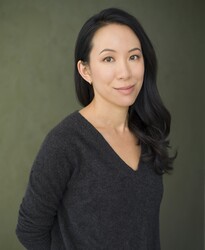
Photograph by Nina Subin

Kathy Wang is the author of Family Trust, Imposter Syndrome, and The Satisfaction Café. She is a graduate of UC Berkeley and Harvard Business School, and lives in the Bay Area. 

Product Details

  • Publisher: Scribner (July 1, 2025)
  • Length: 352 pages
  • ISBN13: 9781668068922

Browse Related Books

Raves and Reviews

“Kathy Wang’s sumptuous new novel The Satisfaction Café beguiled me so fiercely I wanted, once finished, to un-remember it so I could relish it again for the first time... this deft, sharp, funny, poignant chronicle delights and surprises: modern, complex, credibly absurd... One of the richest, prickliest, wittiest contemporary sagas I can recall, Satisfaction is—I’m sorry, no other words work—profoundly satisfying... Every detail mesmerizes... The more we read the more we crave.” —Joan Frank, Boston Globe
 
“An antidote to our global dissatisfaction… winsome… Ironic but rarely biting, Wang’s narration moves nimbly just above Joan’s perplexed perspective while catching the notes of absurdity and hypocrisy around her.” —Ron Charles, Washington Post
 
“Like Anne Tyler, Kathy Wang believes the tiny details of life are worth attending to, small decisions and events can change lives, everyone is messy and that, even so, the story of an ordinary person can be extraordinarily beautiful… Joan might be my favorite literary character since Elizabeth Strout’s Olive Kitteridge. Like Olive, Joan is far from perfect... Wang’s short, graceful chapters are like brushstrokes, and Joan is the resulting work of art.” Minnesota Star Tribune

“The story of Joan's life in America [is] an unexpected journey she greets with rare calm and wry humor. You'll root for her every step of the way.” People Magazine

“Wang’s deeply funny and feeling novel sneaks into your heart and takes over.” Oprah Daily

“A character study about unexpected life paths and found family.” —USA Today

“Wang’s writing is sharp, comical, and quietly heartbreaking. Perfect for readers who love an emotional slow burn, The Satisfaction Café is a poignant, darkly funny story about how we survive—and even sometimes thrive—after life doesn’t go as planned. At its heart, it is a moving portrait of how starting over can be its own kind of victory.” Booklist

“Crisp and assured… independent and pragmatic, but also secretly soulful, Joan is a character capable of surprising the reader at every turn... Wang has a light touch, whether describing events that are heavy or mundane, and avoids sentimentality. This gratifies.” Publishers Weekly

“Warm and thoughtfully told…Wang’s novel gives us a main character to root for.”Kirkus

The Satisfaction Café is both deep and wide, tracing the arc of a single life and then showing how that life ripples out across family, friends, and time. At every turn Joan proves to be more insightful and more necessary than people believed her to be, the result of which is this insightful, necessary, and beautiful novel.” —Ann Patchett

“Kathy Wang is a born storyteller, vivid and precise, deliciously cool-eyed, immensely readable.” —Jonathan Franzen
 

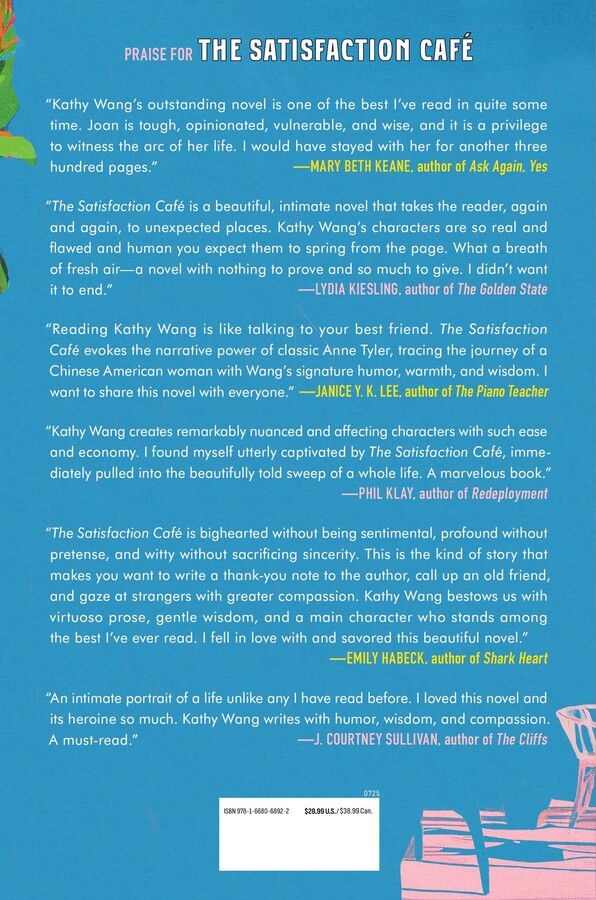
The Satisfaction Café is big-hearted without being sentimental, profound without pretense, and witty without sacrificing sincerity—qualities that reflect its unforgettable protagonist, Joan. This is the kind of story that makes you want to write a thank you note to the author, call up an old friend, and gaze at strangers with greater compassion and curiosity. Kathy Wang bestows us with virtuoso prose, gentle wisdom, and a main character who stands among the best I’ve ever read. I fell in love with and savored this beautiful novel.” —Emily Habeck, author of Shark Heart  

“Kathy Wang's outstanding novel is one of the best I've read in quite some time. 
The protagonist is tough, opinionated, vulnerable, and wise, and it is a privilege to witness the arc of her life. I would have stayed with her for another three hundred pages.” —Mary Beth Keane, author of Ask Again, Yes
 
“This irresistible read traverses decades of a woman’s life. The twists are as unexpected yet realistic as the ones you’d hear from a neighbor or a friend. But the writing is uniquely endearing and funny, leaping off the page. You will be moved by this tale of resilience and taking delight in life despite hardships.” —Today.com's Most Anticipated Books of 2025

“Subtle, surprising, and elegantly constructed, The Satisfaction Café is an insightful and funny exploration of how seldom our choices feel like choices; how rare and elusive the idea of home can feel.” —Lynn Steger Strong, author of Flight 
 
“Kathy Wang creates remarkably nuanced and affecting characters with such ease and economy. I found myself utterly captivated by The Satisfaction Café, immediately pulled into the beautifully told sweep of a whole life. 
A marvelous book.” —Phil Klay, author of Redeployment 
 
“An intimate portrait of a life unlike any I have read before. I loved this novel and its heroine so much. Kathy Wang writes with humor, wisdom and compassion. A must-read.” —J. Courtney Sullivan, author of The Cliffs

“Reading Kathy Wang is like talking to your best friend. The Satisfaction Café evokes the narrative power of classic Anne Tyler, tracing the journey of a Chinese-American woman with Wang's signature humor, warmth and wisdom. I want to share this novel with everyone.” —Janice Y. K. Lee, author of The Piano Teacher
 

The Satisfaction Café is a beautiful, intimate novel that takes the reader, again and again, to unexpected places. Kathy Wang’s characters are so real and flawed and human you expect them to spring from the page. What a breath of fresh air—a novel with nothing to prove and so much to give. I didn't want it to end.” —Lydia Kiesling, author of Golden State

Resources and Downloads

High Resolution Images

BACK TO TOP