1
Problems for Anthropology
When the famous European natural philosopher Georges-Louis Leclerc, the Comte de Buffon (1707–1788),* began to publicize his new idea of “the tendency of nature to belittle her productions” on the American side of the Atlantic, one man quickly silenced him through the method of example. The Americans knew Buffon for his provocative messages, and so elected to defend the New World against further foreign intrusions, intellectual and otherwise; then–US president Thomas Jefferson invited certain prominent gentry among the native people of the great Ozark region to Washington.
On this subject of Jefferson versus Buffon, Joyce Appleby writes: “Among the many tribes that Lewis and Clark encountered, the Osages and the Mandans were the most impressive. Lewis had extended an invitation to the Osage nation to send a delegation to Washington, and Jefferson rejoiced to witness the men’s considerable height, no doubt thinking of his protracted challenge to Buffon’s theory of New World degeneracy . . .”1
Heralded by other invited tribes from July of 1804, the arrival of the Osage delegation in December of 1805 was described by Mrs. Margaret Bayard Smith in these words: “Tall, erect, finely proportioned and majestic in their appearance, dignified, graceful and lofty in their demeanor, they seem to be nature’s own nobility.”2
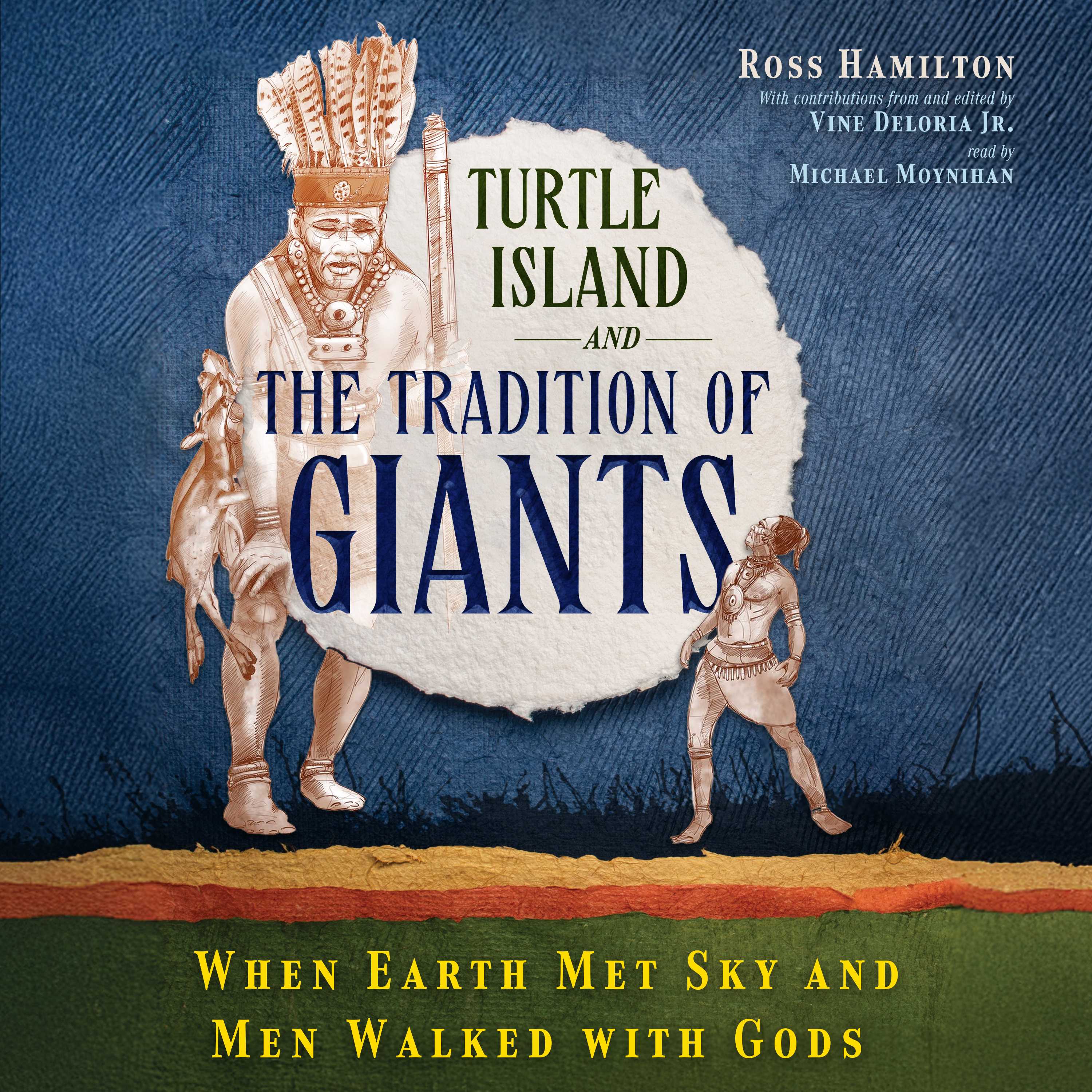
Had these Osage people not been seen by the early French, Jeffersonian society, and others, including the frontier painter George Catlin, we might today have no authentic record of their venerable lineage. A number were said to have been 7 feet tall and robust. Yet with the passage of time, the ghost of Buffon’s reductionist thought seems to have established its haunt within the halls of human study throughout the West and the globe.
SIX REASONS FOR LOSS
As it was in those days, antinative sentiment grew and grew until, by 1850, it became virtually illegal to be an American Indian east of the Mississippi without belonging to a reservation. By then, and spurred on by Andrew Jackson’s decision to go against the Supreme Court who found for the Cherokee, even the so-referenced Five Civilized Tribes of the Great South lost all their lands. As the newborn creed of science arose on the ruins of ever more vague prehistory, the fact of the brawny heroic man was naturally excluded from its scripture along with anything that would engender strength through pride in the hearts and minds of the people.
When I converse with interested parties about the Tall Ones, some ask: “Where can we see the skeletons?” “Well,” I say with a hint of sarcasm, “they were not a renewable resource like corn or switchgrass, and so now their once relatively commonplace existence has been so thoroughly exploited that they, along with most other Indian artifacts retrieved from the earth, have become exceptionally rare.” I use the analogue of nineteenth-century coins, like the Indian Head penny (no pun intended): They may have been commonplace once, but they are beyond scarcity in the field circulating today. Indian Heads, like the tall skeletons of the old and ancient Indian leaders, have been gathered up by the private collectors who have often stored them in the repositories of their collections, but in the main by government agencies, where they were melted to make Lincoln Heads.
Analogue aside though, as human beings, we over time just have a way of losing the most precious relics of the past. If we do not take exceptional care to preserve them, Murphy’s law dictates that by adding time to the equation, they will disappear. So, when people ask “you mean there’s nothing left of them?”—I reiterate, “It’s hard to believe they’ve all but completely vanished, but for any scientific intent, they have.” Then there is a brief hiatus in the conversation before I often add that there are numerous accounts of the greater stature, some of which are from reliable professional sources. Yet there are few bones and practically no complete skeletons.
For example, if an object is on a museum’s display somewhere for years, people will tire of it, and the object will be replaced with another. Large skulls and larger bones were often put on display this way in the nineteenth century, with one or two of their accounts collected for this book. People would pay to see them, but with time the interest was lost or, conversely, the dollar value would induce theft from someone’s personal museum to become part of another’s. Sale to private collectors was common in the pre-NAGPRA (Native American Graves Protection and Repatriation Act) era. Once a federal law like NAGPRA comes along, the collector, being unwilling to give up his lifelong hobby, will sometimes relocate the whole assemblage into a large, hand-dug repository well covered over to avoid prosecution.
This is, unfortunately, a true account in that an old college friend assisted the old collector in burying the bones, confiding to me that there was, indeed, at least one very large skull among all the osteological remains. Although offered rewards to retrieve them from the ground, my friend never broke his promise to the old collector, a lifetime MD, and in this, yet another reason for the old bones permanently disappearing is added to the list, that of honor.
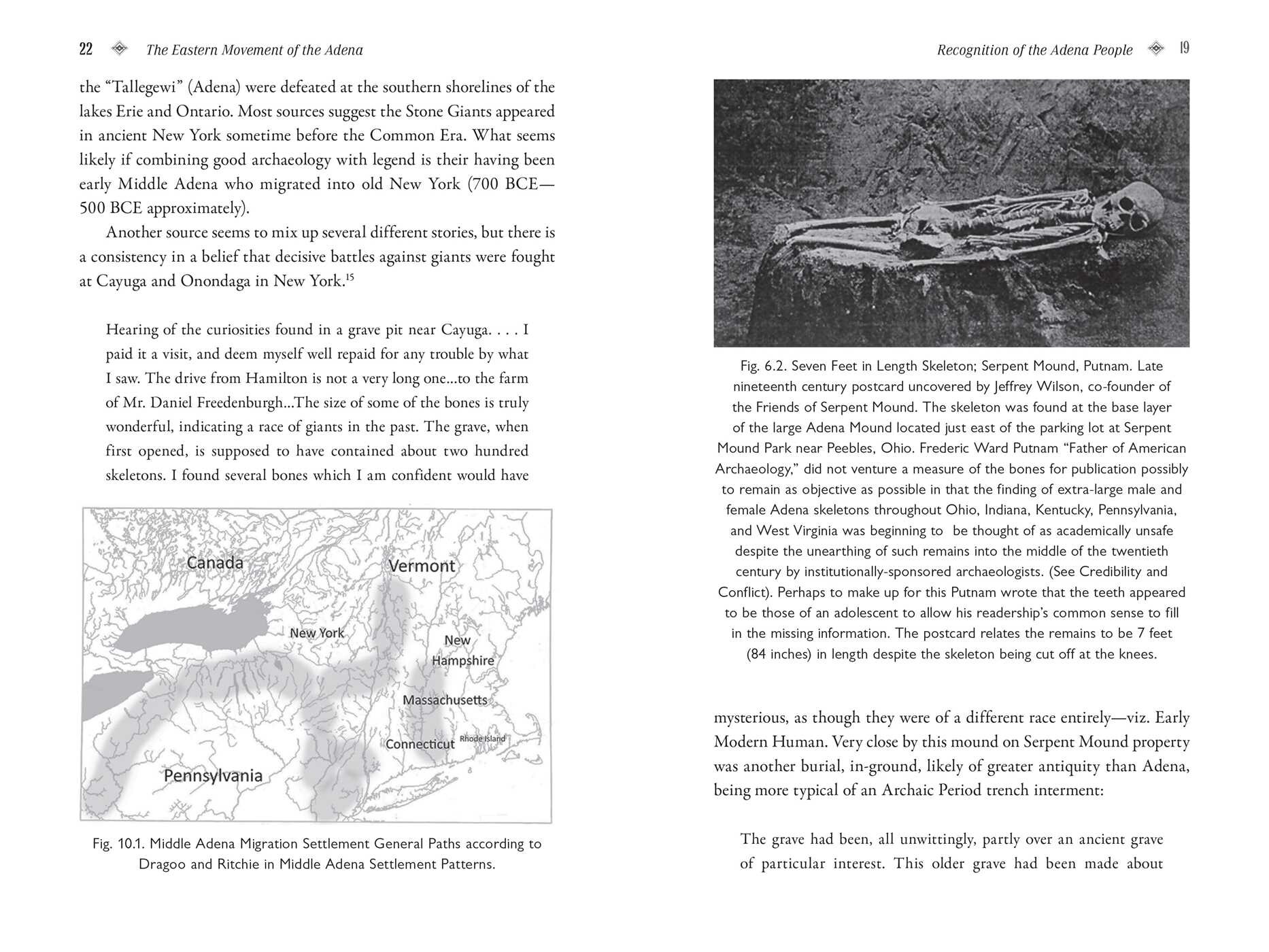
Indian legend plentifully accounts for the existence of such a people in a long-ago period of prehistory, and as the odds would have it, even in these current times an archaeological team will occasionally find yet another single skeleton measuring 7 feet or more in length. Identified in every case as Adena, such a recent instance saw Wayne A. Mortine and Doug Randles performing excavations in the area of Coshocton, Ohio. It was the early 1980s, and Coshocton was already famous for extra-large skeletal finds in the previous century. Nonetheless, this find, being unexpected due to a disconnect between nineteenth-century antiquarianism and twentieth-century archaeology, was not discussed much, perhaps considered an anomaly.3
The loss of the giant skeletons is quite a remarkable story, actually—albeit a bit on the sad side for exposing the haphazard treatment of Indian people, whether living or long departed in spirit. In hindsight what has happened is this:
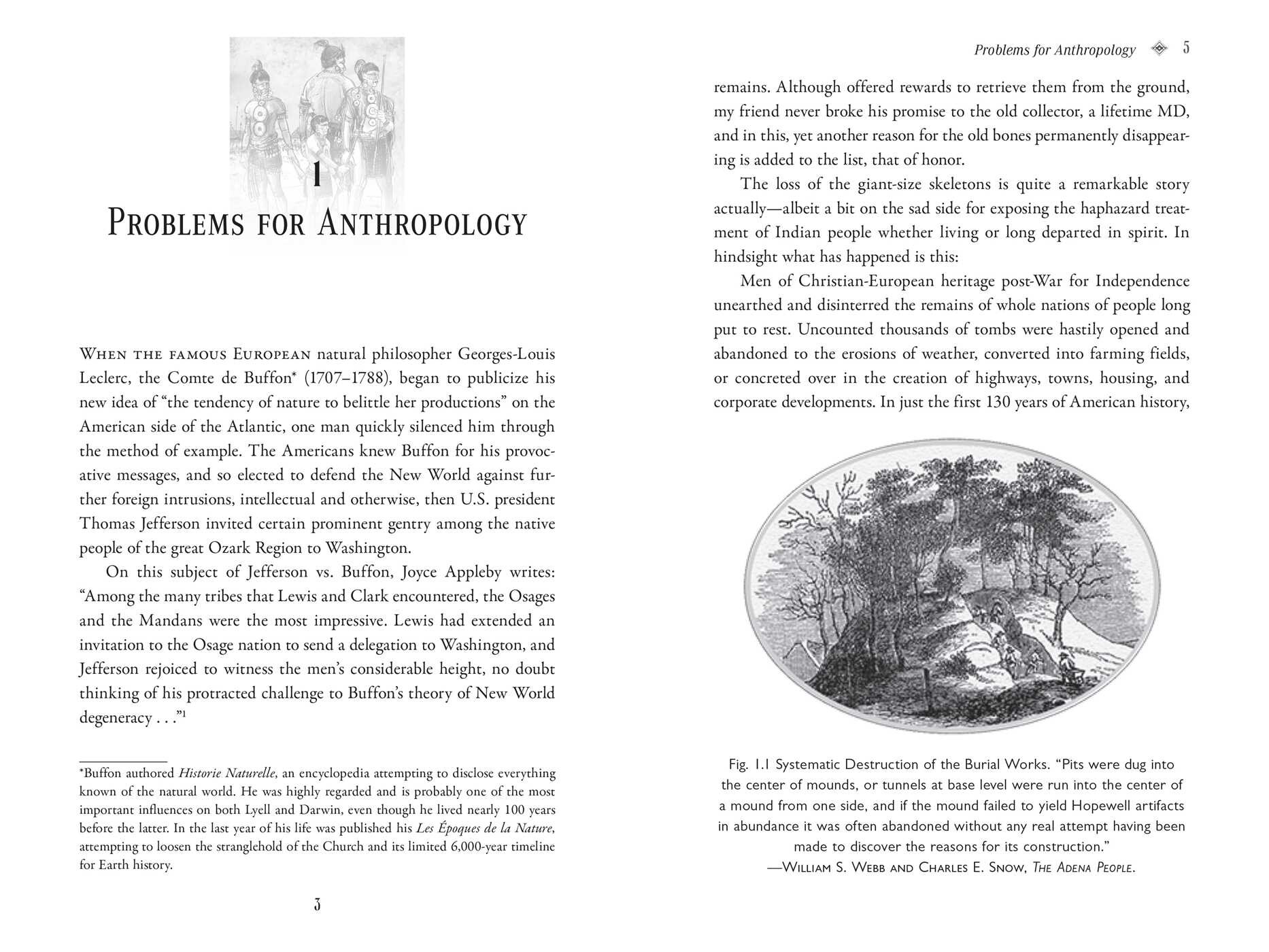
Post–War for Independence, men of Christian-European heritage unearthed and disinterred the remains of whole nations of people long put to rest. Uncounted thousands of tombs were hastily opened and abandoned to the erosions of weather, converted into farming fields, or concreted over in the creation of highways, towns, housing, and corporate developments. In just the first 130 years of American history, looting did irreversible wrong seeking its pearls, pipes, statuettes, copper works, tablets, carven flint, and implements of horn for private trade or sale to museum storehouses. Out of this holocaust of self-interest and morbid curiosity, a sort of science was incrementally conceived that wished to preserve what remained for the sake of learning. But by that late date, the histories, the grave goods, and the remains of the very tall people could not be properly preserved. Among all the grave contents considered, the larger bones were most highly valued and, disappearing faster than any other kind of artifact, left little trace of themselves or their point of origin. The reasons are mainly six:
1. The very tall native people recorded early in American history were said to be of a time-honored tradition of selective mating both fragile and in a stage of imminent collapse. In the Eastern Woodland cultures of North America going back millennia, there was an effort to preserve genetic lines sustaining, among other things, certain highly esteemed physical characteristics giving rise to a class of nobility over time. The tall and robust people in their system married with others of their kind as often as conceivable. Like European royalty, there existed prearranged marital conventions among certain established families. Instead of marrying for pelf and power, these people, by any indication, married to produce physically commanding individuals whenever such arrangements could be made. The gene pool seems to have been deep, healthy, and rich for such planning, with its origins rooted in the past going back to the mostremote memory on North American soil. As we have found in professional accounts of both Glacial Kame and Old Copper cultural interments, there was, by far, a greater percentage of very tall and hearty people in the ancient American population, especially evident in Terminal Archaic and Early Woodland times than in any of our modern populations.
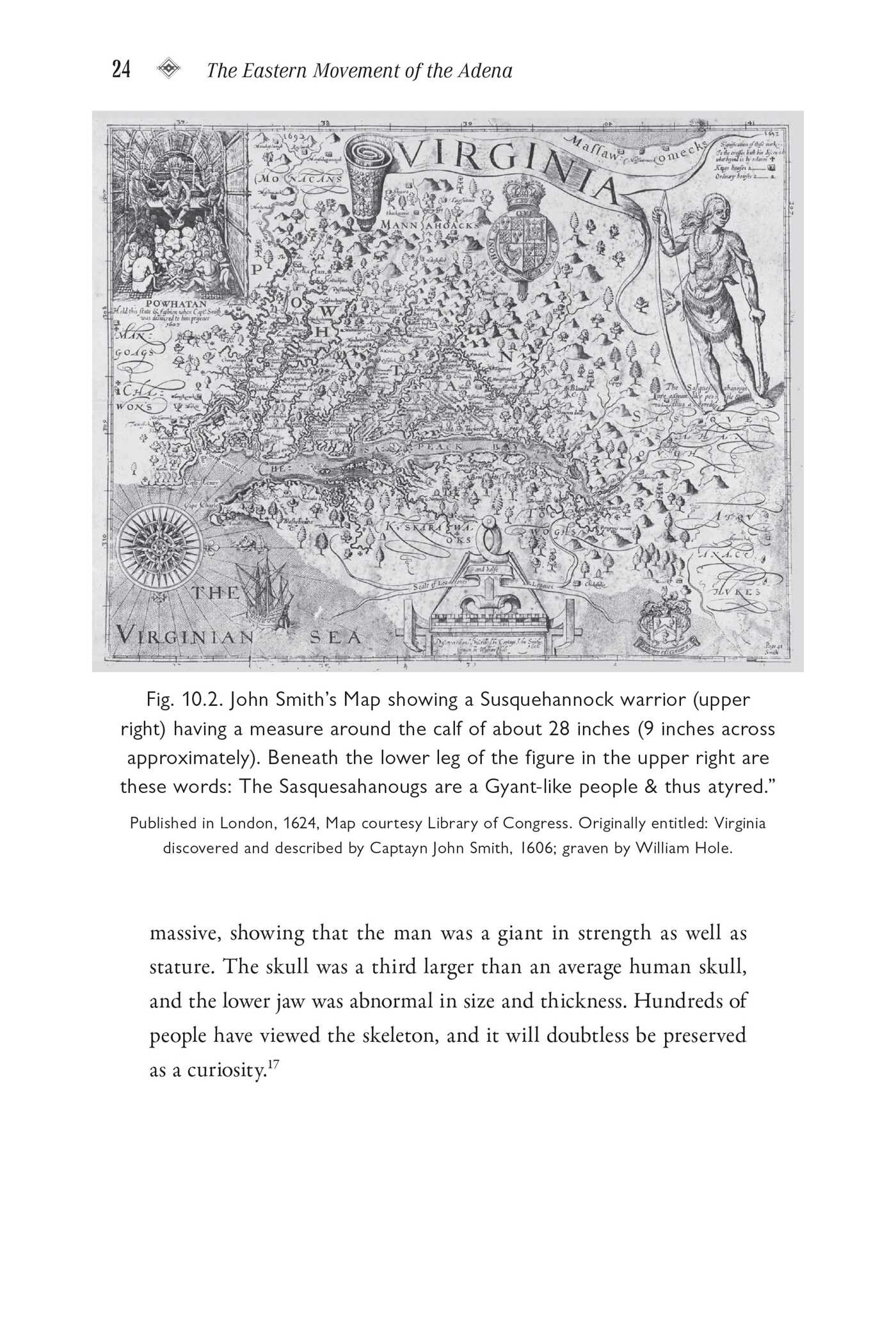
Long in political power, family members received chieftainships and the duties affiliated with seats of power and influence. Intertribal wars in combination with the introduction of European soldiers bringing firearms and smallpox seem to have dramatically hastened the breaking up of the traditional selective-mating protocols. This seems to have been the case with Hernando de Soto and other Spanish explorers and their expeditions’ disastrous interactions with certain tribes of the Great South. This also seems to have applied to the Andaste/Conestoga of the Susquehanna watershed, a theoretic early offshoot of the archaeological Adena.