Dr. Richard Burt

About The Author

DR. RICHARD K. BURT is a Fulbright Scholar, CEO of Genani Biotechnology, a tenured retired Professor at Northwestern, and current Scripps faculty. He pioneered America’s first hematopoietic stem cell transplant for autoimmune diseases like multiple sclerosis and scleroderma. Dr Burt has seven United States Patent and Trademark Office (USPTO) patents on using induced pluripotent stem (IPS) cells for aging and degenerative diseases.

Dr. Burt was awarded Leukemia Scholar of America, the Lupus Foundation of America Fidelitas Award, the van Bekkum Award by the European Society for Blood and Marrow Transplantation (EBMT), the Distinguished Clinical Achievement Award by the Clinical Research Forum, the EBMT Clinical Achievement Award, and the “Keys to the Vatican” in Rome. He has spoken at numerous conferences, universities, and institutions. Hospitals worldwide offer his stem cell protocols to patients.

Dr. Burt was recognized by Science Illustrated for accomplishing one of the Top 10 medical breakthroughs and by Scientific American as one of the Top 50 individuals for improving humanity and outstanding leadership. Dr Burt has written 150 medical / science articles, four medical textbooks, and two lay books: Everyday Miracles and Kill Switch.

Books by Dr. Richard Burt

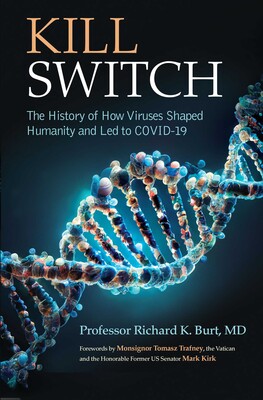
Kill Switch

The History of How Viruses Shaped Humanity and Led to COVID-19

From the fall of empires to the rise of global health, Dr. Richard Burt’s Kill Switch reveals how viruses have shaped human history—and what we must learn to protect our future.

Viruses are the invisible architects of life and human history. From ancient plagues to modern pan...
Everyday Miracles

Curing Multiple Sclerosis, Scleroderma, and Autoimmune Diseases by Hematopoietic Stem Cell Transplant

A life-changing treatment is conquering auto-immune disorders—why doesn’t anyone know about it?  Thirty-five years ago, Dr. Richard Burt began a journey to treat chronic autoimmune diseases as they’d never been treated before. Using a treatment originally developed for leukemia but modified to b...
BACK TO TOP