Goodreads Choice Award Nominee
NPR Books We Love 2025
“Journalist Graff delivers a magisterial oral history of the atomic bomb. . . . The result is a stunning account that brings to the fore the nuclear saga’s surreal combination of ingenuity, fate, and terror.” —Publishers Weekly (starred review)
“By going deeper into the personal details and reminiscences of a generation that is all but lost to us now, Mr. Graff . . . [has] made the story more human, especially when the weapon’s essential inhumanity threatens to overshadow everything else. . . . Each chapter is a compilation of snippets from interviews, memoirs and the personal testimony of figures from President Truman and Hiroshima’s police chief down to the last survivors of the Hiroshima attack and the man responsible for box lunches at the plant in Hanford, Wash., that made the plutonium for the bomb used at Nagasaki. . . . Mr. Graff gives us fascinating snippets about [J. Robert Oppenheimer] the man who has since become the symbol of the entire bomb project.” —Wall Street Journal
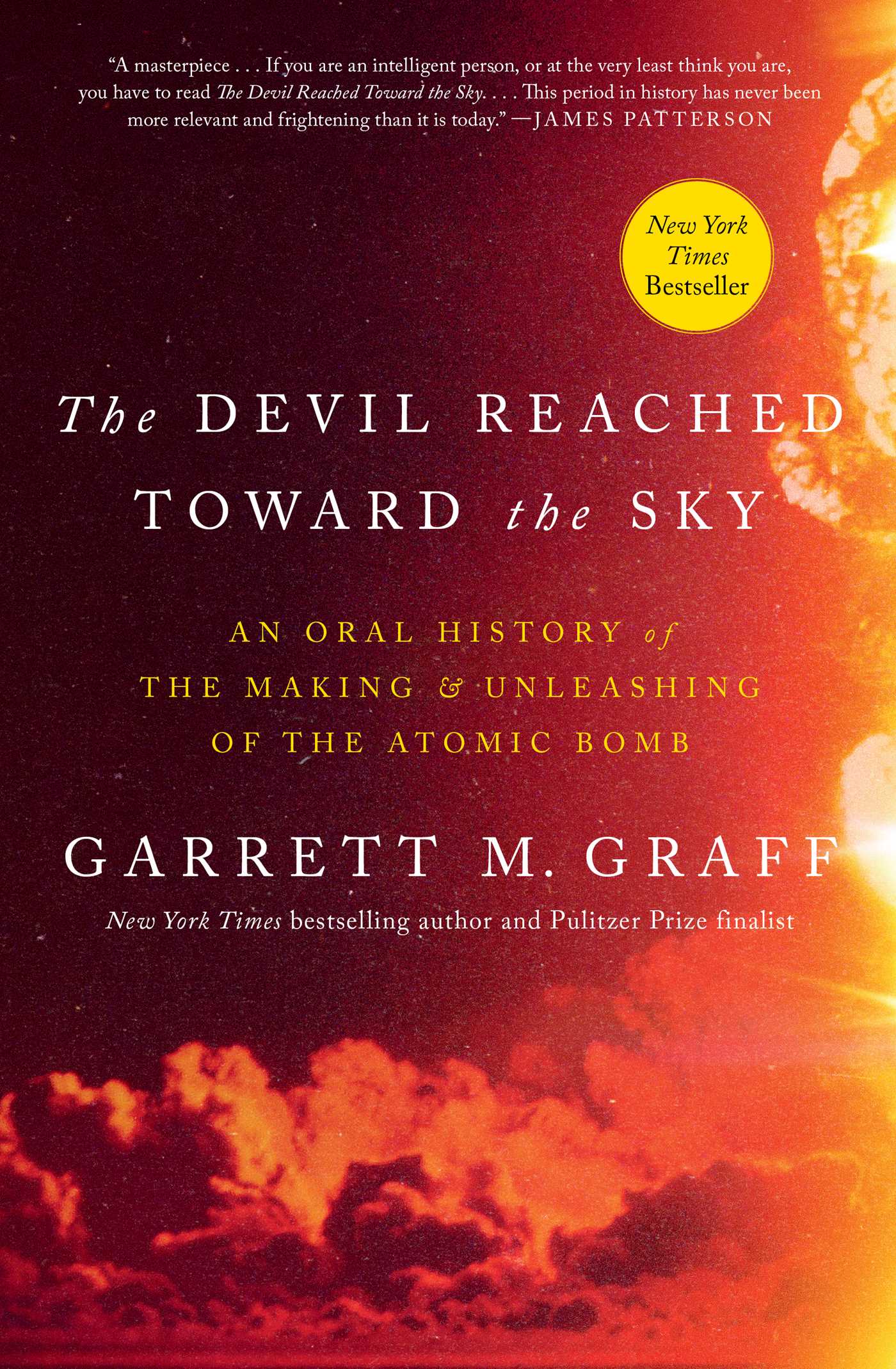
“If you are an intelligent person, or at the very least think you are, you have to read Garrett Graff’s The Devil Reached Toward the Sky. Even if you don’t read this lengthy masterpiece, you should keep it in your library to demonstrate that you are curious and literate. If you Zoom frequently, it should be one of the books on the shelves directly behind you so that viewers can register how smart you are. If you need to know something about the story itself—it’s everything, and more, about the atom, the atom bomb, the Manhattan Project, and the terrifying destruction of Hiroshima and Nagasaki. This period in history has never been more relevant and frightening than it is today.” —James Patterson
“[Graff’s] book puts flesh on the bones of history. He quotes the wives of the scientists; military men responsible for planning and executing the bombing of Hiroshima and Nagasaki; Japanese survivors of the bombings; and those involved in the inevitable coverup. He also highlights the thoughts of those who were there at the creation—and how they felt looking back on their participation. . . . Readers immediately will become absorbed in the daily decisions and details that went into the extraordinary development of the bomb.” —BookReporter
“The power of Graff’s oral history is the diversity of voices he relies upon . . . He creates a comprehensive account of a what seems like a well-told piece of history by including voices that have been either little-heard or missed altogether in the eight decades since the atomic bombs were dropped. . . . The Devil Reached Toward the Sky focuses not just on the voices of scientists like Robert Oppenheimer and Edward Teller. Graff also explores overlooked pieces of the Manhattan Project’s history, such as how segregation affected life at Oak Ridge. But the most powerful portions come in the final chapters of the book. . . . No writer could describe better the hellscape that the bombs unleashed better than those on the ground who survived it.” —Associated Press
“Garrett Graff’s new book about America’s quest for the atomic bomb draws upon hundreds of well-chosen primary sources, and introduces them with some diamond-sharp commentary. The account Graff has assembled is comprehensive and it hits as hard as anything yet written on the topic. . . . By adopting an oral history format and letting the subjects speak for themselves, Graff provides the canon with a valuable human quality without sacrificing the story’s epic sweep.” —Quilette
“A comprehensive and engrossing account of the atomic bomb’s creation—and its effects. . . . The 500 voices who make up the oral history include famous and less-known figures, such as members of the crew who created the first controlled nuclear chain reaction; farmers whose land was needed to build massive complexes to produce enriched uranium and plutonium for the bombs; ‘project spouses’ at all three locations raising families under difficult living conditions; politicians and military men involved in planning and executing the bombing of Hiroshima and Nagasaki; and Japanese survivors of the bombings. . . . Excellent oral history.” —Kirkus Reviews
Praise for The Only Plane in the Sky
“Graff has woven a powerful, graphic narrative of how September 11 played out everywhere from the International Space Station to the inside of the collapsing World Trade Center towers. . . . I repeatedly cried. I could feel my pulse elevate. I often had to put it down after a dozen pages. But I think that’s the point of the book. September 11 was terrible and confusing, and the more time passes, sometimes the harder that is to remember. No matter how much we try to describe those feelings to children who didn’t live through them, something will be lost in the translation and telling. This book captures the emotions and unspooling horror of the day. It will be a good text to hand to a curious teenager when he one day asks: What was September 11 really like?” —NPR
“Over 64 fine-sliced chapters, Mr. Graff . . . gives us ‘the stories of those who lived through and experienced 9/11—where they were, what they remember, and how their lives changed.’ The result is remarkable, and Mr. Graff’s curation of these accounts—drawn from hundreds of his own interviews and from the reporting of other journalists and historians—is a priceless civic gift. . . . The book is refreshingly free from editorializing, ideology and ululation. It gives us instead poignant, often distressing, vignettes and impressions of the day and its aftermath. On page after page, a reader will encounter words that startle, or make him angry, or heartbroken, or queasy.” —The Wall Street Journal
“Remarkable . . . Incredibly evocative and compelling . . . Allows you to experience this fateful day in an intimately visceral fashion, starting with the ordinary (the sky was gorgeously blue) and progressing to confusion, fear, numbness, and grief. . . . By letting those who were present tell stories in their own words, Graff has created a remarkably effective and deeply moving history. Be careful if you read this book in public—at some point you may encounter a story or detail that will bring back memories that overwhelm you.” —The Washington Post
“Intense . . . Dramatic . . . Graff’s project beautifully achieves its chief goal—educating people too young or born too late to remember what the day of September 11, 2001, felt like. But it also restores a form [oral history] to its rightful place as necessity.” —New York Times Book Review
“An ambitious oral history of 9/11 from the perspective of nearly everyone involved—from Laura Bush to the first firefighter on the scene to the young gate agent who checked the hijackers’ plane tickets. Every single line is breathtaking and heartbreaking, weaving together the story of previously unimaginable and tragic events that changed the course of history.” —Newsweek
“Oral history at its finest . . . Graff’s skillful organization and flawless pacing allows him to present multiple perspectives, quickly shifting locations and points of view around the country, to follow every moment. The result is a smooth-flowing, moving and thoroughly human narrative with emotional impact, a sense of detail and immediacy more powerful and moving than any dramatic film or documentary.” —Pittsburgh Post-Gazette
“Graff excels at re-creating the anxiety and terror of that day . . . Readers who emerge dry-eyed from the text should check their pulses: Something is wrong with their hearts.” —Kirkus Reviews (starred review)
Praise for When the Sea Came Alive
“Absolutely gripping. . . . Graff, who was a Pulitzer finalist for Watergate, has collected thousands of short statements from soldiers, nurses, pilots, children, neighbors, sailors, politicians, volunteers, photographers, reporters and so many more and then woven them together to create a contemporaneous narrative of the Allied invasion on June 6, 1944. . . . Given the political situation in the United States today, when some of our leaders are so complacent, even enthusiastic, about the resurgence of fascism, the power of this story feels spiked with foreboding. . . . Never before have I approached Memorial Day in a state of such somber awe.” —Ron Charles, The Washington Post
“Garrett Graff is a treasure: a historian rather like Erik Larson with a vast curiosity. He's written some of the very best books out there on UFOs, Watergate, and 9/11 (The Only Plane in the Sky: An Oral History of 9/11 is brilliant—and not for the faint of heart.) Now he has turned his attention to D-Day, the invasion of Normandy on June 6, 1944, and again he has added so much to what we know and what happened that day (and in the months leading up to it). Using the words of the men and women who were there—some famous, most not—he has crafted a moment by moment and beach by beach narrative that is riveting. As the nephew of a member of the 101st Airborne, Easy Company, it was deeply moving to learn more specifically what my uncle experienced. But, the fact is, you don't need a personal connection to someone who was there to have 'all the feels.' This is the sort of book that is smart, inspiring, and powerful—and adds so much to our knowledge of what that day was like and its historic importance forever.” —Chris Bohjalian, New York Times bestselling author of The Flight Attendant
“Gripping and propulsive . . . A panoramic view of an astonishingly intricate plan coming to fruition, undertaken by men and women with a clear sense of its momentousness. Readers will be spellbound.” —Publisher's Weekly (starred review)
“From books by historian Stephen Ambrose to films like Steven Spielberg’s Saving Private Ryan, there’s ample works chronicling the June 6, 1944, landing during World War II that ultimately led to the downfall of Nazi Germany. But in When the Sea Came Alive: An Oral History of D-Day, Graff weaves together hundreds of eyewitness accounts to create a history that stands alongside those works, expanding readers’ understanding of D-Day and offering a new, complete portrait in time for the 80th anniversary commemorations. . . . The book excels in highlighting the experiences of Black soldiers who landed on D-Day beaches and women who were part of the story, such as correspondent Martha Gellhorn. . . . [A] testimony to the value in preserving memories from grand historical events, demonstrating how much can be unearthed from even the most familiar stories.” —Associated Press